Results by title

4 books match the query 'Two Novellas'

cover of Blue Venom and Forbidden Incense: Two Novellas

Blue Venom and Forbidden Incense

Two Novellas

Syed Shamsul Haq

Seagull Books, 2018

Bangladesh in 1971 showed vividly, and terribly, the deadly effects of war. Piles of corpses, torture cells, ash and destruction everywhere in the wake of the Pakistani army’s attacks on Bengali people. Blue Venom and Forbidden Incense, two novellas by Bangladeshi writer Syed Shamsul Haq, bear bleak witness to the mindless violence and death of that period. Blue Venom tells of a middle-aged middle manager who is arrested and taken to a cell, where he is slowly tortured to death for being a namesake of a rebel poet Kazi Nazrul Islam. Forbidden Incense, meanwhile, tells of a woman’s return to her paternal village after her husband was taken by the army. In the village, she meets a boy with a Muslim name whose entire family has been killed; as they attempt together to gather and bury scattered corpses, they, too, are caught by the killers. 
 
[more]
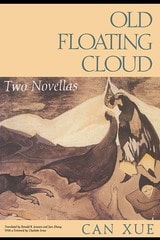
cover of Old Floating Cloud: Two Novellas

Old Floating Cloud

Two Novellas

Can Xue

Northwestern University Press, 1991

Old Floating Cloud brings together two of Can Xue’s early novellas, Yellow Mud Street and the titular Old Floating Cloud.
 
Yellow Mud Street tells of a street, its people, and a strange event that happens there. The street is dilapidated, though it once saw better times. The “S” Machinery Factory, which used to run day and night, is rusty and decaying, though people still deceive themselves into thinking this factory is a fine place, the envy of “foreign devils” and an important connection with “the authorities.” One day, “a thing” appears. No one is sure if it is a person, a flash of light, or a cloud of will-o'-the-wisp. It prompts rumor, superstition, political slogans, and an investigation by the authorities. A chorus of paranoid preoccupations wind up and down Yellow Mud Street, in a series of muttered refrains that build to a screaming frenzy.
 
Old Floating Cloud is the ruthlessly unsentimental story of a man who has an affair with his neighbor's wife. Can Xue describes the damage people do to each other, their obsessions, their lack of connection, and their attempts to exert power over one another. Lovers are not the only targets of Can Xue’s biting humor. Resentment flares between parents and children, in-laws spy, and employees abase themselves before their bosses. Like Yellow Mud Street, this novella teems with insects, excrement, and distorted bodies—visceral reminders of our earthbound state.
 
[more]
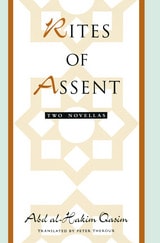
cover of Rites of Assent: Two Novellas

Rites of Assent

Two Novellas

Abdal Qasim

Temple University Press, 1995
"Written in 1977 and 1981, the novellas translated in this volume form a compelling unity and testify to the creativeness and vitality of contemporary Arab fiction." -Choice Abd al-Hakim Qasim (1935-1990), one of modern Egypt's great novelists, began writing short stories while imprisoned for his leftwing politics under the Nasser regime in the 1960s. This period in Qasim's life, along with his subsequent exile in Germany and his opposition to the Camp David Agreement, led him to avoid political commentary in his writing. He focused on people and events in the Egyptian village and the down-to-earth Sufi Islam practiced there. Still, the history of his political beliefs ensured his work would remain controversial, and most was published abroad in Beirut or Baghdad. The power and inventiveness of modern Egyptian writing are manifest in this first English-language translation of two novellas that Qasim published together during his lifetime. Al-Mahdi is the story of Awadallah, an impoverished Coptic umbrella maker forced to convert to Islam by members of the local Muslim brotherhood. Awadallah's conversion, both unwilling and insincere, torments him with guilt, and he soon falls gravely ill. At the same time, subplots explore the philandering mayor's attempt to seduce his maid, and an affectionate homoerotic relationship between two young men in the Brotherhood. Elegantly narrated and visually evocative, Al-Mahdi illuminates everyday religious tensions in a small Egyptian town. Where Al-Mahdi ends with Awadallah's death, Good News from the Afterlife opens virtually at the mouth of the grave--a testament to Qasim's versatility and compositional sense. This fantastical story brilliantly interweaves a young village boy's thoughts and the spiritual, sensual, and sometimes macabre recollections of a dead man newly lowered into his burial place. Memories and experiences mingle with images of the afterlife, as the deceased is judged by the Muslim angels of death and the boy suddenly hears that his grandfather has died. In the end, the boy awakes atop a grave, throwing into question which, if not all, of the story's strange events had been dreamed. "[T]here's more than Mahfouz in modern Egyptian fiction, and it's good to have Qasim's work among us." -Kirkus Reviews
[more]
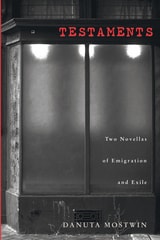
cover of Testaments: Two Novellas of Emigration and Exile

Testaments

Two Novellas of Emigration and Exile

Danuta Mostwin

Ohio University Press, 2005

Translated from Polish by Marta Erdman and Nina Dyke.

Polish émigrés have written poignantly about the pain of exile in letters, diaries, and essays; others, more recently, have recreated Polish-American communities in works of fiction. But it is Danuta Mostwin’s fiction, until now unavailable in English translation, that bridges the divide between Poland and America, exile and emigration.

Mostwin and her husband survived the ravages of World War II, traveled to Britain, and then emigrated to the United States. Mostwin devoted her scholarly career to the study of immigrants trapped between cultural worlds. Winner of international awards for her fiction, Danuta Mostwin here offers two novellas, translated by the late Marta Erdman, which are the first of her works published in English in the United States.

Deeply melancholic and moving in its unsentimental depiction of ordinary people trying to make sense of their uprooted lives, Testaments presents two powerful vignettes of life in immigrant America, The Last Will of Blaise Twardowski and Jocasta. This timely publication provides an introduction to Mostwin’s work that will ensure that she is recognized as the creator of one of the most nuanced and deeply moving pictures of emigration and exile in Polish-American literature.

[more]