Results by title

4 books match the query 'Two Years'

cover of Living at the End of Time: Two Years in a Tiny House

Living at the End of Time

Two Years in a Tiny House

John Hanson Mitchell

University Press of New England, 2014
In this second book in his Scratch Flat Chronicles, John Hanson Mitchell tells how he set out to recreate Henry David Thoreau’s two years at Walden Pond in a replica of Thoreau’s cabin. Mitchell lived off the grid, without running water or electricity, in a tiny house not half a mile from a major highway and in the shadow of a massive new computer company. Nevertheless, his contact with wildlife, the changing seasons, and the natural world equaled and even surpassed Thoreau’s. Hugely popular with the international community of Thoreau followers when it was first published, this book will now be essential reading for the growing community of people who are interested in living in a tiny house, fully experiencing the natural world, or finding self-sufficiency in an increasingly plugged-in society.
[more]
cover of Tracing Paradise: Two Years in Harmony with John Milton

Tracing Paradise

Two Years in Harmony with John Milton

Dawn Potter

University of Massachusetts Press, 2009

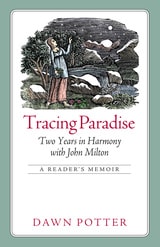
One winter morning, poet Dawn Potter sat down at her desk in Harmony, Maine, and began copying out the opening lines of John Milton's Paradise Lost. Her intent was to spend half an hour with a poem she had never liked, her goal to transcribe a page or two. Maybe she would begin to appreciate the poet's art, though she had no real expectations that the exercise would change her mind about the poem. Yet what began as a whim turned rapidly into an obsession, and soon Potter was immersed in a strange and unexpected project: she found herself copying out every single word of Milton's immense, convoluted epic.

Tracing Paradise: Two Years in Harmony with John Milton is her memoir of that long task. Over the course of twelve chapters, Potter explores her very personal response to Milton and Paradise Lost, tracing the surprising intersections between a seventeenth-century biblical epic and the routine joys and tragedies of domestic life in contemporary rural Maine. Curious, opinionated, and eager, she engages with the canon on mutable, individual terms. Though she writes perceptively about the details and techniques of Milton's art, always her reactions are linked to her present-tense experiences as a poet, small-time farmer, family member, and citizen of a poor and beleaguered north-country town.

A skilled and entertaining writer, Potter is also a wide-ranging and sophisticated reader. Yet her memoir is not a scholarly treatise: her enthusiasms and misgivings about both Milton and Paradise Lost ebb and flow with the days. Tracing Paradise reminds us that close engagement with another artist's task may itself be a form of creation. Above all, Potter's memoir celebrates one reader's difficult yet transformative love affair with Milton's glorious, irritating, inscrutable masterpiece.
[more]
cover of Two Years in the Pontifical Zouaves: A Narrative of Travel, Residence, and Experience in the Roman States

Two Years in the Pontifical Zouaves

A Narrative of Travel, Residence, and Experience in the Roman States

Joseph Powell

Catholic University of America Press, 2026
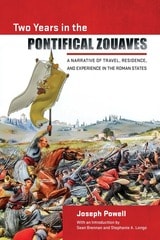
Following the formation of the kingdom of Italy in 1860, the new Italian government, led by its King, Victor Emmanuel II, turned its attention to the city it intended to make its capital, the Eternal City, Caput Mundi, Rome. One major obstacle stood in their path, the Papal States, under the leadership of Pius IX and under the protection of French soldiers sent by Emperor Napoleon III. For the Italian nationalist leader Giuseppe Garibaldi, a ferocious anticlerical who had an uneasy alliance with the monarchial Italian government, the Papacy would no longer be allowed to hold back Italy's progress into the modern world. As French commitments to preserve the independence of the Vatican waned, it increasingly fell to one of the most remarkable military units in the history of modern Europe to protect the center of Western Christendom. This unit was the Papal Zouaves, soldiers and officers from all over the world drawn by their Catholic faith to fight on behalf of the Pope against an Italian government which was ruthless in enforcing its authority. They came from as near as Switzerland and Belgium and as far away as Canada and China. This is the memoir of one of the, and Englishmen named Joseph Powell. His story is a chronicle of one of the most tragic clashes of church and state, and how ancient institutions fought to protect their existence against the ruthless waves of modernity.
[more]
cover of Two Years on the Alabama

Two Years on the Alabama

Arthur Sinclair

University of Alabama Press, 2003

Confederate proclamation of nationhood was backed by an energetic and reasonably well equipped land defense.  Not so for its coastal and sea defenses; much of its hope of tipping the balance in its contention with the Union rested on international support, trade, and naval defense.  In search of a naval arm to counter Northern superiority on the seas, the South turned to foreign sources for a seaborne arm.  Confederate agents in England cagily used scarce gold, promises of cotton, and British sympathy to obtain the devastating naval weapons of speedy and deadly raiders.  Foremost among these was the Alabama, a screw steamer with full sail power, launched in May 1862.  In only twenty-two months of action, this ship engaged nearly 300 vessels and destroyed 55 Northern merchant ships worth millions of dollars.
[more]