Results by title
3 books match the query 'U . S Culture'
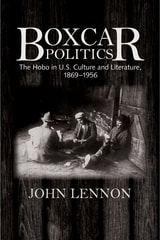
Boxcar Politics
The Hobo in U.S. Culture and Literature, 1869-1956John Lennon
University of Massachusetts Press, 2014
John Lennon maps the rise and demise of the political hobo from the nineteenth-century introduction of the transcontinental railroad to the Federal Aid Highway Act of 1956. Intertwining literary, historical, and theoretical representations of the hobo, he explores how riders and writers imagined alternative ways that working-class people could use mobility to create powerful dissenting voices outside of fixed hierarchal political organizations. Placing portrayals of hobos in the works of Jack London, Jim Tully, John Dos Passos, and Jack Kerouac alongside the lived reality of people hopping trains (including hobos of the IWW, the Scottsboro Boys, and those found in numerous long-forgotten memoirs), Lennon investigates how these marginalized individuals exerted collective political voices through subcultural practices.
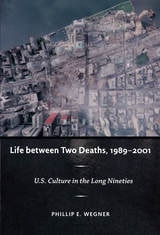
Life between Two Deaths, 1989-2001
U.S. Culture in the Long NinetiesPhillip E. Wegner
Duke University Press, 2009
Wegner shows how phenomena including the debate on globalization, neoliberal notions of the end of history, the explosive growth of the Internet, the efflorescence of new architectural and urban planning projects, developments in literary and cultural production, new turns in theory and philosophy, and the rapid growth of the antiglobalization movement came to characterize the long nineties. He offers readings of some of the most interesting cultural texts of the era: Don DeLillo’s White Noise; Joe Haldeman’s Forever trilogy; Octavia Butler’s Parable novels; the Terminator films; the movies Fight Club, Independence Day, Cape Fear, and Ghost Dog; and the television series Buffy the Vampire Slayer. In so doing, he illuminates fundamental issues concerning narrative, such as how beginnings and endings are recognized and how relationships between events are constructed.

Resisting State Violence
Radicalism, Gender, and Race in U.S. CultureJoy James
University of Minnesota Press, 1996
An incendiary critique of contemporary American society that also offers concrete solutions for the dilemmas facing progressive politics.
As the political climate of the United States moves rightward, effective and visionary voices from the left become both rarer and more essential. In Resisting State Violence, African American scholar-activist Joy James provides such a voice. Taking the convergence of race, gender, and class as fundamental trajectories, James offers a stimulating and iconoclastic account of a world in which the United States functions as the political-police center.
At its core, Resisting State Violence is about the many ways the current structure of American government and society is inimical to human rights. James examines the prevalence of racist violence in U.S. policies, making provocative connections between seemingly disparate themes and events, and always, insistently, linking global and U.S. domestic politics. She creates a picture of a nation that consistently uses dehumanization to normalize and rationalize violence in foreign policy, all the while creating a domestic climate that pathologizes blackness and sexuality, portraying those most vulnerable to violence as its carriers. In the systematic and ubiquitous nature of state violence, however, James sees a possibility of hope in the building of coalitions across race, class, gender, and national divides. She argues that the very commonality that makes the system seem so overpowering can serve as the basis for resistance-that the elements that hold together a web of oppression and misuse of power also mark its vulnerabilities, especially when confronted with an equally systematic resistance. James offers concrete solutions for the dilemmas facing progressive politics and the individuals who work to achieve social justice. Resisting State Violence is a clear-sighted and uncompromising guidebook for those who want to understand the forces that hinder social change, and to effectively move beyond them.