Results by title
4 books match the query 'U . S Empire'
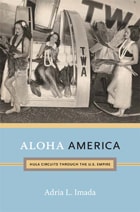
Aloha America
Hula Circuits through the U.S. EmpireAdria L. Imada
Duke University Press, 2012
At vaudeville theaters, international expositions, commercial nightclubs, and military bases, Hawaiian women acted as ambassadors of aloha, enabling Americans to imagine Hawai'i as feminine and benign, and the relation between colonizer and colonized as mutually desired. By the 1930s, Hawaiian culture, particularly its music and hula, had enormous promotional value. In the 1940s, thousands of U.S. soldiers and military personnel in Hawai'i were entertained by hula performances, many of which were filmed by military photographers. Yet, as Adria L. Imada shows, Hawaiians also used hula as a means of cultural survival and countercolonial political praxis. In Aloha America, Imada focuses on the years between the 1890s and the 1960s, examining little-known performances and films before turning to the present-day reappropriation of hula by the Hawaiian self-determination movement.
Ethnographies of U.S. Empire
Carole McGranahan and John F. Collins, editors
Duke University Press, 2018
Contributors: Kevin K. Birth, Joe Bryan, John F. Collins, Jean Dennison, Erin Fitz-Henry, Adriana María Garriga-López, Olívia Maria Gomes da Cunha, Matthew Gutmann, Ju Hui Judy Han, J. Kēhaulani Kauanui, Eleana Kim, Heonik Kwon, Soo Ah Kwon, Darryl Li, Catherine Lutz, Sunaina Maira, Carole McGranahan, Sean T. Mitchell, Jan M. Padios, Melissa Rosario, Audra Simpson, Ann Laura Stoler, Lisa Uperesa, David Vine
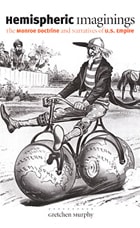
Hemispheric Imaginings
The Monroe Doctrine and Narratives of U.S. EmpireGretchen Murphy
Duke University Press, 2005
Murphy juxtaposes close readings of novels with analyses of nonfiction texts. From uncovering the literary inspirations for the Monroe Doctrine itself to tracing visions of hemispheric unity and transatlantic separation in novels by Lydia Maria Child, Nathaniel Hawthorne, María Amparo Ruiz de Burton, Lew Wallace, and Richard Harding Davis, she reveals the Doctrine’s forgotten cultural history. In making a vital contribution to the effort to move American Studies beyond its limited focus on the United States, Murphy questions recent proposals to reframe the discipline in hemispheric terms. She warns that to do so risks replicating the Monroe Doctrine’s proprietary claim to isolate the Americas from the rest of the world.
The Heartland of U.S. Empire
Race, Region, and the Queer Filipinx MidwestThomas Xavier Sarmiento
Temple University Press, 2026
Examining Filipinx cultural representations in the Midwest since the early twentieth century, Thomas Sarmiento shrewdly considers the impact of American exceptionalism and U.S. imperialism in a region where white, middle class, heterosexual, and Christian is the norm. The Heartland of U.S. Empire offers a cogent analysis of the 1904 St. Louis World’s Fair and its infamous Philippine Exhibit alongside minor museum displays and archives of Midwesterners in the Philippines. Sarmiento also considers the “exile literature” of Filipino/American writer Bienvenido Santos as well as the TV shows Glee and Superstore, which provide mainstream visibility of the queer Filipinx Midwest.
He employs a queer, decolonial Filipinx methodology that traces how narratives of America’s heartland position Filipinxs in the region as nonnormative due to their racial, gender, sexual, and national statuses. The Heartland of U.S. Empire locates queer Filipinxs in the geographic center of the nation and at the center of cultural narratives, thereby mapping alternative images of diasporic Filipinx identity and experience alongside U.S. regional and national identities, histories, and realities.
In the series Asian American History and Culture