Results by title

6 books match the query 'UAW'
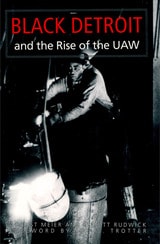
cover of Black Detroit and the Rise of the UAW

Black Detroit and the Rise of the UAW

August Meier and Elliott Rudwick

University of Michigan Press, 2007
For almost two decades, August Meier and Elliott Rudwick have roamed the frontier of Afro-American history, blazing trails that others have followed. This book forges a solid link between race and class conflict in the twentieth century.---Ira Berlin, The Nation"This fact-filled study is essential to students of the labor and civil rights movements."---David Kusnet, The New Republic"A fascinating slice of history illustrating important race and class issues that are still with us."---Library Journal"By ignoring the conventional lines between labor and black history, Meier and Rudwick have found an unexplored middle ground---the net of relations between the black community and white economic institutions---that shaped the working life of blacks in Detroit's auto plants. This is a major achievement."---David Brody, Professor Emeritus of History, University of California, Davis". . . an important work . . . one of the first to apply the nitty-gritty of social and institutional history to 20th century African American and labor history." ---Eric Arnesen, University of Illinois at ChicagoBlack Detroit and the Rise of the UAW is essential reading for historians of labor and race in America, as well those interested in Detroit's importance as a crucible for American urban history.
[more]
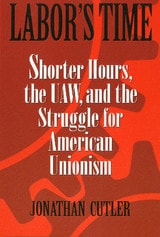
cover of Labor's Time: Shorter Hours, The Uaw, And The

Labor's Time

Shorter Hours, The Uaw, And The

Jonathan Cutler

Temple University Press, 2004
The movement for a shorter workweek that once defined the labor movement in the United States was largely displaced by the new corporatist structure of organized labor in the post-New Deal era. Labor's Time examines the changes that occurred within organized labor and traces their influence on the decline of the shorter hours movement. Focusing on the internal union politics of the influential United Automobile Workers and Local 600, its chapter at Henry Ford's massive River Rouge factory, Jonathan Cutler demonstrates how an all-but-forgotten interracial movement for a shorter workweek during the 1950s and 1960s became a casualty of an increasingly top-heavy union bureaucracy that lost touch with the desires, fears, and aspirations of rank and file workers and dug its own grave in the process. Jonathan Cutler examines the political context in which the shorter hours movement emerged within Local 600 in the 1940s, then chronicles the attempts by Walter Reuther, the head of the UAW, to suppress it. Cutler also reviews the role the Communist Party played in the controversy. Finally, he documents the UAW response to rank and file pressure for a shorter workweek, and how the local's own organizational flaws allowed Reuther and the national union to wrest control from the dissidents. Fresh and boldly written, Labor's Time recreates a moment when unions—as a movement, not as an amalgam of leaders—could have transformed the landscape of work in the United States.
[more]
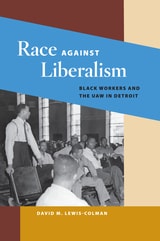
cover of Race against Liberalism: Black Workers and the UAW in Detroit

Race against Liberalism

Black Workers and the UAW in Detroit

David M. Lewis-Colman

University of Illinois Press, 2007

Race against Liberalism examines how black worker activism in Detroit shaped the racial politics of the labor movement and the white working class. David M. Lewis-Colman traces the substantive, long-standing disagreements between liberals and the black workers who embraced autonomous race-based action. As he shows, black autoworkers placed themselves at the center of Detroit's working-class politics and sought to forge a kind of working class unity that accommodated their interests as African Americans. The book covers the independent caucuses in the 1940s and the Trade Union Leadership Council in the 1950s; the black power movement and Revolutionary Union Movements of the mid-1960s; and the independent race-based activism of the 1970s that resulted in Coleman Young's 1973 election as the city's first black mayor.
[more]
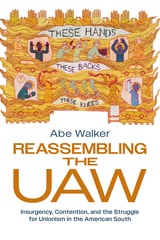
cover of Reassembling the UAW: Insurgency, Contention, and the Struggle for Unionism in the American South

Reassembling the UAW

Insurgency, Contention, and the Struggle for Unionism in the American South

Abe Walker

Temple University Press, 2026

When Volkswagen’s Chattanooga Assembly Plant opened in 2012, the United Auto Workers were excited by the golden opportunity to organize in the anti-union South, where their efforts had been routinely thwarted. However, it took ten years and several attempts before the UAW was successful in unionizing the plant. Reassembling the UAW explains why.

Abe Walker chronicles the organizing campaign from its origin in 2014 to the union’s breakthrough victory in 2024, illustrating what went wrong—and what went right—along the way. Walker provides a systematic analysis of the strategic challenges and tactical shifts, showing the patterns that persisted across three election cycles while highlighting their differences, from global-level alliances to local labor issues.

Reassembling the UAW also demonstrates how rebel rank-and-file workers ousted the old-guard leadership and transformed the UAW into a militant union to achieve results. Ultimately, Walker offers valuable lessons for organizational strategy, the power of collective action, and the future of the labor movement.
[more]
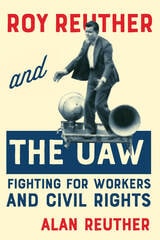
cover of Roy Reuther and the UAW: Fighting for Workers and Civil Rights

Roy Reuther and the UAW

Fighting for Workers and Civil Rights

Alan Reuther

Michigan State University Press, 2025

This biography of Roy Reuther examines his tumultuous life, including the triumphs and tragedies in the labor and civil rights movements. It also serves as a cautionary tale about the dangers activists may face as they confront entrenched societal powers. As the brother of famed labor leader Walter Reuther, Roy was a key figure in the historic Flint sit-down strike that gave birth to the United Auto Workers (UAW). He became the political director of the UAW and was deeply involved in struggles to pass civil rights legislation. This book explores his passion for increasing voter participation and his vow to help downtrodden farmworkers. 

Many of the injustices that Reuther fought continue to plague America today. This book provides important context for the current efforts of workers to organize, for the Black Lives Matter movement, and for efforts to reform the filibuster rule and stop voter suppression. It shows how dedicated individuals can overcome enormous odds to win great victories for social justice and emphasizes the potential connections between the labor and civil rights movements, offering hope for a more just future.
 
[more]
cover of Union Power and American Democracy: The UAW and the Democratic Party, 1972-83

Union Power and American Democracy

The UAW and the Democratic Party, 1972-83

Dudley W. Buffa

University of Michigan Press, 1984

Nineteen seventy-two marked the end of one era and the beginning of another in the United Auto Workers' involvement in the Michigan Democratic party. Before 1972 the UAW acted as a dominating influence in party activities; after 1972 the UAW simply took over the leadership of the Michigan Democratic party. For years the UAW encouraged participation of its members in the Democratic party. Its members were elected to every level of the party organization. There were, however, other members of the Democratic coalition that had been important components of the party, especially the blacks. The coalition that promised economic benefits was in danger of being destroyed by a social issue — busing. After the 1972 election and with the appointment of a union candidate as party chairman, the UAW had taken control of the party to return it to an emphasis on economic issues. They still did not control the electorate, however, and the state's highest office remained Republican through the 1978 election. Weakened by the schism between the black leadership in Detroit and the white leadership of the party, Michigan Democrats looked to the 1982 gubernatorial election as the unifying event. With the right candidate, party wounds could be healed, for at stake was a greater prize — a democratic governor.
[more]