Results by title
5 books match the query 'US Empire'
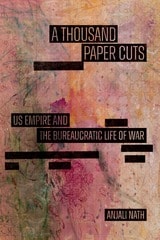
A Thousand Paper Cuts
US Empire and the Bureaucratic Life of WarAnjali Nath
Duke University Press, 2025
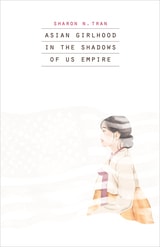
Asian Girlhood in the Shadows of US Empire
Sharon N. Tran
University of Minnesota Press, 2026
How the “Asian girl” is central to the story of US imperialism and the formation of Asian America
Representations of the “Asian girl” as lucky objects of humanitarian rescue and rehabilitation have been used to advance America’s imperial ambitions from World War II to the wars in Korean and Viet Nam. In this compelling work, Sharon N. Tran traces the production and instrumentalization of this figure through an examination of state documents, military newspapers, documentary photographs, and other archival materials. Theorizing “Asian girlhood” as a technology of imperial power, Tran exposes how the Asian girl is invoked as a shield that protects the innocence of US empire while she is excluded from innocence herself—relegated instead to a precarious position between child and adult, human and nonhuman, plaything and laborer.
Offering fresh insight into how imperial power operates, Tran analyzes figures such as the Japanese American school-girl in the context of World War II incarceration, the elusive “camptown girl,” and the objectified image of the “Napalm Girl.” Her innovative feminist approach interrogates the tendency to reclaim innocence for the Asian girl or to reframe her as an empowered woman. She engages the work of writers and artists such as Kiku Hughes, Nora Okja Keller, Aimee Phan, and lê thi diem thúy to demonstrate how Asian American literature offers rich theoretical interventions for critiquing the child–adult dichotomy that underpins key structures of imperial domination, illuminating more capacious conceptions of girlhood.
Restoring the dignity and agency of a figure too often denied both, Asian Girlhood in the Shadows of US Empire is a groundbreaking intersectional contribution to studies of gender, race, childhood, and state power.
Retail e-book files for this title are screen-reader friendly with images accompanied by short alt text and/or extended descriptions.
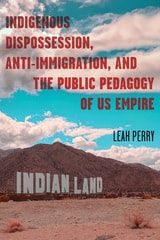
Indigenous Dispossession, Anti-Immigration, and the Public Pedagogy of US Empire
Leah Perry
The Ohio State University Press, 2024
From the founding of the United States, enduringly consequential debates over Indigeneity and immigration have occurred on the battlefield and in Congress, in courtrooms, at territorial borders, and in mainstream culture. In Indigenous Dispossession, Anti-Immigration, and the Public Pedagogy of US Empire, Leah Perry traces the ways that the US created its empire through public pedagogies—which she defines as policy and media discourses—surrounding Indigenous dispossession, gendered state violence, and racialized immigration. These pedagogies have propelled the expansion of US empire, including the redrawing of the US as a neoliberal democracy. Perry argues that by changing the discourse around gender, race, immigration, and Indigeneity, the United States has continued its imperial project through different eras, always predicated on Indigenous dispossession.
In exploring crucial components of empire, such as welfare, eugenics, disability, sexual violence, foodways, queerness, and policing, Perry interrogates violence against Indigenous peoples and against immigrants, examining these not independently—as is so often the case—but as co-constitutive. Indigenous Dispossession, Anti-Immigration, and the Public Pedagogy of US Empire thus intervenes in and fills a gap in immigration studies, Indigenous studies, race and ethnic studies, gender and sexuality studies, and US history.
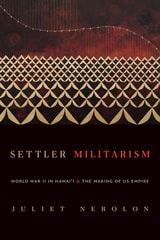
Settler Militarism
World War II in Hawai'i and the Making of US EmpireJuliet Nebolon
Duke University Press, 2024

The Fall of the US Empire
Global Fault-Lines and the Shifting Imperial OrderVassilis K. Fouskas and Bulent Gokay
Pluto Press, 2012
Whither the US empire? Despite Washington's military supremacy, its economic foundations have been weakening since the Vietnam war – accelerated by the great recession and credit-rating downgrade – and its global authority dented by the quagmires in Iraq and Afghanistan.
In this accessible, punchy text, Vassilis K. Fouskas and Bülent Gökay intervene in the debates that surround the US's status as an Empire. They survey the arguments amongst Marxist and critical scholars, from Immanuel Wallerstein and others who argue that the US is in decline, to those who maintain that it remains a robust superpower. By explaining how America's neo-imperial system of governance has been working since WWII, Fouskas and Gökay link the US's domestic and foreign vulnerabilities.
The Fall of the US Empire argues that the time has come to understand the US empire not by its power but by its systemic vulnerabilities of financialisation, resource depletion and environmental degradation. Its informed and accessible style will have wide appeal to students looking for an introduction to these issues.