Results by title
5 books match the query 'Uncertain Times'
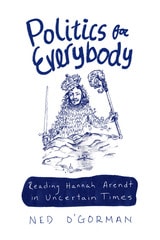
Politics for Everybody
Reading Hannah Arendt in Uncertain TimesNed O'Gorman
University of Chicago Press, 2020
Politics for Everybody
Reading Hannah Arendt in Uncertain TimesNed O'Gorman
University of Chicago Press, 2020
This is an auto-narrated audiobook edition of this book.
In this age of nearly unprecedented partisan rancor, you’d be forgiven for thinking we could all do with a smaller daily dose of politics. In his provocative and sharp book, however, Ned O’Gorman argues just the opposite: Politics for Everybody contends that what we really need to do is engage more deeply with politics, rather than chuck the whole thing out the window. In calling for a purer, more humanistic relationship with politics—one that does justice to the virtues of open, honest exchange—O’Gorman draws on the work of Hannah Arendt (1906–75). As a German-born Jewish thinker who fled the Nazis for the United States, Arendt set out to defend politics from its many detractors along several key lines: the challenge of separating genuine politics from distorted forms; the difficulty of appreciating politics for what it is; the problems of truth and judgment in politics; and the role of persuasion in politics. O’Gorman’s book offers an insightful introduction to Arendt’s ideas for anyone who wants to think more carefully
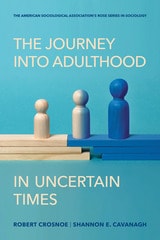
The Journey into Adulthood in Uncertain Times
Robert Crosnoe
Russell Sage Foundation, 2025
Drawing on both quantitative and qualitative survey data over five decades, Crosnoe and Cavanagh find that young adults are, in fact, waiting longer to take on “real” adult roles, such as worker or parent. However, this is not out of a reluctance to grow up. Instead, increased inequality and changes in the economy have forced young people to adapt their lives in new ways. Young adults are now spending more time in school, have more trouble finding their footing in the labor force, and consequently postpone getting married and having children. They also mix and match roles in more complicated ways now than in the past—going back and forth between school and work over longer periods of time or disconnecting parenthood from their romantic relationships. While the period from late teens to mid-twenties does look different now than in the past, the change has been slow and steady rather than a dramatic shift due to social crises. The Great Recession, for example, had a more muted effect on young people’s social and economic attainment and family formation than fears of a lost generation would suggest.
Crosnoe and Cavanagh find that while the panic over young adults today may be somewhat overblown, this conclusion should not obscure some clear concerns. Young adults do struggle with their social and emotional wellbeing. They are more depressed than their counterparts in previous generations, drink less alcohol in ways that suggest less engagement with social life, and express deep distrust of social institutions and the idea of the American Dream. The authors argue that worries about the state of young adulthood today should trigger more reflection about how to support young people rather than how to fix them.
The Journey into Adulthood in Uncertain Times is a comprehensive and illuminating examination of the challenges faced by contemporary young adults.

Uncertain Times
Anthropological Approaches to Labor in a Neoliberal WorldE. Paul Durrenberger
University Press of Colorado, 2017
In this first-ever collection of labor anthropology from around the world, the contributors to Uncertain Times assert that traditional labor unions have been co-opted by neoliberal policies of corporate capital and have become service organizations rather than drivers of social movements. The current structure of labor unions facilitates corporations’ need for a stable labor force while reducing their power to prevent outsourcing, subcontracting, and other methods of undercutting worker security and union power. Through case studies from Switzerland, Israel, Argentina, Mexico, the United States, Greece, Sweden,Turkey, Brazil and Spain, the authors demonstrate that this process of neutering unions has been uneven across time and space. They also show that the potential exists for renewed union power based on more vociferous and creative collective action. These firsthand accounts—from activist anthropologists in the trenches as union members and staff, as well as academics analyzing policy, law, worker organizing, and community impact—illustrate the many approaches that workers around the world are taking to reclaim their rights in this ever-shifting labor landscape.
Uncertain Times is the first book to use this crucial comparative, ethnographic approach for understanding the new rules of the global labor struggle and the power workers have to change those rules. The volume will be of great interest to students and scholars of anthropology, sociology of work, and labor studies; labor union leadership; and others interested in developing innovative methods for organizing working people, fomenting class consciousness, and expanding social movements.
Contributors: Alpkan Birelma, Emma Braden, Maria Eugenia de la O, Christopher Kelley, Staffan Löfving, Gadi Nissim, Darcy Pan, Steven Payne, Alicia Reigada, Julia Soul, Manos Spyridakis, Christian Zlolniski
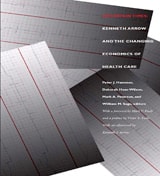
Uncertain Times
Kenneth Arrow and the Changing Economics of Health CarePeter J. Hammer, Deborah Haas-Wilson, Mark A. Peterson, and William M. Sage, eds.
Duke University Press, 2003
Coming from diverse backgrounds—economics, law, political science, and the health care industry itself—the contributors use Arrow’s article to address a range of present-day health-policy questions. They examine everything from health insurance and technological innovation to the roles of charity, nonprofit institutions, and self-regulation in addressing medical needs. The collection concludes with a new essay by Arrow, in which he reflects on the health care markets of the new millennium. At a time when medical costs continue to rise, the ranks of the uninsured grow, and uncertainty reigns even among those with health insurance, this volume looks back at a seminal work of scholarship to provide critical guidance for the years ahead.
Contributors
Linda H. Aiken
Kenneth J. Arrow
Gloria J. Bazzoli
M. Gregg Bloche
Lawrence Casalino
Michael Chernew
Richard A. Cooper
Victor R. Fuchs
Annetine C. Gelijns
Sherry A. Glied
Deborah Haas-Wilson
Mark A. Hall
Peter J. Hammer
Clark C. Havighurst
Peter D. Jacobson
Richard Kronick
Michael L. Millenson
Jack Needleman
Richard R. Nelson
Mark V. Pauly
Mark A. Peterson
Uwe E. Reinhardt
James C. Robinson
William M. Sage
J. B. Silvers
Frank A. Sloan
Joshua Graff Zivin