Results by title

5 books match the query 'Undead'
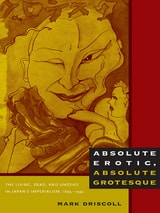
cover of Absolute Erotic, Absolute Grotesque: The Living, Dead, and Undead in Japan's Imperialism, 1895-1945

Absolute Erotic, Absolute Grotesque

The Living, Dead, and Undead in Japan's Imperialism, 1895-1945

Mark Driscoll

Duke University Press, 2010
In this major reassessment of Japanese imperialism in Asia, Mark Driscoll foregrounds the role of human life and labor. Drawing on subaltern postcolonial studies and Marxism, he directs critical attention to the peripheries, where figures including Chinese coolies, Japanese pimps, trafficked Japanese women, and Korean tenant farmers supplied the vital energy that drove Japan's empire. He identifies three phases of Japan's capitalist expansion, each powered by distinct modes of capturing and expropriating life and labor: biopolitics (1895–1914), neuropolitics (1920–32), and necropolitics (1935-45). During the first phase, Japanese elites harnessed the labor of marginalized subjects as Japan colonized Taiwan, Korea, and south Manchuria, and sent hustlers and sex workers into China to expand its market hegemony. Linking the deformed bodies laboring in the peripheries with the "erotic-grotesque" media in the metropole, Driscoll centers the second phase on commercial sexology, pornography, and detective stories in Tokyo to argue that by 1930, capitalism had colonized all aspects of human life: not just labor practices but also consumers’ attention and leisure time. Focusing on Japan's Manchukuo colony in the third phase, he shows what happens to the central figures of biopolitics as they are subsumed under necropolitical capitalism: coolies become forced laborers, pimps turn into state officials and authorized narcotraffickers, and sex workers become "comfort women". Driscoll concludes by discussing Chinese fiction written inside Manchukuo, describing the everyday violence unleashed by necropolitics.
[more]
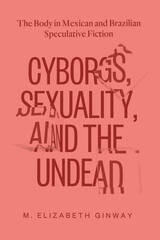
cover of Cyborgs, Sexuality, and the Undead: The Body in Mexican and Brazilian Speculative Fiction

Cyborgs, Sexuality, and the Undead

The Body in Mexican and Brazilian Speculative Fiction

M. Elizabeth Ginway

Vanderbilt University Press, 2020

Writers in Brazil and Mexico discovered early on that speculative fiction provides an ideal platform for addressing the complex issues of modernity, yet the study of speculative fictions rarely strays from the United States and England. Cyborgs, Sexuality, and the Undead expands the traditional purview of speculative fiction in all its incarnations (science fiction, fantasy, horror) beyond the traditional Anglo-American context to focus on work produced in Mexico and Brazil across a historical overview from 1870 to the present. The book portrays the effects—and ravages—of modernity in these two nations, addressing its technological, cultural, and social consequences and their implications for the human body.

In Cyborgs, Sexuality, and the Undead, M. Elizabeth Ginway examines all these issues from a number of theoretical perspectives, most importantly through the lens of Bolívar Echeverría’s “baroque ethos,” which emphasizes the strategies that subaltern populations may adopt in order to survive and prosper in the face of massive historical and structural disadvantages. Foucault’s concept of biopolitics is developed in discussion with Roberto Esposito’s concept of immunity and Giorgio Agamben’s distinction between “political life” and “bare life.”

This book will be of interest to scholars of speculative fiction, as well as Mexicanists and Brazilianists in history, literary studies, and critical theory.
[more]
cover of Meaninglessness: Time, Rhythm, and the Undead in Postcolonial Cinema

Meaninglessness

Time, Rhythm, and the Undead in Postcolonial Cinema

Vlad Dima

Michigan State University Press, 2023
For too long, the approach to seemingly universal experiences like love, death, and even time in film has been dominated by the Global North. But what if such explorations developed horizontally instead? Drawing from both European and African cultural theorists, including Gilles Deleuze and Wole Soyinka, Vlad Dima invites us to consider what happens to postcolonial African film if we no longer privilege the idea of time. How else might we understand the cinematic image, and how would its meanings change? Meaninglessness: Time, Rhythm, and the Undead in Postcolonial Cinema is a study of meaning and meaninglessness through the figure of the undead, beginning with francophone Africa and extending to postcolonial France. Through the analysis of films like Mati Diop’s Atlantics and Jean-Pierre Bekolo’s Miraculous Weapons, Dima shows how the African cinematic image may produce meaning without any attachment to European time, and how that meaning is connected instead to the philosophy of negritude and to the notion of rhythm. Meaninglessness introduces the concept of the rhythm-sequence as a new way to understand the African moving image.
[more]
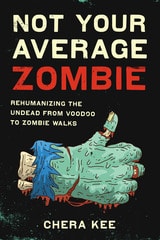
cover of Not Your Average Zombie: Rehumanizing the Undead from Voodoo to Zombie Walks

Not Your Average Zombie

Rehumanizing the Undead from Voodoo to Zombie Walks

By Chera Kee

University of Texas Press, 2017

The zombie apocalypse hasn’t happened—yet—but zombies are all over popular culture. From movies and TV shows to video games and zombie walks, the undead stalk through our collective fantasies. What is it about zombies that exerts such a powerful fascination? In Not Your Average Zombie, Chera Kee offers an innovative answer by looking at zombies that don’t conform to the stereotypes of mindless slaves or flesh-eating cannibals. Zombies who think, who speak, and who feel love can be sympathetic and even politically powerful, she asserts.

Kee analyzes zombies in popular culture from 1930s depictions of zombies in voodoo rituals to contemporary film and television, comic books, video games, and fan practices such as zombie walks. She discusses how the zombie has embodied our fears of losing the self through slavery and cannibalism and shows how “extra-ordinary” zombies defy that loss of free will by refusing to be dehumanized. By challenging their masters, falling in love, and leading rebellions, “extra-ordinary” zombies become figures of liberation and resistance. Kee also thoroughly investigates how representations of racial and gendered identities in zombie texts offer opportunities for living people to gain agency over their lives. Not Your Average Zombie thus deepens and broadens our understanding of how media producers and consumers take up and use these undead figures to make political interventions in the world of the living.
[more]
cover of The Living and the Undead: Slaying Vampires, Exterminating Zombies

The Living and the Undead

Slaying Vampires, Exterminating Zombies

Gregory A. Waller

University of Illinois Press, 2010

With a legacy stretching back into legend and folklore, the vampire in all its guises haunts the film and fiction of the twentieth century and remains the most enduring of all the monstrous threats that roam the landscapes of horror. In The Living and the Undead, Gregory A. Waller shows why this creature continues to fascinate us and why every generation reshapes the story of the violent confrontation between the living and the undead to fit new times.

Examining a broad range of novels, stories, plays, films, and made-for-television movies, Waller focuses upon a series of interrelated texts: Bram Stoker's Dracula (1897); several film adaptations of Stoker's novel; F. W. Murnau's Nosferatu, A Symphony of Horror (1922); Richard Matheson's I Am Legend (1954); Stephen King's 'Salem's Lot (1975); Werner Herzog's Nosferatu the Vampyre (1979); and George Romero's Night of the Living Dead (1968) and Dawn of the Dead (1979). All of these works, Waller argues, speak to our understanding and fear of evil and chaos, of desire and egotism, of slavish dependence and masterful control. This paperback edition of The Living and the Undead features a new preface in which Waller positions his analysis in relation to the explosion of vampire and zombie films, fiction, and criticism in the past twenty-five years.

[more]