Results by title

10 books match the query 'Underground press publications'
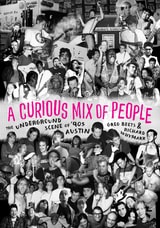
cover of A Curious Mix of People: The Underground Scene of '90s Austin

A Curious Mix of People

The Underground Scene of '90s Austin

Greg Beets

University of Texas Press, 2023

A twisting path through Austin’s underground music scene in the twentieth century’s last decade, narrated by the people who were there.

It’s 1990 in Austin, Texas. The next decade will be a tipping point in the city's metamorphosis from sleepy college town to major city. Beneath the increasingly slick exterior, though, a group of like-minded contrarians were reimagining an underground music scene. Embracing a do-it-yourself ethos, record labels emerged to release local music, zines cheered and jeered acts beneath the radar of mainstream media outlets, and upstart clubs provided a home venue for new bands to build their sound.

This vibrant scene valued expression over erudition, from the razor-sharp songcraft of Spoon to the fuzzed-out poptones of Sixteen Deluxe, and blurred the boundaries between observer and participant. Evolving in tandem with the city’s emergence on the national stage via the film Slacker and the SXSW conference and festivals, Austin’s musical underground became a spiritual crucible for the uneasy balance between commercial success and cultural authenticity, a tension that still resonates today.

The first book about Austin underground music in the ’90s, A Curious Mix of People is an oral history that tells the story of this transformative decade through the eyes of the musicians, writers, DJs, club owners, record-store employees, and other key figures who were there.

[more]
cover of Against the Grain: Interviews with Maverick American Publishers

Against the Grain

Interviews with Maverick American Publishers

Robert Dana

University of Iowa Press, 1986

Against the Grain is a collection of interviews with nine small press publishers, each one characterized by strength of resolve and a dedication to good books. Each press reflects, perhaps more directly than any large trade publisher could, the character of its founder; and each has earned its own place in the select group of important small presses in America.

This collection is the first of its kind to explore with the publishers themselves the historical, aesthetic, practical, and personal impulses behind literary publishing. The publishers included are Harry Duncan (the Cummington Press), Lawrence Ferlinghetti (City Lights), David Godine (David R. Godine), Daniel Halpern (the Ecco Press), Sam Hamill and Tree Swenson (Copper Canyon Press), James Laughlin (New Directions), John Martin (Black Sparrow), and Jonathan Williams (the Jargon Society). Their passion for books, their belief in their individual visions of what publishing is or could be, their inspired mulishness crackle on the page.
[more]
cover of Insider Histories of the Vietnam Era Underground Press, Part 1

Insider Histories of the Vietnam Era Underground Press, Part 1

Ken Wachsberger

Michigan State University Press, 2011

This enlightening book offers a collection of histories of underground papers from the Vietnam Era as written and told by key staff members of the time. Their stories (as well as those to be included in Part 2, forthcoming) represent a wide range of publications: counterculture, gay, lesbian, feminist, Puerto Rican, Native American, Black, socialist, Southern consciousness, prisoner's rights, New Age, rank-and-file, military, and more. The edition includes forewords by former Chicago Seed editor Abe Peck, radical attorney William M. Kunstler, and Markos Moulitsas, founder of the Daily Kos, along with an introductory essay by Ken Wachsberger.
     Wachsberger notes that the underground press not only produce a few well-known papers but also was truly national and diverse in scope. His goal is to capture the essence of "the countercultural community."
     A fundamental resource for anyone seeking a deeper understanding of a dramatic era in U.S. history.

[more]
cover of Insider Histories of the Vietnam Era Underground Press, Part 2

Insider Histories of the Vietnam Era Underground Press, Part 2

Ken Wachsberger

Michigan State University Press, 2011

This enlightening book offers a collection of histories of underground papers from the Vietnam Era as written and told by key staff members of the time. Their stories, building on those presented in Part 1, represent a wide range of publications: countercultural, gay, lesbian, feminist, Puerto Rican, Native American, Black, socialist, Southern consciousness, prisoners’ rights, New Age, rank-and-file, military, and more. Wachsberger notes that the underground press not only produced a few well-known papers but also was truly national and diverse in scope. His goal is to capture the essence of “the countercultural community.” This book will be a fundamental resource for anyone seeking a deeper understanding of a dramatic era in U.S. history, as well as offering a younger readership a glimpse into a generation of idealists who rose up to challenge and improve government and society.

[more]
cover of My Odyssey Through the Underground Press

My Odyssey Through the Underground Press

Michael Kindman

Michigan State University Press, 2011
In 1963, Michigan State University, the nation’s first land grant college, attracted a record number of National Merit Scholars by offering competitive scholarships. One of these exceptional students was Michael Kindman. After the beginning of the Free Speech Movement in Berkeley, Kindman, in line to be editor-in-chief of the official MSU student newspaper, felt compelled to seek a more radical forum of intellectual debate. In 1965, he dropped out of school and founded The Paper, one of the first five members of Underground Press Syndicate. This gripping autobiography follows Kindman’s inspiring journey of self-discovery, from MSU to Boston, where he joined the staff of Avatar, unaware that the large commune that controlled the paper was a charismatic cult. Five years later, he fled the commune’s outpost in Kansas and headed to San Francisco, where he came out as a gay man, changed his name to Mica, and continued his work as an activist and visionary.
[more]
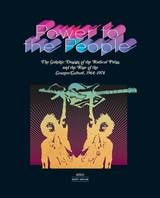
cover of Power to the People: The Graphic Design of the Radical Press and the Rise of the Counter-Culture, 1964-1974

Power to the People

The Graphic Design of the Radical Press and the Rise of the Counter-Culture, 1964-1974

Geoff Kaplan

University of Chicago Press, 2013

Though we think of the 1960s and the early ‘70s as a time of radical social, cultural, and political upheaval, we tend to picture the action as happening on campuses and in the streets. Yet the rise of the underground newspaper was equally daring and original. Thanks to advances in cheap offset printing, groups involved in antiwar, civil rights, and other social liberation issues began to spread their messages through provocatively designed newspapers and broadsheets. This vibrant new media was essential to the counterculture revolution as a whole—helping to motivate the masses and proliferate ideas. Power to the People presents more than 700 full-color images and excerpts from these astonishing publications, many of which have not been seen since they were first published almost fifty years ago.
 
From the psychedelic pages of the Oracle, Haight-Ashbury’s paper of choice, to the fiery editorials of the Black Panther Party Paper, these papers were remarkable for their editors’ fervent belief in freedom of expression and their DIY philosophy. They were also extraordinary for their graphic innovations. Experimental typography and wildly inventive layouts reflect an alternative media culture as much informed by the space age, television, and socialism as it was by the great trinity of sex, drugs, and rock ‘n’ roll. Assembled by renowned graphic designer Geoff Kaplan, Power to the People pays homage in its layout to the radical press. Beyond its unparalleled images, Power to the People includes essays by Gwen Allen, Bob Ostertag, and Fred Turner, as well as a series of recollections edited by Pamela M. Lee, all of which comment on the critical impact of the alternative press in the social and popular movements of those turbulent years. Power to the People treats the design practices of that moment as activism in its own right that offers a vehement challenge to the dominance of official media and a critical form of self-representation.
 
No other book surveys in such variety the highly innovative graphic design of the underground press, and certainly no other book captures the era with such an unmatched eye toward its aesthetic and look. Power to the People is not just a major compendium of art from the ’60s and ’70s—it showcases how the radical media graphically fashioned the image of a countercultural revolution that still resounds to this day.

[more]
cover of Protest on the Page: Essays on Print and the Culture of Dissent since 1865

Protest on the Page

Essays on Print and the Culture of Dissent since 1865

Edited by James L. Baughman, Jennifer Ratner-Rosenhagen, and James P. Danky

University of Wisconsin Press, 2015

The use of print to challenge prevailing ideas and conventions has a long history in American public life. As dissenters in America sought social change, they used print to document, articulate, and disseminate their ideas to others. Protest always begins on the margins, but print is the medium that allows it to reach a larger audience. In Protest on the Page, scholars in multiple disciplines offer ten original essays that examine protest print culture in America since 1865. They explore the surprising range of dissidents who enlisted print in their causes—from vegetarians and anarchists at the advent of the twentieth century, to midcentury evangelicals and tween comic book readers, to GIs and feminists in the 1970s–80s. Together they demonstrate that print has never been a neutral medium, but rather has been instrumental in shaping the substance of protest and its audiences.
[more]
cover of South Africa’s Resistance Press: Alternative Voices in the Last Generation under Apartheid

South Africa’s Resistance Press

Alternative Voices in the Last Generation under Apartheid

Les Switzer

Ohio University Press, 2000

South Africa's Resistance Press is a collection of essays celebrating the contributions of scores of newspapers, newsletters, and magazines that confronted the state in the generation after 1960. These publications contributed in no small measure to reviving a mass movement inside South Africa that would finally bring an end to apartheid. This marginalized press had an impact on its audience that cannot be measured in terms of the small number of issues sold, the limited amount of advertising revenue raised, or the relative absence of effective marketing and distribution strategies. These journalists rendered communities visible that were too often invisible and provided a voice for those too often voiceless. They contributed immeasurably to broadening the concept of a free press in South Africa. The guardians of the new South Africa owe these publications a debt of gratitude that cannot be repaid.
[more]
cover of The Labor of Literature: Democracy and Literary Culture in Modern Chile

The Labor of Literature

Democracy and Literary Culture in Modern Chile

Jane D. Griffin

University of Massachusetts Press, 2016

By producing literature in nontraditional forms—books made of cardboard trash, posters in subway stations, miniature shopping bags, digital publications, and even children's toys—Chileans have made and circulated literary objects in defiance of state censorship and independent of capitalist definitions of value. In The Labor of Literature Jane D. Griffin studies amateur and noncommercial forms of literary production in Chile that originated in response to authoritarian state politics and have gained momentum throughout the postdictatorship period. She argues that such forms advance a model of cultural democracy that differs from and sometimes contradicts the model endorsed by the state and the market.

By examining alternative literary publications, Griffin recasts the seventeen-year Pinochet dictatorship as a time of editorial experimentation despite widespread cultural oppression and shows how grassroots cultural activism has challenged government-approved corporate publishing models throughout the postdictatorship period. Griffin's work also points to the growing importance of autogestión, or do-it-yourself cultural production, where individuals combine artisanal forms with new technologies to make and share creative work on a global scale.
[more]
cover of Uncensored: Samizdat Novels and the Quest for Autonomy in Soviet Dissidence

Uncensored

Samizdat Novels and the Quest for Autonomy in Soviet Dissidence

Ann Komaromi

Northwestern University Press, 2015

Literature that was self-published and informally circulated in the former Soviet Union in order to evade censorship, in addition to prosecution of its authors, came to be known as samizdat. Vasilii Aksenov, Andrei Bitov, and Venedikt Erofeev were among its most acclaimed practitioners. In her innovative study, Ann Komaromi uses their work to argue for a far more sophisticated understanding of the phenomenon of samizdat, showing how the material circumstances of its creation and dissemination exercised a profound influence on the very idea of dissidence. When a text comes to life as samizdat, it necessarily reconfigures the relationship between author and reader. Using archival research to fully illustrate samizdat’s social and historical context, Komaromi arrives at a more nuanced theoretical position that breaks down the opposition between the autonomous work of art and direct political engagement. The similarities between samizdat and digital culture give her formulation of dissident subjectivity particular contemporary relevance.
[more]