Results by title
7 books match the query 'Underworld'
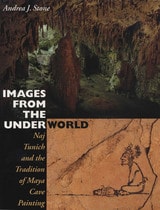
Images from the Underworld
Naj Tunich and the Tradition of Maya Cave PaintingBy Andrea J. Stone
University of Texas Press, 1995
In 1979, a Kekchi Maya Indian accidentally discovered the entrance to Naj Tunich, a deep cave in the Maya Mountains of El Peten, Guatemala. One of the world's few deep caves that contain rock art, Naj Tunich features figural images and hieroglyphic inscriptions that have helped to revolutionize our understanding of ancient Maya art and ritual.
In this book, Andrea Stone takes a comprehensive look at Maya cave painting from Preconquest times to the Colonial period. After surveying Mesoamerican cave and rock painting sites and discussing all twenty-five known painted caves in the Maya area, she focuses extensively on Naj Tunich. Her text analyzes the images and inscriptions, while photographs and line drawings provide a complete visual catalog of the cave art, some of which has been subsequently destroyed by vandals.
This important new body of images and texts enlarges our understanding of the Maya view of sacred landscape and the role of caves in ritual. It will be important reading for all students of the Maya, as well as for others interested in cave art and in human relationships with the natural environment.
Kidnapped to the Underworld
Memories of XibalbaVíctor Montejo; Translated by Sean S. Sell
University of Arizona Press, 2024
Narrated from Antonio’s perspective, the reader follows along on a journey to the Maya underworld of Xibalba, accompanied by two spirit guides. Antonio traverses Xibalba’s levels of heaven and hell, encountering instructive scenes of punishment and reward: in one chapter, conquistadors are perpetually submerged in a pool of their victims’ blood; in another, the souls of animal abusers are forever unable to cross a crocodile-infested river. Infused with memory, the author illustrates Guatemala’s unique religious syncretism, exploring conceptions of heaven and hell shared between Catholicism and Indigenous Maya spirituality. In the tradition of both the Popol Vuh and the Divine Comedy, Montejo’s narrative challenges easy categorization—this is a work of family history, religious testimony, political allegory, and sacred literature.

Orpheus in the Underworld
Essays on MusicTheodor W. Adorno
Seagull Books, 2024
Theodor W. Adorno is recognized as one of the twentieth century’s most prominent social theorists. Though best known for his association with the Frankfurt School of critical theory, Adorno began his career as a composer and successful music critic.
Comprehensive and illuminating, Orpheus in the Underworld centers on Adorno’s concrete and immediate engagement with musical compositions and their interpretation in the concert hall and elsewhere. Here, Adorno registers his initial encounters with the compositions of the Second Viennese School, when he had yet to integrate them into a broad aesthetics of music. Complementarily essays on Bela Bartók, Jean Sibelius, and Kurt Weill afford insight into his understanding of composers who did not fit neatly into the dialectical schema propounded in the Philosophy of New Music. Additionally, essays on recording and broadcasting show Adorno engaging with these media in a spirit that is no less productive than polemical and focused as sharply on their potentialities as on their shortcomings.
Orpheus in the Underworld offers a captivating exploration of Adorno’s musical compositions, shedding new light on his understanding of influential composers and his critical perspectives on recording and broadcasting.
Postcards from the Underworld
PoemsSinan Antoon
Seagull Books, 2023
To confront time, pre-modern Arabic poems often began with the poet standing before the ruins, real and imagined, of a beloved’s home. In Postcards from the Underworld, Sinan Antoon works in that tradition, observing the detritus of his home city, Baghdad, where he survived two wars—the Iran-Iraq War of 1980 and the First Gulf War of 1991—and which, after he left, he watched from afar being attacked during the US invasion in 2003. Antoon’s poems confront violence and force us not to look away as he traces death’s haunting presence in the world. Nature offers consolation, and flowers and butterflies are the poet’s interlocutors, but they too cannot escape ruin. Composed in Arabic and translated into English by the poet himself, Postcards from the Underworld is a searing meditation on the destruction of humans, habitats, and homes.
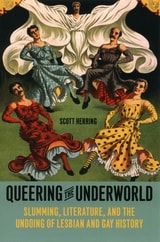
Queering the Underworld
Slumming, Literature, and the Undoing of Lesbian and Gay HistoryScott Herring
University of Chicago Press, 2007
In this major rethinking of American literature and culture, Scott Herring explores how a key group of authors manipulated this genre to paradoxically evade the confines of sexual identification. Queering the Underworld examines a range of writers, from Jane Addams and Willa Cather to Carl Van Vechten and Djuna Barnes, revealing how they fulfilled the conventions of slumming literature but undermined its goals, and in the process, queered the genre itself. Their work frustrated the reader’s desire for sexual knowledge, restored the inscrutability of sexual identity, and cast doubt on the value of a homosexual subculture made visible and therefore subject to official control.
Herring is persuasive and polemical in connecting these writers to ongoing debates about lesbian and gay history and politics, and Queering the Underworld will be widely read by students and scholars of literature, history, and sexuality.
Socrates in the Underworld
On Plato's GorgiasNalin Ranasinghe
St. Augustine's Press, 2009
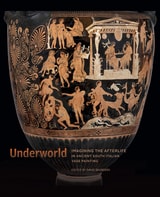
Underworld
Imagining the Afterlife in Ancient South Italian Vase PaintingDavid Saunders
J. Paul Getty Trust, The, 2022
What happens to us when we die? What might the afterlife look like? For the ancient Greeks, the dead lived on, overseen by Hades in the Underworld. We read of famous sinners, such as Sisyphus, forever rolling his rock, and the fierce guard dog Kerberos, who was captured by Herakles. For mere mortals, ritual and religion offered possibilities for ensuring a happy existence in the beyond, and some of the richest evidence for beliefs about death comes from southern Italy, where the local Italic peoples engaged with Greek beliefs. Monumental funerary vases that accompanied the deceased were decorated with consolatory scenes from myth, and around forty preserve elaborate depictions of Hades’s domain.
For the first time in over four decades, these compelling vase paintings are brought together in one volume, with detailed commentaries and ample illustrations. The catalogue is accompanied by a series of essays by leading experts in the field, which provides a framework for understanding these intriguing scenes and their contexts. Topics include attitudes toward the afterlife in Greek ritual and myth, inscriptions on leaves of gold that provided guidance for the deceased, funerary practices and religious beliefs in Apulia, and the importance accorded to Orpheus and Dionysos. Drawing from a variety of textual and archaeological sources, this volume is an essential source for anyone interested in religion and belief in the ancient Mediterranean.