Results by title
4 books match the query 'Unfinished'
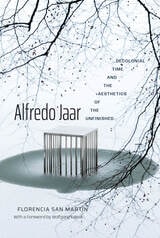
Alfredo Jaar
Decolonial Time and the Aesthetics of the UnfinishedFlorencia San Martin. With a Foreword by Wolfgang Kaleck.
Duke University Press, 2026
In Alfredo Jaar, Florencia San Martín analyzes the work of the prominent Chilean-born artist Alfredo Jaar, whose work challenges the linear and triumphalist temporality of Western modernity that obscures the violence of colonization and globalization. San Martín argues that Jaar’s work represents decolonial time, exposing the limits of the violent systems we inhabit. His art, she maintains, is informed by and responds to two interconnected historical events relevant to his own life: the US-backed military coup that established Pinochet’s dictatorship in Chile and the implementation around the world of the corollary neoliberal economic system. San Martín explores the key themes in Jaar’s artistic practice—mourning, accountability, and failure—which situates the victims of the Chilean regime in a global context, directly confronts the architects of atrocity, and questions how ideas of diversity and inclusion have been co-opted by modern neoliberal discourses. Alfredo Jaar enables us to reimagine art history, offering a fresh paradigm with which to think about global contemporary art.
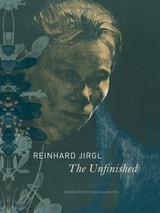
The Unfinished
Reinhard Jirgl
Seagull Books, 2020
Komotau, the Czech Republic, late summer, 1945. Four women—seventy-year-old Johanna, her two daughters Hanna and Maria, and Hanna’s daughter Anna—are ordered by the new Czech authorities to leave their homes and assemble with other Germans at the local train station. They are given thirty minutes—the “wild expulsions” of Sudeten Germans have begun. But where is Anna?
Witnessing the revenge lynching of SS and suspected collaborators on her walk home, she arrives in Komotau to find her family gone. The trek takes the older women via Munich, then Dresden and Magdeburg, to an outpost in the far northwest of the Soviet zone where they settle as farm laborers. Once united again, their hope of one day returning to the heimat—homeland—is both a source of strength and a burden, choking attachments to new surroundings and neighbors. This conflict will prove to be the story of their lives, as well as both the joy and ruin of Anna’s son.
A tale of four generations told in Reinhard Jirgl’s unique and subversively expressive idiom, The Unfinished plays out between the ruins of Nazi Germany and the rise and fall of communist East Germany, the birth of the Berlin Republic, and the shadow of a new millennium.
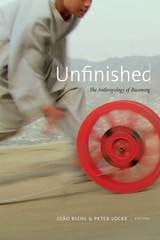
Unfinished
The Anthropology of BecomingJoão Biehl and Peter Locke, editors
Duke University Press, 2017
Contributors. Lucas Bessire, João Biehl, Naisargi N. Dave, Elizabeth A. Davis, Michael M. J. Fischer, Angela Garcia, Peter Locke, Adriana Petryna, Bridget Purcell, Laurence Ralph, Lilia M. Schwarcz
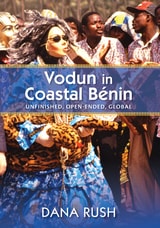
Vodun in Coastal Benin
Unfinished, Open-Ended, GlobalDana Rush
Vanderbilt University Press, 2013
The book is richly illustrated with color photographs of Vodun shrines, temple wall paintings, masquerades, and Hindu chromolithographs.
This book is the first publication in a new series called "Critical Investigations of the African Diaspora." The series grows out of Issues in Critical Investigation, a Vanderbilt initiative to assist junior scholars through critical feedback from senior faculty, annual symposia, and prize competitions in the humanities and social sciences. Dana Rush's Vodun in Coastal Benin is the winner of the inaugural Anna Julia Cooper Prize in the Humanities.