Results by title
75 books match the query 'United States. Supreme Court' and 7 start with a
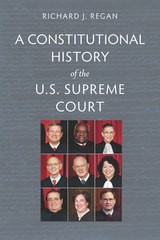
A Constitutional History of the U.S. Supreme Court
Richard Regan
Catholic University of America Press, 2015
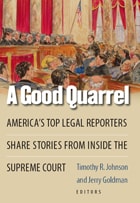
A Good Quarrel
America's Top Legal Reporters Share Stories from Inside the Supreme CourtTimothy R. Johnson and Jerry Goldman, Editors
University of Michigan Press, 2009
While reading what top legal reporters say about some of the most important U.S. Supreme Court oral arguments in recent history, go to www.goodquarrel.com to listen to audio and hear for yourself the very style and delivery of the oral arguments that have shaped the history of our nation's highest law. See Preface for full instructions.
Contributors
- Charles Bierbauer, CNN
- Lyle Denniston, scotusblog.com
- Fred Graham, Court TV
- Brent Kendall, Los Angeles Daily Journal
- Steve Lash, Houston Chronicle
- Dahlia Lithwick, Slate.com
- Tony Mauro, American Lawyer Media
- Tim O'Brien, ABC News
- David Savage, Los Angeles Times
- Greg Stohr, Bloomberg News
- Nina Totenberg, NPR
Timothy R. Johnson teaches in the Department of Political Science and the Law School at the University of Minnesota.
Jerry Goldman teaches political science at Northwestern University and directs the OYEZ Project, a multimedia archive devoted to the Supreme Court, at www.oyez.org.
Cover sketch by Dana Verkouteren
"Supreme Court oral arguments are good government in action. A Good Quarrel brilliantly showcases this important aspect of the Court's work."
---Paul Clement, Partner, King & Spalding, and former United States Solicitor General
"Few legal experiences are as exhilarating as a Supreme Court oral argument---a unique art form that this superb collection brings vividly to life."
---Kathleen Sullivan, Partner, Quinn Emanuel Urquhart Oliver and Hedges, and former Dean, Stanford Law School
"[A Good Quarrel] shines a brilliant spotlight on the pivotal moment of advocacy when the Supreme Court confronts the nation's most profound legal questions."
---Thomas C. Goldstein, Partner, Akin Gump, and Lecturer, Supreme Court Litigation, Harvard Law School and Stanford Law School
"A brilliant way to understand America's most important mysterious institution."
---Lawrence Lessig, Stanford Law School
A Supreme Court Unlike Any Other
The Deepening Divide Between the Justices and the PeopleKevin J. McMahon
University of Chicago Press, 2024
A data-rich examination of the US Supreme Court's unprecedented detachment from the democratic processes that buttress its legitimacy.
Today’s Supreme Court is unlike any other in American history. This is not just because of its jurisprudence but also because the current Court has a tenuous relationship with the democratic processes that help establish its authority. Historically, this “democracy gap” was not nearly as severe as it is today. Simply put, past Supreme Courts were constructed in a fashion far more in line with the promise of democracy—that the people decide and the majority rules.
Drawing on historical and contemporary data alongside a deep knowledge of court battles during presidencies ranging from FDR to Donald Trump, Kevin J. McMahon charts the developments that brought us here. McMahon offers insight into the altered politics of nominating and confirming justices, the shifting pool of Supreme Court hopefuls, and the increased salience of the Court in elections. A Supreme Court Unlike Any Other is an eye-opening account of today’s Court within the context of US history and the broader structure of contemporary politics.
A Year at the Supreme Court
Neal Devins and Davison M. Douglas, eds.
Duke University Press, 2004
Some essays consider the role of “swing” Justices Sandra Day O’Connor and Anthony Kennedy within a Court that divides 5–4 more than any other group of Justices in the nation’s history. Others examine the political reaction to and legal context of the Court’s Lawrence v. Texas decision declaring a Texas law criminalizing homosexual sodomy unconstitutional. Contributors analyze the Court’s rulings on affirmative action and reassess its commitment to states’ rights. Considering the Court’s practices, one advocate explores the use and utility of amicus curiae, or “friend of the court” briefs, while another reflects on indications of an increased openness by the Court to public scrutiny. Two advocates who argued cases before the Court—one related to hate speech and the other to a “three strikes and you’re out” criminal statute—offer vivid accounts of their experiences. Intended for general readers, A Year at the Supreme Court is for all those who want to understand the Rehnquist Court and its momentous 2002–03 term.
Contributors
Erwin Chemerinsky
Neal Devins
Davison M. Douglas
David J. Garrow
Dahlia Lithwick
Tony Mauro
Carter Phillips
Ramesh Ponnuru
Jeffrey Rosen
David G. Savage
Rodney A. Smolla
Stuart Taylor Jr.
A Year in the Life of the Supreme Court
Rodney A. Smolla, ed.
Duke University Press, 1995
The cases heard by the Supreme Court are, first and foremost, disputes involving real people with actual stories. The accidents and twists of circumstance that have brought these people to the last resort of litigation can make for compelling drama. The contributors to this volume bring these dramatic stories to life, using them as a backdrop for the larger issues of law and social policy that constitute the Court’s business: abortion, separation of church and state, freedom of speech, the right of privacy, crime, violence, discrimination, and the death penalty. In the course of these narratives, the authors describe the personalities and jurisprudential leanings of the various Justices, explaining how the interplay of these characters and theories about the Constitution interact to influence the Court’s decisions.
Highly readable and richly informative, this book offers an unusually clear and comprehensive portrait of one of the most influential institutions in modern American life.
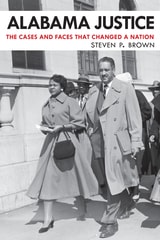
Alabama Justice
The Cases and Faces That Changed a NationSteven P. Brown
University of Alabama Press, 2020
WINNER OF THE ANNE B. & JAMES B. MCMILLAN PRIZE IN SOUTHERN HISTORY
Examines the legacies of eight momentous US Supreme Court decisions that have their origins in Alabama legal disputes.
Unknown to many, Alabama has played a remarkable role in a number of Supreme Court rulings that continue to touch the lives of every American. In Alabama Justice: The Cases and Faces That Changed a Nation, Steven P. Brown has identified eight landmark cases that deal with religion, voting rights, libel, gender discrimination, and other issues, all originating from legal disputes in Alabama.
Written in a concise and accessible manner, each case law chapter begins with the circumstances that created the dispute. Brown then provides historical and constitutional background for the issue followed by a review of the path of litigation. Excerpts from the Court’s ruling in the case are also presented, along with a brief account of the aftermath and significance of the decision. The First Amendment (New York Times v. Sullivan), racial redistricting (Gomillion v. Lightfoot), the Equal Protection Clause of the Fourteenth Amendment (Frontiero v. Richardson), and prayer in public schools (Wallace v. Jaffree) are among the pivotal issues stamped indelibly by disputes with their origins in Alabama legal, political, and cultural landscapes. By examining such landmark twentieth-century milestones and eras such as the Scottsboro Boys trial, the Civil Rights movement, and the fight for women’s rights through a legal lens, Brown sheds new and unexpected light on the ways that events in Alabama have shaped the nation.
In addition to his analysis of cases, Brown discusses the three associate Supreme Court justices from Alabama to the Supreme Court: John McKinley, John Archibald Campbell, and Hugo Black. Their cumulative influence on constitutional interpretation, the institution of the Court, and the day-to-day rights and liberties enjoyed by every American is impossible to measure. A closing chapter examines the careers and contributions of these three Alabamians.
American Indian Sovereignty and the U.S. Supreme Court
The Masking of JusticeBy David E. Wilkins
University of Texas Press, 1997
"Like the miner's canary, the Indian marks the shift from fresh air to poison gas in our political atmosphere; and our treatment of Indians, even more than our treatment of other minorities, reflects the rise and fall in our democratic faith," wrote Felix S. Cohen, an early expert in Indian legal affairs.
In this book, David Wilkins charts the "fall in our democratic faith" through fifteen landmark cases in which the Supreme Court significantly curtailed Indian rights. He offers compelling evidence that Supreme Court justices selectively used precedents and facts, both historical and contemporary, to arrive at decisions that have undermined tribal sovereignty, legitimated massive tribal land losses, sanctioned the diminishment of Indian religious rights, and curtailed other rights as well.
These case studies—and their implications for all minority groups—make important and troubling reading at a time when the Supreme Court is at the vortex of political and moral developments that are redefining the nature of American government, transforming the relationship between the legal and political branches, and altering the very meaning of federalism.