Results by title
3 books match the query 'United States. Work Projects Administration'
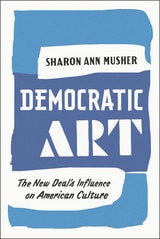
Democratic Art
The New Deal's Influence on American CultureSharon Ann Musher
University of Chicago Press, 2015
Throughout the Great Recession American artists and public art endowments have had to fight for government support to keep themselves afloat. It wasn’t always this way. At its height in 1935, the New Deal devoted $27 million—roughly $461 million today—to supporting tens of thousands of needy artists, who used that support to create more than 100,000 works. Why did the government become so involved with these artists, and why weren’t these projects considered a frivolous waste of funds, as surely many would be today?
In Democratic Art, Sharon Musher explores these questions and uses them as a springboard for an examination of the role art can and should play in contemporary society. Drawing on close readings of government-funded architecture, murals, plays, writing, and photographs, Democratic Art examines the New Deal’s diverse cultural initiatives and outlines five perspectives on art that were prominent at the time: art as grandeur, enrichment, weapon, experience, and subversion. Musher argues that those engaged in New Deal art were part of an explicitly cultural agenda that sought not just to create art but to democratize and Americanize it as well. By tracing a range of aesthetic visions that flourished during the 1930s, this highly original book outlines the successes, shortcomings, and lessons of the golden age of government funding for the arts.
In Democratic Art, Sharon Musher explores these questions and uses them as a springboard for an examination of the role art can and should play in contemporary society. Drawing on close readings of government-funded architecture, murals, plays, writing, and photographs, Democratic Art examines the New Deal’s diverse cultural initiatives and outlines five perspectives on art that were prominent at the time: art as grandeur, enrichment, weapon, experience, and subversion. Musher argues that those engaged in New Deal art were part of an explicitly cultural agenda that sought not just to create art but to democratize and Americanize it as well. By tracing a range of aesthetic visions that flourished during the 1930s, this highly original book outlines the successes, shortcomings, and lessons of the golden age of government funding for the arts.
[more]

Shovel Ready
Archaeology and Roosevelt's New Deal for AmericaBernard K. Means
University of Alabama Press, 2013
Shovel Ready provides a comprehensive lens through which to view the New Deal period, a fascinating and prolific time in American archaeology.
In this collection of diverse essays united by a common theme, Bernard K. Means and his contributors deliver a valuable research tool for practicing archaeologists and historians of archaeology, as well as New Deal scholars in general.
To rescue Americans from economic misery and the depths of despair during the Great Depression, President Franklin Delano Roosevelt created several New Deal jobs programs to put people to work. Men and women labored on a variety of jobs, from building roads to improving zoos. Some ordinary citizens—with no prior experience—were called on to act as archaeologists and excavate sites across the nation, ranging in size from small camps to massive mound complexes, and dating from thousands of years ago to the early Colonial period.
Shovel Ready contains essays on projects ranging across the breadth of the United States, including New Deal investigations in California, Georgia, Illinois, Iowa, Kentucky, New Jersey, Oklahoma, Pennsylvania, Tennessee, and Texas. Some essays engage in historical retrospectives. Others bring the technologies of the twenty-first century, including accelerator mass spectrometry (AMS) dating of curated collections and geophysical surveys at New Deal–excavated sites, to bear on decades-old excavations. The volume closes with an investigation into material remnants of the New Deal itself.
Contributors
John L. Cordell / John F. Doershuk / David H. Dye /Scott W. Hammerstedt / Janet R. Johnson / Kevin Kiernan /Gregory D. Lattanzi /Patrick C. Livingood / Anna R. Lunn / Bernard K. Means / Stephen E. Nash / Amanda L. Regnier / Sissel Schroeder / James R. Wettstaed
John L. Cordell / John F. Doershuk / David H. Dye /Scott W. Hammerstedt / Janet R. Johnson / Kevin Kiernan /Gregory D. Lattanzi /Patrick C. Livingood / Anna R. Lunn / Bernard K. Means / Stephen E. Nash / Amanda L. Regnier / Sissel Schroeder / James R. Wettstaed
[more]
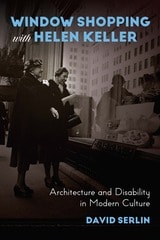
Window Shopping with Helen Keller
Architecture and Disability in Modern CultureDavid Serlin
University of Chicago Press, 2025
A particular history of how encounters between architects and people with disabilities transformed modern culture.
Window Shopping with Helen Keller recovers a series of influential moments when architects and designers engaged the embodied experiences of people with disabilities. David Serlin reveals how people with sensory and physical impairments navigated urban spaces and helped to shape modern culture. Through four case studies—the lives of Joseph Merrick (aka “The Elephant Man”) and Helen Keller, the projects of the Works Progress Administration, and the design of the Illinois Regional Library for the Blind and Physically Handicapped—Serlin offers a new history of modernity’s entanglements with disability.
Window Shopping with Helen Keller recovers a series of influential moments when architects and designers engaged the embodied experiences of people with disabilities. David Serlin reveals how people with sensory and physical impairments navigated urban spaces and helped to shape modern culture. Through four case studies—the lives of Joseph Merrick (aka “The Elephant Man”) and Helen Keller, the projects of the Works Progress Administration, and the design of the Illinois Regional Library for the Blind and Physically Handicapped—Serlin offers a new history of modernity’s entanglements with disability.
[more]