Results by title
11 books match the query 'University Michigan'
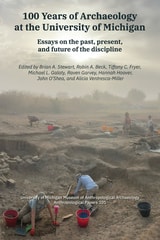
100 Years of Archaeology at the University of Michigan
Essays on the Past, Present, and Future of the DisciplineEdited by Brian A. Stewart, Robin A. Beck, Tiffany C. Fryer, Michael L. Galaty, Raven Garvey, Hannah Hoover, John O’Shea, and Alicia Ventresca-Miller
University of Michigan Press, 2025
The University of Michigan has been at the forefront of archaeological research for more than 100 years, since 1922, when the Museum of Anthropology (now the Museum of Anthropological Archaeology) was established on the Ann Arbor campus. The goal of its curators for many decades was to create a research and teaching program that emphasized methodological rigor in the analysis of archaeological materials, attempting to solve grand questions about human behavior through fieldwork, collections, and laboratory work. About fifty years ago, the Museum's emphasis shifted to developing archaeological theory when a new generation of curators with processualist leanings made Ann Arbor a testing ground for the so-called New Archaeology.
Now, archaeology stands at a crossroads. Some archaeologists refer to the death of archaeological theory. Others stake out opposed camps of generalists and particularists. At U-M, as at many other universities, the past decade has seen a new commitment to collaborative archaeology, working with descendant communities and acknowledging the discipline's roots in colonialism and extraction.
In 2022, to celebrate a century of existence, the University of Michigan Museum of Anthropological Archaeology (UMMAA) hosted an international conference to explore possibilities for a middle way: an archaeology for the next 100 years, combining humanistic and scientific approaches, which allows for both agents and systems, description and explanation, science and heritage. This volume is meant to be a snapshot of that conference and this moment in the development of the discipline. Included are most of the papers and posters presented, as well as photographs of the panels and the proceedings.
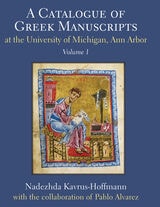
A Catalogue of Greek Manuscripts at the University of Michigan, Ann Arbor, Volume 1
Nadezhda Kavrus-Hoffmann with the collaboration of Pablo Alvarez
University of Michigan Press, 2021
A Catalogue of Greek Manuscripts at the University of Michigan, Ann Arbor is a comprehensive, fully illustrated catalogue of the largest collection of Greek manuscripts in America, including 110 codices and fragments ranging from the fourth to the nineteenth century. The collection, held in the Special Collections Research Center of the University of Michigan Library, contains many manuscripts from Epirus and the Meteora monasteries built on high pinnacles of rocks in Thessaly. Nadezhda Kavrus-Hoffmann has based the manuscript descriptions on the latest developments in the fields of paleography and codicology, including the newest recommendations of the Institute for Research and History of Texts in Paris. The catalogue includes high-resolution plates of all the manuscripts, allowing researchers to compare the entries with other Greek manuscripts around the world. This catalogue contains a trove of fascinating information related to Byzantine culture that will be available for the first time to scholars working on various disciplines of the humanities such as Classical and Byzantine Studies, Art History, Medieval Studies, Theology, and History.
This is the first volume of a projected two-volume set. Volume 2, also by Nadezhda Kavrus-Hoffmann, will contain descriptions of remaining Greek manuscripts in the Library’s collection, starting with Mich. Ms. 59 and ending with Mich. Ms. 238, for a total of 53 manuscripts and 8 fragments. Both volumes will have the same format – catalogue entries for each manuscript together with extensive illustrations. The publication date for Volume 2 has not been established.
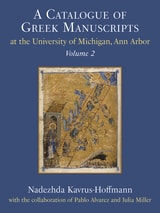
A Catalogue of Greek Manuscripts at the University of Michigan, Ann Arbor, Volume 2
Nadezhda Kavrus-Hoffmann with the collaboration of Pablo Alvarez and Julia Miller
University of Michigan Press, 2026
A Catalogue of Greek Manuscripts at the University of Michigan, Ann Arbor, Volume II unveils the rich diversity and enduring legacy of the Greek manuscript tradition preserved in one of North America's largest collections. Building on the acclaimed first volume, this second and concluding volume offers comprehensive illustrated descriptions of eighty-four manuscripts and fragments housed in the University of Michigan Library's Special Collections Research Center. The discovery of twenty-three previously unknown manuscripts and fragments significantly expands our understanding of Byzantine and post-Byzantine book culture, illuminating the remarkable continuity of Greek scholarly, liturgical, and artistic traditions from the ninth through the nineteenth centuries.
Each entry integrates codicological features, handwriting analysis, textual content, decoration, binding, provenance, and references to earlier scholarship as well as high-quality color plates to illustrate representative pages, script types, and illuminations. Among the exceptional highlights are a fragment of The Great Calculation According to the Indians by Maximos Planoudes, preserving portions of this rare mathematical treatise otherwise lost; an illuminated 1371 copy of The Heavenly Ladder by John Klimax, created by the renowned scribe Joasaph II of the Hodegon Monastery in Constantinople; and a newly identified manuscript containing rare patristic homilies linked to the sixteenth-century Choniates scriptorium in Venice.

A Guide to the Campus of the University of Michigan
Margo MacInnes
University of Michigan Press, 1979
Archive of Aurelius Isidorus
in the Egyptian Museum, Cairo, and the University of MichiganArthur E. R. Boak and Herbert Chayyim Youtie, Editors
University of Michigan Press, 1960
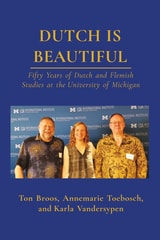
Dutch is Beautiful
Fifty Years of Dutch and Flemish Studies at the University of MichiganTon Broos, Annemarie Toebosch, and Karla Vandersypen
Michigan Publishing Services, 2019
Dutch is Beautiful tells the story of the fifty years of Dutch and Flemish Studies at the University of Michigan in Ann Arbor, Michigan, USA. It is an account of the efforts to promote Dutch and Flemish culture and language, as well as a description of how the teaching of Dutch language, literature, history and culture can be a tool to look at a world of diverse identities. It also offers a comprehensive overview of the beginnings of a successful program that included Dutch writers-in-residence, visiting Netherlands professors, cultural and educational events, arts, music, films, conferences and publications. Several alumni of the program look back at their college years with appreciation. Articles and essays on history, Anne Frank, and conversations on colonialism discuss critical and educational views on Dutch and Flemish Studies in past, present and future, when diversity, equity and inclusion are important goals and objectives, and public scholarship and academic activism will be a larger part of the curriculum. This book will inform, entertain, stimulate and impress everyone who is interested in the culture of the Low Countries. The title says it all!

Foundation of Urology at the University of Michigan
Emergence of a Medical Specialty, 1919–1970David A. Bloom
Michigan Publishing Services, 2027
In 1919, urology came to the University of Michigan when Hugh Cabot arrived from Boston, attracted by the fulltime position of surgery chair. The celebrity urologist created a multi-specialty surgery department and, two years later, became the Dean of the Medical School. He trained Reed Nesbit who became the Chief of Urology in 1930; Nesbit made Ann Arbor an epicenter of international urological practice, education, and research until his retirement in 1967. In this history of urology at the university, David Bloom recounts Cabot and Nesbit’s careers, the introduction of hemodialysis to Michigan, and the role of the Ann Arbor Sarns corporation in worldwide hemodialysis technology.
Rackham Funds of the University of Michigan, 1933-1953
Sheridan W. Baker, Jr.
University of Michigan Press, 1955
The Evolution of Investing at the University of Michigan
1817–2016Rafael E. Castilla and William P. Hodgeson
Michigan Publishing Services, 2017
Under the Campus, the Land
Anishinaabe Futuring, Colonial Non-Memory, and the Origin of the University of MichiganAndrew Herscher
University of Michigan Press, 2025
Under the Campus, the Land narrates the University of Michigan’s place in both Anishinaabe and settler history, tracing the university’s participation in the colonization of Anishinaabe homelands, Anishinaabe efforts to claim their right to an education, and the university’s history of disavowing, marginalizing, and minimizing its responsibilities and obligations to Anishinaabe people. Continuing the public conversations of the same name on U-M’s campus in 2023, Under the Campus, the Land provides a new perspective on the relationship between universities and settler colonialism in the US. Members of the U-M community, scholars of Midwest history, and those interested in Indigenous studies will find this book compelling.