Results by title
3 books match the query 'Unmasking'

Blood and Religion
The Unmasking of the Jewish and Democratic StateJonathan Cook
Pluto Press, 2006
"Timely and important . . . by far the most penetrarting and comprehensive [book] on the subject to date. . . . This work should be required reading." --Nur Masalha, Director of Holy Land Studies, St. Mary's College, University of Surrey, and author of The Politics of Denial
"An original and powerful book." --Ilan Pappe, Senior Lecturer in Political Science, Haifa University, and author of A Modern History of Palestine
"Very impressive. . . . Some of his findings will astound even the knowledgeable reader." --Salim Tamari, Director, Institute of Jerusalem Studies
What is Israel hoping to achieve with its recent withdrawal from Gaza and the buildiing of a 700 km wall? Journalist Jonathan Cook presents a lucid account of the motives. The heart of the issue, he argues, is demography. Israel fears the moment when the region's Palestinians--Israel's own Palestinian citizens and those in the Occupied Territories--become a majority. Inevitable omparisons with apartheid in South Africa will be drawn. The book charts Israel's increasingly desperate responses, including military repression of Palestinian dissent; a ban on marriages between Israel's Palestinian population and Palestinians living under occupation to prevent a right of return "through the back door;" and the redrawing of the Green Line to create an expanded state. Ultimately, the author concludes, these abuses will lead to a third, far deadlier intifada.
Jonathan Cook, a former staff journalist of the Guardian newspaper, has written for the Times, Le Monde diplomatique, the International Herald Tribune, al-Ahram Weekly, and Aljazeera.net. He is based in Nazareth.
[more]
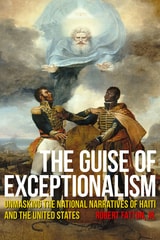
The Guise of Exceptionalism
Unmasking the National Narratives of Haiti and the United StatesRobert Fatton
Rutgers University Press, 2021
The Guise of Exceptionalism compares the historical origins of Haitian and American exceptionalisms. It also traces how exceptionalism as a narrative of uniqueness has shaped relations between the two countries from their early days of independence through the contemporary period. Exceptionalism is at the core of every national founding narrative. It allows countries to purge history of injurious stains, and embellish it with mythical innocence and claims of distinction. Exceptionalism also builds the bonds of solidarity that forge an imagined national fellowship of the chosen, but it excludes those deemed unfit for membership because of their race, ethnicity, gender, or class. Exceptionalism, however, is not frozen. As a social invention, it changes over time, but always within the parameters of its original principles. Our capacity to reinvent it is dependent on the degree of hegemony achieved by the ruling class, and if this class has the infrastructural power to gradually co-opt and include €the groups it had once excluded.
[more]
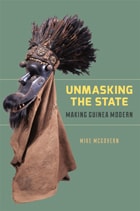
Unmasking the State
Making Guinea ModernMike McGovern
University of Chicago Press, 2012
When the Republic of Guinea gained independence in 1958, one of the first policies of the new state was a village-to-village eradication of masks and other ritual objects it deemed “fetishes.” The Demystification Program, as it was called, was so urgent it even preceded the building of a national road system. In Unmasking the State, Mike McGovern attempts to understand why this program was so important to the emerging state and examines the complex role it had in creating a unified national identity. In doing so, he tells a dramatic story of cat and mouse where minority groups cling desperately to their important— and outlawed—customs.
Primarily focused on the communities in the country’s southeastern rainforest region—people known as Forestiers—the Demystification Program operated via a paradox. At the same time it banned rituals from Forestiers’ day-to-day lives, it appropriated them into a state-sponsored program of folklorization. McGovern points to an important purpose for this: by objectifying this polytheistic group’s rituals, the state created a viable counterexample against which the Muslim majority could define proper modernity. Describing the intertwined relationship between national and local identity making, McGovern showcases the coercive power and the unintended consequences involved when states attempt to engineer culture.
[more]