Results by title
7 books match the query 'Unnatural History'

Blood Orchid
An Unnatural History of AmericaBy Charles Bowden, Foreword by William Langewiesche
University of Texas Press, 2018
Through stark observations and visceral experiences, Blood Orchid begins Charles Bowden’s dizzying excavation of the brutal, systemic violence and corruption at the roots of American society. Like a nightmarish fever dream that turns out to be our own reality, Bowden visits dying friends in skid row apartments in Los Angeles, traverses San Francisco byways lined with clubs and joints, and roams through village bars and streets in the Sierra Madre mountains. In these wanderings resides a yearning for the understanding of past and present sins, the human penchant for warfare, abuse, and oppression, and the true war between humanity, the industrialized world, and the immense tolls of our shared land. Deeply personal, hauntingly prophetic, and bracingly sharp, the start to Bowden’s harrowed quest to unearth our ugly truths remains strikingly poignant today.
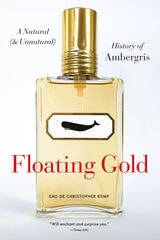
Floating Gold
A Natural (and Unnatural) History of AmbergrisChristopher Kemp
University of Chicago Press, 2012
A fascinating natural history of an incredibly curious substance.
“Preternaturally hardened whale dung” is not the first image that comes to mind when we think of perfume, otherwise a symbol of glamour and allure. But the key ingredient that makes the sophisticated scent linger on the skin is precisely this bizarre digestive by-product—ambergris. Despite being one of the world’s most expensive substances (its value is nearly that of gold and has at times in history been triple it), ambergris is also one of the world’s least known. But with this unusual and highly alluring book, Christopher Kemp promises to change that by uncovering the unique history of ambergris.
A rare secretion produced only by sperm whales, which have a fondness for squid but an inability to digest their beaks, ambergris is expelled at sea and floats on ocean currents for years, slowly transforming, before it sometimes washes ashore looking like a nondescript waxy pebble. It can appear almost anywhere but is found so rarely, it might as well appear nowhere. Kemp’s journey begins with an encounter on a New Zealand beach with a giant lump of faux ambergris—determined after much excitement to nothing more exotic than lard—that inspires a comprehensive quest to seek out ambergris and its story. He takes us from the wild, rocky New Zealand coastline to Stewart Island, a remote, windswept island in the southern seas, to Boston and Cape Cod, and back again. Along the way, he tracks down the secretive collectors and traders who populate the clandestine modern-day ambergris trade.
Floating Gold is an entertaining and lively history that covers not only these precious gray lumps and those who covet them, but presents a highly informative account of the natural history of whales, squid, ocean ecology, and even a history of the perfume industry. Kemp’s obsessive curiosity is infectious, and eager readers will feel as though they have stumbled upon a precious bounty of this intriguing substance.
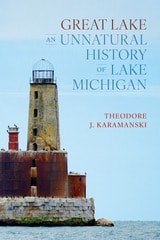
Great Lake
An Unnatural History of Lake MichiganTheodore J. Karamanski
University of Michigan Press, 2026
Great Lake is a comprehensive survey of the manifold ways Americans, from the first Native American communities to the present age, have abused, nurtured, loved, and neglected this massive freshwater resource. Extending 307 miles from north to south, the lake cuts across climatic, environmental, and physiographic zones, from the prairies of Illinois to the boreal forests of the north. Bordered by large cities like Chicago and Milwaukee as well as smaller Wisconsin resorts and northern Michigan mines and mill towns, the lake touches people in urban centers and countryside. Thus, the history of Lake Michigan combines the history of frontier resource extraction, agricultural abundance, industrialization, and dense urbanization in the American heartland. Great Lake is the story of the ever-escalating and divergent demands Americans have placed on Lake Michigan, how the lake’s ecosystem responded to those changes, and how together they have shaped the modern American Midwest.
Messages from the Wild
An Almanac of Suburban Natural and Unnatural HistoryBy Frederick R. Gehlbach
University of Texas Press, 2002
Seeking a closer connection with nature than the manicured lawns of suburbia, naturalist Fred Gehlbach and his family built a house on the edge of a wooded ravine in Central Texas in the mid-1960s. On daily walks over the hills, creek hollows, and fields of the ravine, Gehlbach has observed the cycles of weather and seasons, the annual migrations of birds, and the life cycles of animals and plants that also live in the ravine.
In this book, Gehlbach draws on thirty-five years of journal entries to present a composite, day-by-day almanac of the life cycles of this semiwild natural island in the midst of urban Texas. Recording such events as the hatching of Eastern screech owl chicks, the emergence of June bugs, and the first freeze of November, he reminds us of nature's daily, monthly, and annual cycles, from which humans are becoming ever more detached in our unnatural urban environments. The long span of the almanac also allows Gehlbach to track how local and even global developments have affected the ravine, from scars left by sewer construction to an increase in frost-free days probably linked to global warming.
This long-term record of natural cycles provides one of only two such baseline data sets for North America. At the same time, the book is an eloquent account of one keen observer's daily interactions with his wild and human neighbors and of the lessons in connectedness and the "play of life" that they teach.
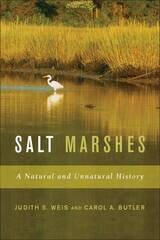
Salt Marshes
A Natural and Unnatural HistoryWeis, Judith S
Rutgers University Press, 2009
Now championed as critical habitats for plants, animals, and people because of the environmental service and protection they provide, these ecological wonders were once considered unproductive wastelands, home solely to mosquitoes and toxic waste, and mistreated for centuries by the human population. Exploring the fascinating biodiversity of these boggy wetlands, Salt Marshes offers readers a wealth of essential information about a variety of plants, fish, and animals, the importance of these habitats, consequences of human neglect and thoughtless development, and insight into how these wetlands recover.
Judith S. Weis and Carol A. Butler shed ample light on the human impact, including chapters on physical and biological alterations, pollution, and remediation and recovery programs. In addition to a national and global perspective, the authors place special emphasis on coastal wetlands in the Atlantic and Gulf regions, as well as the San Francisco Bay Area, calling attention to their historical and economic legacies.
Written in clear, easy-to-read language, Salt Marshes proves that the battles for preservation and conservation must continue, because threats to salt marshes ebb and flow like the water that runs through them.
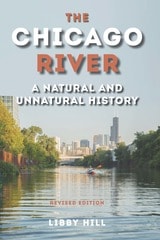
The Chicago River
A Natural and Unnatural HistoryLibby Hill
Southern Illinois University Press, 2019
This widely acclaimed volume weaves the perspectives of science, engineering, commerce, politics, economics, and the natural world into a chronicle of the river from its earliest geologic history through its repeated adaptations to the city that grew up around it. While explaining the river’s role in massive public works, such as drainage and straightening, designed to address the infrastructure needs of a growing population, Hill focuses on the synergy between the river and the people of greater Chicago, whether they be the tribal cultures that occupied the land after glacial retreat, the first European inhabitants, or more recent residents.
In the first edition, Hill brought together years of original research and the contributions of dozens of experts to tell the Chicago River’s story up until 2000. This revised edition features discussions of disinfection, Asian carp, green strategies, the evolution of the Chicago Riverwalk, and the river’s rejuvenation. It also explores how earlier solutions to problems challenge today’s engineers, architects, environmentalists, and public policy agencies as they address contemporary issues.
Revealing the river to be a microcosm of the uneasy relationship between nature and civilization, The Chicago River offers the tools and knowledge for the city’s residents to be champions on the river’s behalf.
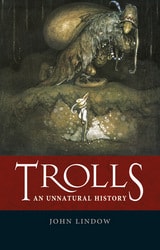
Trolls
An Unnatural HistoryJohn Lindow
Reaktion Books, 2014
To explain why trolls still hold our interest, John Lindow goes back to their first appearances in Scandinavian folklore, where they were beings in nature living beside a preindustrial society of small-scale farming and fishing. He explores reports of actual encounters with trolls—meetings others found plausible in spite of their better judgment—and follows trolls’ natural transition from folktales to other domains in popular culture. Trolls, Lindow argues, would not continue to appeal to our imaginations today if they had not made the jump to illustrations in Nordic books and Scandinavian literature and drama. From the Moomins to Brothers Grimm and Three Billy Goats Gruff to cartoons, fantasy novels, and social media, Lindow considers the panoply of trolls that surround us and their sometimes troubling connotations in the contemporary world.
Taking readers into Norwegian music and film and even Yahoo Finance chat rooms, Trolls is a fun and fascinating book about these strange creatures.