Results by title
5 books match the query 'Unrest'
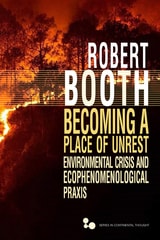
Becoming a Place of Unrest
Environmental Crisis and Ecophenomenological PraxisRobert Booth
Ohio University Press, 2021
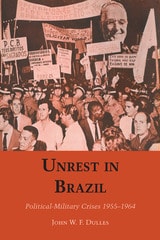
Unrest in Brazil
Political-Military Crises 1955-1964By John W. F. Dulles
University of Texas Press, 1970
… I offer my life in a holocaust … This people whose slave I was will no longer be slave to anyone. My sacrifice will remain forever in their souls and my blood will be the price of their ransom.
President Getulio Vargas' testament—written shortly before his suicide on August 24, 1954—was prophetic, for the Vargas legacy was to cast a shadow on political-military events of the next decade.
With news of Vargas' suicide, opponents of the late President, who were usually out of power, tried to organize. The military itself was split, but those favoring Kubitschek, apparent winner of the 1955 presidential election on a ticket of Vargas-created parties, gained control. To assure Kubitschek's inauguration Army leaders deposed two acting Presidents in 1955.
During Kubitschek's presidency (1956–1961 ) there were manifestations of discontent by military and political groups who ascribed numerous evils to Vargas and his followers.
In 1961, when Kubitschek's successor, Jânio Quadros, resigned after six months in office, the unrest intensified. Vice President Jango Goulart assumed the presidency and sought unsuccessfully to conciliate contending forces; his battle for reform seemed to make him an ally of "far leftists." Feeling that discipline was being undermined by men close to the President and that only military action could save Brazil from following the path favored by influential Communist labor leaders, a majority of the Army officers agreed to overthrow Goulart's administration in 1964.
Unrest in Brazil describes in exciting detail the government crises and resulting military interventions that punctuated the power struggle between supporters and opponents of Vargas in the decade following his death.
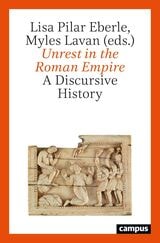
Unrest in the Roman Empire
A Discursive HistoryEdited by Lisa Pilar Eberle and Myles Lavan
Campus Verlag, 2024
Despite Roman claims to have brought peace, unrest was widespread in the Roman Empire. Revolts, protests, and piracy were common occurrences. How did contemporaries relate to and make sense of such phenomena?
This volume gathers eleven contributions by specialists in the various literatures and modes of thinking that flourished in the empire between the second century BCE and the fifth century CE, including Graeco-Roman historiography and philosophy, Jewish prophecy, Christian apology, and the writings of the Tannaitic rabbis, to investigate these questions. Each contribution analyzes the discourses by which the diverse authors of these texts understood instances of unrest. Together, the contributions expand our understanding of the varied politics that pervaded the Roman empire. They highlight the intellectual labor at every level of society that went to (re)making this imperial formation throughout its long history.
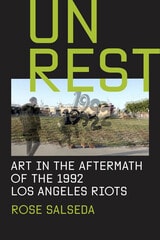
Unrest
Art in the Aftermath of the 1992 Los Angeles RiotsRose Salseda
University of Chicago Press, 2026
The first book to examine the visual art legacy of the 1992 Los Angeles Riots.
On April 29, 1992, a jury’s acquittal of four white Los Angeles police officers who had beaten Rodney King, a Black man, incited five days of intense protests. The 1992 Los Angeles Riots resulted in nearly four thousand fires, over $1 billion in property damage, fourteen thousand arrests, two thousand injuries, and sixty-three deaths. While many scholars have studied the period leading up to and following the riots, few have focused on how contemporary artists reacted to and continued to respond to this traumatic event.
In Unrest, Rose Salseda provides the first major art historical account of the 1992 Los Angeles Riots that chronicles the works of two generations of artists. Closely examining visual art that explores overlooked cross-racial, immigrant, and intergenerational experiences of the events, Salseda provocatively frames unrest as an act of the bereaved that makes visible the unrelenting experiences of injustice. She provides important insights into how we process violence through imagery; how the criminal justice system visualizes race and tolerates racial and xenophobic violence; and how we adapt racialized modes of viewing, normalize violence and oppression, and perhaps unwittingly contribute to these injustices. Ultimately, Unrest highlights how the experience of the 1992 Los Angeles Riots has driven artists to address the King beating and related episodes of racial violence for over thirty years—underscoring unrest as the inability to rest in the face of state-sanctioned violence, which persists to this day.

unrest in the nebulae
Gitan Djeli
Duke University Press, 2026