Results by title
2 books match the query 'Untying'

Untying the Afghan Knot
Negotiating Soviet WithdrawalRiaz M. Khan
Duke University Press, 1991
Diplomatic efforts to resolve the Afghanistan crisis began almost immediately after the Soviet Union’s military intervention in that country in December 1979. Untying the Afghan Knot offers the first detailed account of the diplomatic process set in motion by that intervention and culminating in the April 1988 Geneva Accords—a milestone in multilateralism and United Nations (UN) peacemaking.
Riaz M. Khan, a senior Pakistani diplomat, participated actively in all meetings on Afghanistan in the United Nations, the Non-Aligned Movement, and the Organization of the Islamic Conference, and in all of the Geneva negotiating rounds (1882–1988). Drawing upon his personal experience, official documents, scholarly literature, and press accounts, he provides a unique insider’s view of these precedent-setting negotiations, which were often shrouded in secrecy and misperceptions.
Khan examines the interests, positions, and behind-the-scenes maneuverings of the major players—Afghan governments and resistance groups, Pakistan, the Soviet Union, the United States, and UN mediators—and assesses the impact of military and political developments inside Afghanistan and elsewhere, including the advent of Mikhail Gorbachev. Khan’s authoritative account of these critical diplomatic initiatives sheds important light on the internal dynamics of the multilateral Afghanistan negotiations.
[more]
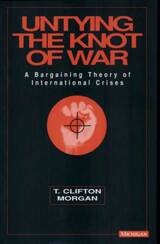
Untying the Knot of War
A Bargaining Theory of International CrisesT. Clifton Morgan
University of Michigan Press, 1994
This book utilizes formal, spatial voting models and game-theoretic techniques to examine why certain international crises erupt into all-out wars while others resolve peacefully through diplomacy. Operating on the premise that a crisis always precedes war, Morgan develops original mathematical frameworks to show how crisis outcomes are fundamentally dictated by the specific characteristics of the bargainers, the multi-dimensional nature of the disputed issues, and the vital interventions of third-party negotiators and agenda setters. By illustrating these formal equations with historical cases, the text moves beyond rigid security-maximization arguments, providing international relations scholars with a robust, predictive framework for conflict resolution and crisis bargaining.
[more]