Results by title
5 books match the query 'Urban China'
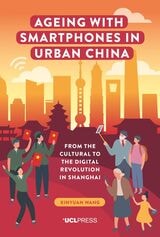
Ageing with Smartphones in Urban China
From the Cultural to the Digital Revolution in ShanghaiXinyuan Wang
University College London, 2023
The current oldest generation in Shanghai was born at a time when the average household could not afford electric lights, but today they can turn their lights off using smartphone apps. Grounded in extensive ethnographic fieldwork in Shanghai, Ageing with Smartphones in Urban China tackles the intersection between the “two revolutions” experienced by the older generation in Shanghai: the contemporary smartphone-based digital revolution and the earlier communist revolutions and argues that we can only understand the smartphone revolution if we first appreciate the long-term consequences of these people’s experiences during the communist revolutions. Supported by detailed ethnographic material, the observations and analysis here provide a panorama view of the social landscape of contemporary China, addressing such topics the digital and everyday life, aging and healthcare, intergenerational relations and family development, community building and grassroots organizations, collective memories, and political attitudes among ordinary Chinese people.
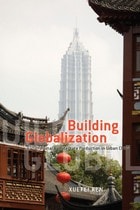
Building Globalization
Transnational Architecture Production in Urban ChinaXuefei Ren
University of Chicago Press, 2011
From the years 2004 to 2008, Beijing and Shanghai witnessed the construction of an extraordinary number of new buildings, many of which were designed by architectural firms overseas. Combining ethnographic fieldwork, historical research, and network analysis, Building Globalization closely scrutinizes the growing phenomenon of transnational architecture and its profound effect on the development of urban space.
Roaming from construction sites in Shanghai to architects’ offices in Paris, Xuefei Ren interviews hundreds of architects, developers, politicians, residents, and activists to explore this issue. She finds that in the rapidly transforming cities of modern China, iconic designs from prestigious international architects help private developers to distinguish their projects, government officials to advance their careers, and the Chinese state to announce the arrival of modern China on the world stage.
China leads the way in the globalization of architecture, a process whose ramifications can be felt from Beijing to Dubai to Basel. Connecting the dots between real estate speculation, megaproject construction, residential displacement, historical preservation, housing rights, and urban activism, Building Globalization reveals the contradictions and consequences of this new, global urban frontier.
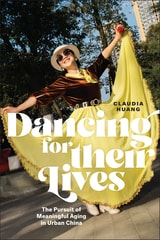
Dancing for Their Lives
The Pursuit of Meaningful Aging in Urban ChinaClaudia Huang
Rutgers University Press, 2025

Home Team Away
Watching European Football in Urban ChinaYuan Gong
University of Michigan Press, 2026
Home Team Away calls for a rethinking of sport fandom that is divorced from an attachment to location. As the first comprehensive account of the European football fandom in China, this book explores how the Chinese middle class subjectivity is formed through the cross-cultural, digital consumption of the Big Five leagues. Yuan Gong captures the embodied experiences of fans and fan clubs, fan discourses and activities unfolding on digital platforms on Weibo, Weixin, and Hupu, combining fieldwork in Shanghai and virtual ethnography. Gong argues that Chinese fans’ decisions to follow and engage with European football result from their material conditions, ideological contestation, and technology appropriation as a new demographic bloc arising during China’s transition to authoritarian digital capitalism. By engaging with their home teams away, the Chinese middle class fans perform as citizens with a global vision despite the resurgence of the nationalist and anti-Western sentiments.
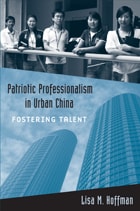
Patriotic Professionalism in Urban China
Fostering TalentAuthored by Lisa M. Hoffman
Temple University Press, 2010
In the post-Maoist era, China adopted a strategy for investing in the “quality” of its people—through education and training opportunities—that created talented labor. In her significant ethnographic study, Patriotic Professionalism in Urban China, Lisa Hoffman explains why the development of “human capital” is seen as fundamental for economic growth and national progress. She examines these new urban employees, who were deemed vital to the success of the global city in China, and who hoped for social mobility, a satisfying career, and perhaps a family.
Patriotic Professionalism in Urban China addresses the emergence of this urban professional subject in Dalian, a port city in China. Hoffman identifies who these new professionals are, what choices they have made, and how they have remained closely connected with the nation—although not necessarily the Communist party—leading to a new social form she calls “Patriotic Professionalism.”
Hoffman contributes to the understanding of changing urban life in China while providing an analysis of the country’s “late-socialist neoliberalism.” In the process, she asks pressing questions about how such shifts in urban life reshape cities, impact individual and family decisions, and reflect economic growth in China in tandem with “global” neoliberal practices.