Results by title
2 books match the query 'Urban Living'
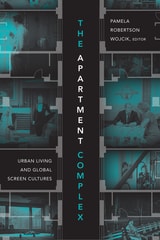
The Apartment Complex
Urban Living and Global Screen CulturesPamela Robertson Wojcik
Duke University Press, 2018
From the bachelor pad that Jack Lemmon's C. C. Baxter loans out to his superiors in Billy Wilder's The Apartment (1960) to the crumbling tenement in a dystopian Taipei in Tsai Ming-liang's The Hole (1998), the apartment in films and television series is often more than just a setting: it can motivate or shape the narrative in key ways. Such works belong to a critical genre identified by Pamela Robertson Wojcik as the apartment plot, which comprises specific thematic, visual, and narrative conventions that explore modern urbanism's various forms and possibilities. In The Apartment Complex a diverse group of international scholars discuss the apartment plot in a global context, examining films made both within and beyond the Hollywood studios. The contributors consider the apartment plot's intersections with film noir, horror, comedy, and the musical, addressing how different national or historical contexts modify the apartment plot and how the genre's framework allows us to rethink the work of auteurs and identify productive connections and tensions between otherwise disparate texts.
Contributors. Steven Cohan, Michael DeAngelis, Veronica Fitzpatrick, Annamarie Jagose, Paula J. Massood, Joe McElhaney, Merrill Schleier, Lee Wallace, Pamela Robertson Wojcik
Contributors. Steven Cohan, Michael DeAngelis, Veronica Fitzpatrick, Annamarie Jagose, Paula J. Massood, Joe McElhaney, Merrill Schleier, Lee Wallace, Pamela Robertson Wojcik
[more]
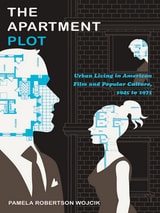
The Apartment Plot
Urban Living in American Film and Popular Culture, 1945 to 1975Pamela Robertson Wojcik
Duke University Press, 2010
Rethinking the significance of films including Pillow Talk, Rear Window, and The Seven Year Itch, Pamela Robertson Wojcik examines the popularity of the “apartment plot,” her term for stories in which the apartment functions as a central narrative device. From the baby boom years into the 1970s, the apartment plot was not only key to films; it also surfaced in TV shows, Broadway plays, literature, and comic strips, from The Honeymooners and The Mary Tyler Moore Show to Subways are for Sleeping and Apartment 3-G. By identifying the apartment plot as a film genre, Wojcik reveals affinities between movies generally viewed as belonging to such distinct genres as film noir, romantic comedy, and melodrama. She analyzes the apartment plot as part of a mid-twentieth-century urban discourse, showing how it offers a vision of home centered on values of community, visibility, contact, mobility, impermanence, and porousness that contrasts with views of home as private, stable, and family-based. Wojcik suggests that the apartment plot presents a philosophy of urbanism related to the theories of Jane Jacobs and Henri Lefebvre. Urban apartments were important spaces for negotiating gender, sexuality, race, and class in mid-twentieth-century America.
[more]