Results by title
3 books match the query 'Urban Revolution'
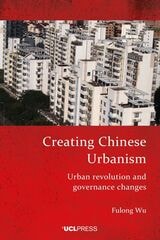
Creating Chinese Urbanism
Urban Revolution and Governance ChangesFulong Wu
University College London, 2022
A detailed account of the Chinese urbanization boom and its implications.
While the imperial and socialist periods of Chinese history were marked by a union of society and state, the rapid urbanization of China has dismantled the territorial foundation of an “earth-bound” or rural society. Through this urban revolution, the Chinese state has become a visible factor in the construction of urban life, with State-led rebuilding of residential communities hastening the demise of traditionalism and giving birth to a new China with greater urbanism and state-centered governance. In Creating Chinese Urbanism, Fulong Wu describes the landscape of urbanization in China, revealing the profound impacts of marketization on Chinese society and the consequential governance changes at the grassroots level. Taking the vantage point of concrete residential neighborhoods, this book offers a cutting-edge analysis of how China is becoming urban and conceptualizes the changes in state governance through the process of urbanization.
While the imperial and socialist periods of Chinese history were marked by a union of society and state, the rapid urbanization of China has dismantled the territorial foundation of an “earth-bound” or rural society. Through this urban revolution, the Chinese state has become a visible factor in the construction of urban life, with State-led rebuilding of residential communities hastening the demise of traditionalism and giving birth to a new China with greater urbanism and state-centered governance. In Creating Chinese Urbanism, Fulong Wu describes the landscape of urbanization in China, revealing the profound impacts of marketization on Chinese society and the consequential governance changes at the grassroots level. Taking the vantage point of concrete residential neighborhoods, this book offers a cutting-edge analysis of how China is becoming urban and conceptualizes the changes in state governance through the process of urbanization.
[more]
Monstrous Politics
Geography, Rights, and the Urban Revolution in Mexico CityBen Gerlofs
Vanderbilt University Press, 2022
The birth of the world’s great megacities is the surest and starkest harbinger of the “urban age” inaugurated in the twentieth century. As the world’s urban population achieves majority for the first time in recorded history, theories proliferate on the nature of urban politics, including the shape and quality of urban democracy, the role of urban social and political movements, and the prospects for progressive and emancipatory change from the corridors of powerful states to the routinized rhythms of everyday life. At stake are both the ways in which the rapidly changing urban world is understood and the urban futures being negotiated by the governments and populations struggling to contend with these changes and forge a place in contemporary cities.
Transdisciplinary by design, Monstrous Politics first moves historically through Mexico City’s turbulent twentieth century, driven centrally by the contentious imbrication of the Institutional Revolutionary Party (PRI) and its capital city. Participant observation, expert interviews, and archival materials demonstrate the shifting strategies and alliances of recent decades, provide the reader with a sense of the texture of contemporary political life in the city during a time of unprecedented change, and locate these dynamics within the history and geography of twentieth-century urbanization and political revolution. Substantive ethnographic chapters trace the emergence and decline of the political language of “the right to the city,” the establishment and contestation of a “postpolitical” governance regime, and the culmination of a century of urban politics in the processes of “political reform” by which Mexico City finally wrested back significant political autonomy and local democracy from the federal state.
A four-fold transection of the revolutionary structure of feeling that pervades the city in this historic moment illustrates the complex and contradictory sentiments, appraisals, and motivations through which contemporary politics are understood and enacted. Drawing on theories of social revolution that embrace complexity, and espousing a methodology that foregrounds the everyday nature of politics, Monstrous Politics develops an understanding of revolutionary urban politics at once contextually nuanced and conceptually expansive, and thus better able to address the realities of politics in the “urban age” even beyond Mexico City.
[more]
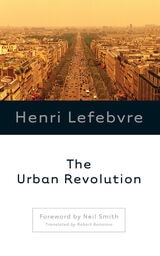
The Urban Revolution
Henri Lefebvre
University of Minnesota Press, 2003
Originally published in 1970, The Urban Revolution marked Henri Lefebvre’s first sustained critique of urban society, a work in which he pioneered the use of semiotic, structuralist, and poststructuralist methodologies in analyzing the development of the urban environment. Although it is widely considered a foundational book in contemporary thinking about the city, The Urban Revolution has never been translated into English—until now. This first English edition, deftly translated by Robert Bononno, makes available to a broad audience Lefebvre’s sophisticated insights into the urban dimensions of modern life.Lefebvre begins with the premise that the total urbanization of society is an inevitable process that demands of its critics new interpretive and perceptual approaches that recognize the urban as a complex field of inquiry. Dismissive of cold, modernist visions of the city, particularly those embodied by rationalist architects and urban planners like Le Corbusier, Lefebvre instead articulates the lived experiences of individual inhabitants of the city. In contrast to the ideology of urbanism and its reliance on commodification and bureaucratization—the capitalist logic of market and state—Lefebvre conceives of an urban utopia characterized by self-determination, individual creativity, and authentic social relationships.A brilliantly conceived and theoretically rigorous investigation into the realities and possibilities of urban space, The Urban Revolution remains an essential analysis of and guide to the nature of the city.Henri Lefebvre (d. 1991) was one of the most significant European thinkers of the twentieth century. His many books include The Production of Space (1991), Everyday Life in the Modern World (1994), Introduction to Modernity (1995), and Writings on Cities (1995).Robert Bononno is a full-time translator who lives in New York. His recent translations include The Singular Objects of Architecture by Jean Baudrillard and Jean Nouvel (Minnesota, 2002) and Cyberculture by Pierre Lévy (Minnesota, 2001).
[more]