Results by title
13 books match the query 'Urban anthropology'
Bombay Brokers
Lisa Björkman, editor
Duke University Press, 2021
Contributors. Anjali Arondekar, Sarthak Bagchi, Tobias Baitsch, Sangeeta Banerji, Srimati Basu, Tarini Bedi, Amita Bhide, Lisa Björkman, Uday Chandra, Simon Chauchard, Ka-Kin Cheuk, Michael Collins, Daisy Deomampo, Maura Finkelstein, Ajay Gandhi, Rupali Gupte, Kathryn C. Hardy, Lalitha Kamath, Prasad Khanolkar, Bhushan Korgaonkar, Ratoola Kundu, Ken Kuroda, Annelies Kusters, Lisa Mitchell, Shailaja Paik, Gautam Pemmaraju, Lubaina Rangwala, Llerena Guiu Searle, Atreyee Sen, Prasad Shetty, Rohan Shivkumar, Edward Simpson, David Strohl, Rachel Sturman, R. Swaminathan, Aneri Taskar, Yaffa Truelove, Sahana Udupa, Lalit Vachani, Leilah Vevaina
God and Caesar at the Rio Grande
Sanctuary and the Politics of ReligionHilary Cunningham
University of Minnesota Press, 1995
Jerusalem 1900
The Holy City in the Age of PossibilitiesVincent Lemire
University of Chicago Press, 2017
In this masterly history, Lemire uses newly opened archives to explore how Jerusalem’s elite residents of differing faiths cooperated through an intercommunity municipal council they created in the mid-1860s to administer the affairs of all inhabitants and improve their shared city. These residents embraced a spirit of modern urbanism and cultivated a civic identity that transcended religion and reflected the relatively secular and cosmopolitan way of life of Jerusalem at the time. These few years would turn out to be a tipping point in the city’s history—a pivotal moment when the horizon of possibility was still open, before the council broke up in 1934, under British rule, into separate Jewish and Arab factions. Uncovering this often overlooked diplomatic period, Lemire reveals that the struggle over Jerusalem was not historically inevitable—and therefore is not necessarily intractable. Jerusalem 1900 sheds light on how the Holy City once functioned peacefully and illustrates how it might one day do so again.
Making Down Syndrome
Motherhood and Kinship Futures in Urban JordanChristine Sargent
Rutgers University Press, 2026
Making Down Syndrome: Motherhood and Kinship Futures in Urban Jordan draws on ethnographic research conducted primarily in Jordan’s capital city of Amman to explore how the label and identity of Down syndrome is gaining increasing cohesiveness. Focused on the experiences of mothers, who serve as an entry point for understanding broader family dynamics and choices, the book argues that practices and ideologies of care play a central role in making Down syndrome’s embodied and political realities. They do so through the momentum of kinship futures, or futures imagined through the prism of kinship roles and relations, which shape how families organize and distribute care between and beyond kinship networks and under conditions of economic and political uncertainty. By approaching everyday life in Jordan through the lens of disability, Making Down Syndrome offers new insights into how people navigate structures of family, gender, power, inequality, and precarity, all while trying to maintain hope for and cultivate better futures.
Materializing Identities in Socialist and Post-Socialist Cities
Edited by Jaroslav Ira and Jirí Janác
Karolinum Press, 2017
Monrovia Modern
Urban Form and Political Imagination in LiberiaDanny Hoffman
Duke University Press, 2017
Pyramids and Nightclubs
A Travel Ethnography of Arab and Western Imaginations of Egypt, from King Tut and a Colony of Atlantis to Rumors of Sex Orgies, Urban Legends about a Marauding Prince, and Blonde Belly DancersBy L. L. Wynn
University of Texas Press, 2007
2008 — Leeds Honor Book in Urban Anthropology – Society for Urban, National, and Transnational/Global Anthropology
Living in Egypt at the turn of the millennium, cultural anthropologist L. L. Wynn was struck by the juxtapositions of Western, Gulf Arab, and Egyptian viewpoints she encountered. For some, Egypt is the land of mummies and pharaohs. For others, it is a vortex of decadence, where nightlife promises a chance to salivate over belly dancers and maybe even glimpse a movie star. Offering a new approach to ethnography, Pyramids and Nightclubs examines cross-cultural encounters to bring to light the counterintuitive ways in which Egypt is defined.
Guiding readers on an armchair journey that introduces us to Russian and Australian belly dancers on Nile cruise ships, Egyptian rumors about an Arab prince and his royal entourage, Saudi girls looking for a less restrictive dating scene, and other visitors to this "antique" land, Wynn uses the lens of travel and tourism to depict a fascinating and often surprising version of Egypt, while exploring the concept of stereotype itself. Tracing the history of Western and Arab fascination with Egypt through spurious hunts for lost civilizations and the new economic disparities brought about by the oil industry, Pyramids and Nightclubs ultimately describes the ways in which moments of cultural contact, driven by tourism and labor migration, become eye-opening opportunities for defining self and other.
Saigon’s Edge
On the Margins of Ho Chi Minh CityErik Harms
University of Minnesota Press, 2010
Unlike the idealized Vietnamese model of urban space, Hóc Môn is between worlds, neither outside nor inside but always uncomfortably both. With particular attention to everyday social realities, Harms demonstrates how living on the margin can be both alienating and empowering, as forces that exclude its denizens from power and privilege in the inner city are used to thwart the status quo on the rural edges.
More than a local case study of urban change, Harms’s work also opens a window on Vietnam’s larger turn toward market socialism and the celebration of urbanization—transformations instructively linked to trends around the globe.
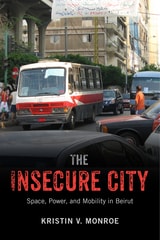
The Insecure City
Space, Power, and Mobility in BeirutMonroe, Kristin V
Rutgers University Press, 2016
Download open access ebook here.
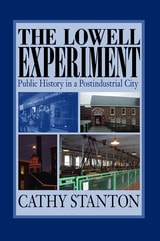
The Lowell Experiment
Public History in a Postindustrial CityCathy Stanton
University of Massachusetts Press, 2006
In the early nineteenth century, Lowell, Massachusetts, was widely studied and emulated as a model for capitalist industrial development. One of the first cities in the United States to experience the ravages of deindustrialization, it was also among the first places in the world to turn to its own industrial and ethnic history as a tool for reinventing itself in the emerging postindustrial economy. The Lowell Experiment explores how history and culture have been used to remake Lowell and how historians have played a crucial yet ambiguous role in that process.
The book focuses on Lowell National Historical Park, the flagship project of Lowell's new cultural economy. When it was created in 1978, the park broke new ground with its sweeping reinterpretations of labor, immigrant, and women's history. It served as a test site for the ideas of practitioners in the new field of public history—a field that links the work of professionally trained historians with many different kinds of projects in the public realm.
The Lowell Experiment takes an anthropological approach to public history in Lowell, showing it as a complex cultural performance shaped by local memory, the imperatives of economic redevelopment, and tourist rituals—all serving to locate the park's audiences and workers more securely within a changing and uncertain new economy characterized by growing inequalities and new exclusions.
The paradoxical dual role of Lowell's public historians as both interpreters of and contributors to that new economy raises important questions about the challenges and limitations facing academically trained scholars in contemporary American culture. As a long-standing and well-known example of “culture-led re-development,” Lowell offers an outstanding site for exploring questions of concern to those in the fields of public and urban history, urban planning, and tourism studies.
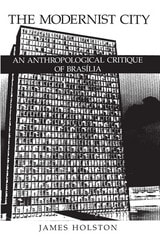
The Modernist City
An Anthropological Critique of BrasiliaJames Holston
University of Chicago Press, 1989
The Urban Grotesque
Life and Debt in JakartaDoreen Lee
Duke University Press, 2025
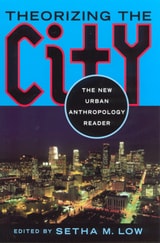
Theorizing the City
The New Urban Anthropology ReaderLow, Setha M.
Rutgers University Press, 1999
Anthropological perspectives are not often represented in urban studies, even though many anthropologists have been contributing actively to theory and research on urban poverty, racism, globalization, and architecture. The New Urban Anthropology Reader corrects this omission by presenting 12 cross-cultural case studies focusing on the analysis of space and place.