Results by title
5 books match the query 'Urban archaeology'
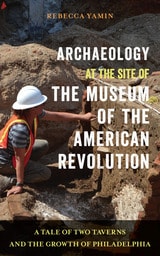
Archaeology at the Site of the Museum of the American Revolution
A Tale of Two Taverns and the Growth of PhiladelphiaRebecca Yamin
Temple University Press, 2019
When the Museum of the American Revolution acquired the land at Third and Chestnut streets in Olde City, Philadelphia, it came with the condition that an archaeological investigation be conducted. The excavation that began in the summer of 2014 yielded treasures in the trash: unearthed privy pits provided remarkable finds from a mid-eighteenth-century tavern to relics from a button factory dating to the early twentieth century. These artifacts are described and analyzed by urban archaeologist Rebecca Yamin in Archaeology at the Site of the Museum of the American Revolution.
Yamin, lead archaeologist on the dig, catalogues items—including earthenware plates and jugs, wig curlers, clay pipes, and liquor bottles—to tell the stories of their owners and their roles in Philadelphia history. As she uncovers the history of the people as well as their houses, taverns, and buildings that were once on the site, she explains that by looking at these remains, we see the story of the growth of Philadelphia from its colonial beginnings to the Second World War.
Archaeology at the Site of the Museum of the American Revolution is a perfect keepsake for armchair archaeologists, introductory students, and history buffs.
Archaeology of Southern Urban Landscapes
Amy L Young
University of Alabama Press, 2000
Groundbreaking essays in urban archaeology highlight the impact of towns and cities on the southern landscape.
The rapid growth and development of urban areas in the South have resulted in an increase in the number of urban archaeology projects required by federal and state agencies. These projects provide opportunities not only to investigate marginal areas between the town and countryside but also to recover information long buried beneath the earliest urban structures. Such projects have also created a need for a one-volume update on archaeology as it is practiced in the urban areas of the southeastern United States.
Archaeology of Southern Urban Landscapes will assist practitioners and scholars in the burgeoning fields of urban and landscape archaeology by treating the South as a distinctive social, geographic, and material entity and by focusing on the urban South rather than the stereotypical South of rural plantations. The case studies in this volume span the entire southeastern United States, from Annapolis to New Orleans and from colonial times to the 19th century. The authors address questions involving the function of cities, interregional diversity, the evolution of the urban landscape, and the impact of the urban landscape on southern culture. By identifying the relationship between southern culture and the South's urban landscapes, this book will help us understand the built landscape of the past and predict future growth in the region.
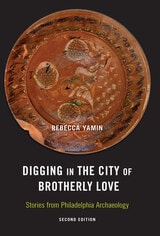
Digging in the City of Brotherly Love
Stories from Philadelphia ArchaeologyYamin, Rebecca
Temple University Press, 2023
Rebecca Yamin adds three new chapters that showcase several major discoveries from recent finds including unmarked early eighteenth-century burial grounds, one of which associated with the first African Methodist Episcopal (AME) Church, in the oldest part of the city; a nineteenth-century working-class neighborhood built along the path of what is now Route I-95 and was once home to Native American life; and the remains of two taverns found on the site of the current Museum of the American Revolution.
Yamin describes the research and state-of-the-art techniques used to study these exciting discoveries. In chronicling the value of looking into a city’s past, Digging in the City of Brotherly Love brings to life the people who lived in the early city and the people in the present who study them.
The Urban Questions
Interdisciplinary and Multiscalar Approaches to Investigating the Ancient Mesoamerican CityLisa Johnson and Arianna Campiani
University of Utah Press, 2025
This groundbreaking volume presents a fresh and comprehensive look at the urban development of Mesoamerican cities. Moving beyond traditional methods, The Urban Questions adopts a dynamic, multidisciplinary approach to understanding the complexity and diversity of ancient settlements. By examining urbanism at multiple scales—from individual events to households, neighborhoods, and entire regions—it offers a nuanced view of how these cities evolved over time.
Contributors explore key themes such as community identity, infrastructure management, and the intersection of social, political, and economic processes. Rich in both spatial and material analysis, the chapters provide insights into the lived experience of ancient Mesoamerican inhabitants and the gradual expansion of their cities. With innovative archaeological methodologies and theoretical frameworks, this volume is an essential resource for scholars of Mesoamerican studies, archaeology, and urban history, shedding new light on the dynamic nature of ancient cities.
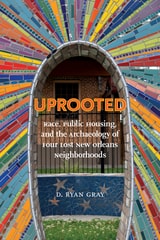
Uprooted
Race, Public Housing, and the Archaeology of Four Lost New Orleans NeighborhoodsD. Ryan Gray
University of Alabama Press, 2020
The archaeology of four New Orleans neighborhoods that were replaced by public housing projects
Uprooted: Race, Public Housing, and the Archaeology of Four Lost New Orleans Neighborhoods uses archaeological research on four neighborhoods that were razed during the construction of public housing in World War II–era New Orleans. Although each of these neighborhoods was identified as a “slum” historically, the material record challenges the simplicity of this designation. D. Ryan Gray provides evidence of the inventiveness of former residents who were marginalized by class, color, or gender and whose everyday strategies of survival, subsistence, and spirituality challenged the city’s developing racial and social hierarchies.
These neighborhoods initially appear to have been quite distinct, ranging from the working-class Irish Channel, to the relatively affluent Creole of Color–dominated Lafitte area, to the former location of Storyville, the city’s experiment in semilegal prostitution. Archaeological and historical investigations suggest that race was the crucial factor in the areas’ selection for clearance. Each neighborhood manifested a particular perceived racial disorder, where race intersected with ethnicity, class, or gender in ways that defied the norms of Jim Crow segregation.
Gray’s research makes use of both primary documents—including census records, city directories, and even the brothel advertising guides called “Blue Books”—and archaeological data to examine what this entailed at a variety of scales, reconstructing narratives of the households and communities affected by clearance. Public housing, both in New Orleans and elsewhere, imposed a new kind of control on urban life that had the effect of making cities both more segregated and less equal. The story of the neighborhoods that were destroyed provides a reminder that their erasure was not an inevitable outcome, and that a more equitable and just city is still possible today. A critical examination of the rise of public housing helps inform the ongoing debates over its demise, especially in light of the changing face of post-Katrina New Orleans.