Results by title
2 books match the query 'Urban landscape architecture'
Chicago Reflected
A Skyline Drawing from the Chicago RiverRyan Chester
University of Chicago Press, 2023
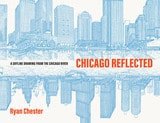
A unique and playful hand-drawn exploration of the Chicago River’s landscape, documented on an eleven-foot-long foldout.
In March 2020, architect Ryan Chester began drawing the Chicago River for at least one hour every day. Using only a pen, he moved methodically along a single massive roll of paper. As each chaotic, isolating day of the COVID-19 pandemic passed, he stayed connected with his adopted city by carefully documenting by hand the beautiful intricacies of Chicago’s riverfront architecture, boats, and bridges.
As completed, Chester’s two-foot-high, fifty-five-foot-long drawing is a unique vision. In addition to dozens of accurately depicted buildings, Chester included pieces of Chicago’s past, including the Union Station Concourse Building that was demolished in 1969 and the immense SS Eastland, which sank in the river in 1915, killing hundreds of people. Recent architecture is featured as well, including Studio Gang’s St. Regis Chicago tower and the Bank of America Tower by Goettsch Partners.
An essay by acclaimed writer Thomas Dyja accompanies the accordion-fold presentation of Chester’s drawing, enhancing this remarkable volume that will delight any fan of Chicago, architecture, or art. Chicago Reflected opens up fresh vistas of the stunning, ever-evolving architectural landscape that can be found only in Chicago.
[more]
St. Louis
Evolution Of American Urban LandscapeERIC SANDWEISS
Temple University Press, 2001
St. Louis's story stands for the story of all those cities whose ambitions and civic self-image, forged from the growth of the mercantile and industrial eras, have been dramatically altered over time. More dramatically, perhaps, than most -- but in a manner shared by all -- St. Louis's changing economic base, shifting population and altered landscape have forced scholars, policymakers, and residents alike to acknowledge the transciency of what once seemed inexorable metropolitan trends: concentration, growth, accumulated wealth, and generally improved well-being.
In this book, Eric Sandweiss scrutinizes the everyday landscape -- streets, houses, neighborhoods, and public buildings -- as it evolved in a classic American city. Bringing to life the spaces that most of us pass without noticing, he reveals how the processes of dividing, trading, improving, and dwelling upon land are acts that reflect and shape social relations. From its origins as a French colonial settlement in the eighteenth century to the present day, St. Louis offers a story not just about how our past is diagrammed in brick and asphalt, but also about the American city's continuing viability as a place where the balance of individual rights and collective responsibilities can be debated, demonstrated and adjusted for generations to come.
In this book, Eric Sandweiss scrutinizes the everyday landscape -- streets, houses, neighborhoods, and public buildings -- as it evolved in a classic American city. Bringing to life the spaces that most of us pass without noticing, he reveals how the processes of dividing, trading, improving, and dwelling upon land are acts that reflect and shape social relations. From its origins as a French colonial settlement in the eighteenth century to the present day, St. Louis offers a story not just about how our past is diagrammed in brick and asphalt, but also about the American city's continuing viability as a place where the balance of individual rights and collective responsibilities can be debated, demonstrated and adjusted for generations to come.
[more]