Results by title
8 books match the query 'Usage'
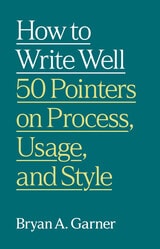
How to Write Well
50 Pointers on Process, Usage, and StyleBryan A. Garner
University of Chicago Press, 2027
Stop worshipping Strunk and White. Start writing well, with 50 tips and techniques from language expert Bryan A. Garner.
For decades, people looking for a concise guide to English-language writing turned to The Elements of Style by William Strunk Jr. and E. B. White. That slim book has been used by everyone from high school and college students to professionals seeking quick advice on usage, grammar, and form. But The Elements of Style hasn’t been updated in more than a quarter century, and it no longer reflects the way good writers work or what they most need to know, especially in the age of generative AI.
How to Write Well: 50 Pointers on Process, Usage, and Style is the modern, evidence-based alternative. Leading language and writing expert Bryan A. Gamer distills a lifetime of teaching and research into 50 compact pointers for modern writers seeking to produce clear, accurate, and lively prose. You’ll learn how strong writers think, how they turn ideas into blueprints, and how they draft, revise, and tighten with ruthless selectivity. You’ll also encounter lucid guidance on grammar and punctuation that corrects Strunk & White’s famous blunders, including shaky treatment of passive voice and a fixation on trivia over substance.
How to Write Well presents a start-to-finish method: mindset, habits, process, and the concrete techniques that produce clean, forceful writing. Unlike The Elements of Style, this book doesn’t pretend your draft magically appears on the page. It shows you how to generate ideas, structure them, and build a repeatable process for everything you write—from emails and memos to articles, briefs, and books. And while emphasizing the mind and the voice of the writer, it also offers advice on working intelligently with AI while keeping full editorial control.
If you’re serious about writing, Garner’s How to Write Well is the indispensable style book you need now.
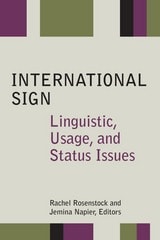
International Sign
Linguistic, Usage, and Status IssuesRachel Rosenstock
Gallaudet University Press, 2015
Editors Rachel Rosenstock and Jemina Napier have assembled an international group of renowned linguists and interpreters to examine various aspects of International Sign. Their contributions are divided into three parts: International Sign as a Linguistic System; International Sign in Action—Interpreting, Translation, and Teaching; and International Sign Policy and Language Planning. The chapters cover a range of topics, including the morphosyntactic and discursive structures of interpreted IS, the interplay between conventional linguistic elements and nonconventional gestural elements in IS discourse, how deaf signers who use different signed languages establish communication, Deaf/hearing IS interpreting teams and how they sign depicting verbs, how best to teach foundation-level IS skills, strategies used by IS interpreters when interpreting from IS into English, and explorations of the best ways to prepare interpreters for international events.
The work of the editors and contributors in this volume makes International Sign the most comprehensive, research-based analysis of a young but growing field in linguistics and interpretation.
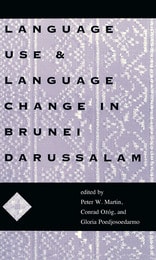
Language Use and Language Change in Brunei Darussalam
Mis Sea#100Peter W. Martin
Ohio University Press, 1996
The oil-rich sultanate of Brunei Darussalam is located on the northern coast of Borneo between the two Malaysian states of Sarawak and Sabah. Though the country is small in size and in population, the variety of language use there provides a veritable laboratory for linguists in the fields of Austronesian linguistics, bilingual studies, and sociolinguistic studies, particularly those dealing with language shift.
This useful reference is divided into three sections: one on varieties of the Malay language used in the country, one on other indigenous languages, and one on the role and form of the English used there. Contributors to the collection include Bruneian scholars as well as established experts in the fields of Austronesian linguistics, sociolinguistics studies, and the description of new varieties of English.
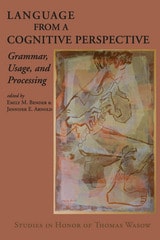
Language from a Cognitive Perspective
Grammar, Usage, and ProcessingEdited by Emily M. Bender and Jennifer E. Arnold
CSLI, 2011
This book is a collection of papers on language processing, usage, and grammar, written to commemorate the career of Thomas Wasow on the occasion of his sixty-fifth birthday. Wasow has been professor of linguistics and philosophy at Stanford University since 1973, and is affiliated with the Symbolic Systems Program. He has made significant contributions to the study of English syntax, psycholinguistics, and philosophy of linguistics.
Relevant Linguistics
An Introduction to the Structure and Use of English for TeachersPaul W. Justice
CSLI, 2001
The Chicago Guide to Grammar, Usage, and Punctuation
Bryan A. Garner
University of Chicago Press, 2016
Throughout the book Garner describes standard literary English—the forms that mark writers and speakers as educated users of the language. He also offers historical context for understanding the development of these forms. The section on grammar explains how the canonical parts of speech came to be identified, while the section on syntax covers the nuances of sentence patterns as well as both traditional sentence diagramming and transformational grammar. The usage section provides an unprecedented trove of empirical evidence in the form of Google Ngrams, diagrams that illustrate the changing prevalence of specific terms over decades and even centuries of English literature. Garner also treats punctuation and word formation, and concludes the book with an exhaustive glossary of grammatical terms and a bibliography of suggested further reading and references.
The Chicago Guide to Grammar, Usage, and Punctuation is a magisterial work, the culmination of Garner’s lifelong study of the English language. The result is a landmark resource that will offer clear guidelines to students, writers, and editors alike.
The Writer's Reference Guide to Spanish
By David William Foster, Daniel Altamiranda, and Carmen de Urioste
University of Texas Press, 2000
Writers and editors of Spanish have long needed an authoritative guide to written language usage, similar to The MLA Style Manual and The Chicago Manual of Style. And here it is! This reference guide provides comprehensive information on how the Spanish language is copyedited for publication.
The book covers these major areas:
- Language basics: capitalization, word division, spelling, and punctuation.
- Language conventions: abbreviations, professional and personal titles, names of organizations, and nationalities.
- Bibliographic format, particularly how Spanish differs from English.
- Spanish language forms of classical authors' names.
- Literary and grammatical terminology.
- Linguistic terminology.
- Biblical names and allusions.
- A dictionary of grammatical doubts, including usage, grammatical constructions of particular words and phrases, verbal irregularities, and gender variations.
Usage of Idem, Ipse and Words of Related Meaning
Clarence L. Meader
University of Michigan Press, 1910