Results by title
6 books match the query 'Vélez-Ibáñez, Carlos G.'
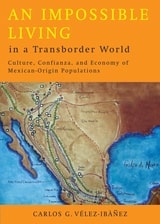
An Impossible Living in a Transborder World
Culture, Confianza, and Economy of Mexican-Origin PopulationsCarlos G. Vélez-Ibáñez
University of Arizona Press, 2010
Central to the ROSCA is the cultural concept of mutual trust, or confianza. This is the cultural glue that holds the reciprocal relationship together. As Vélez-Ibáñez explains, confianza “shapes the expectations for relationships within broad networks of interpersonal links, in which intimacies, favors, goods, services, emotion, power, or information are exchanged.” In a border region where migration, class movement, economic changes, and institutional inaccessibility produce a great deal of uncertainty, Mexican-origin populations rely on confianza and ROSCAs to maintain a sense of security in daily life. How do transborder people adapt these common practices to meet the demands of a global economy? That is precisely what Vélez-Ibáñez investigates.
Border Visions
Mexican Cultures of the Southwest United StatesCarlos G. Vélez-Ibáñez
University of Arizona Press, 1996
Hegemonies of Language and Their Discontents
The Southwest North American Region Since 1540Carlos G. Vélez-Ibáñez
University of Arizona Press, 2017
Well-regarded author Carlos G. Vélez-Ibáñez details the linguistic and cultural processes used by penetrating imperial and national states. He argues that these impositions have been not linear but hydra-headed, complex and contradictory, sometimes accommodated and sometimes forcefully imposed. Such impositions have created discontent resulting in physical and linguistic revolts, translanguage versions, and multilayered capacities of use and misuse of imposed languages—even the invention of community-created trilingual dictionaries.
Vélez-Ibáñez gives particular attention to both sides of the border, explaining the consequences of the fragile splitting of the area through geopolitical border formation. He illustrates the many ways those discontents have manifested in linguistic, cultural, educational, political, and legal forms.
From revolt to revitalization, from silent objection to expressive defiance, people in the Southwest North American Region have developed arcs of discontent from the Spanish colonial period to the present. These narratives are supported by multiple sources, including original Spanish colonial documents and new and original ethnographic studies of performance rituals like the matachines of New Mexico. This unique work discusses the most recent neurobiological studies of bilingualism and their implications for cognitive development and language as it spans multiple disciplines. Finally, it provides the most important models for dual language development and their integration to the "Funds of Knowledge" concept as creative contemporary discontents with monolingual approaches.
Reflections of a Transborder Anthropologist
From Netzahualcóyotl to AztlánCarlos G. Vélez-Ibáñez
University of Arizona Press, 2020
In each chapter, Vélez-Ibáñez revisits a critical piece of his written work, providing a new introduction and discussion of ideas, sources, and influences for the piece. These are followed by the work, chosen because it accentuates key aspects of his development and formation as an anthropologist. By returning to these previously published works, Vélez-Ibáñez offers insight not only into the evolution of his own thinking and conceptualization but also into changes in the fields in which he has been so influential. Throughout his career, Vélez-Ibáñez has addressed why he does the work that he does, and in this volume he continues to address the personal and intellectual drives that have brought him from Netzahualcóyotl to Aztlán.
Reflections of a Transborder Anthropologist shows how both Vélez-Ibáñez and anthropology have changed and formed over a fifty-year period. Throughout, he has worked to understand how people survive and thrive against all odds. Vélez-Ibáñez has been guided by the burning desire to understand inequality, exploitation, and legitimacy, and, most importantly, to provide platforms for the voiceless to narrate their own histories.
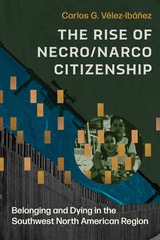
The Rise of Necro/Narco Citizenship
Belonging and Dying in the Southwest North American RegionCarlos G. Vélez-Ibáñez
University of Arizona Press, 2025
Carlos G. Vélez-Ibáñez’s latest work, The Rise of Necro/Narco Citizenship investigates the intricate and often harrowing dynamics that define the borderlands between the United States, Mexico, and beyond. This groundbreaking book provides a comprehensive cultural, economic, social, and political-ecological analysis, illustrating how various forms of violence and militarization have reshaped the daily lives and identities of the region’s inhabitants. Through meticulous ethnographic fieldwork, extensive archival research, and rigorous statistical data, Vélez-Ibáñez exposes the deeply entrenched networks of exploitation and conflict that have emerged in response to global capitalism’s pressures.
Vélez-Ibáñez builds on theorization about necrocitizenship to introduce the concept of necro/narco citizenship, which argues that pervasive violence and socioeconomic disruptions create a unique form of existence on both sides of the border. The author examines the dislocation of thousands, the persistent threat of violence, and the ways in which these forces compel individuals to navigate a reality steeped in addiction, self-destruction, and civil deterioration. This book reveals the transnational networks and the morally compromised political economies that sustain them, offering readers an unflinching look at the cost of survival in this tumultuous region.
This essential volume is not only a critical addition to the field of anthropology but also an invaluable resource for those interested in the sociopolitical landscape of the U.S.-Mexico border. Vélez-Ibáñez’s insights will resonate with scholars, students, and policymakers alike. The Rise of Necro/Narco Citizenship challenges us to rethink the narratives of violence, militarization, and resistance that define our understanding of the Southwest North American Region.
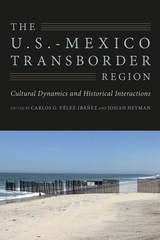
The U.S.-Mexico Transborder Region
Cultural Dynamics and Historical InteractionsEdited by Carlos G. Vélez-Ibáñez and Josiah Heyman
University of Arizona Press, 2017
The U.S.-Mexico Transborder Region presents advanced anthropological theorizing of culture in an important regional setting. Not a static entity, the transborder region is peopled by ever-changing groups who face the challenges of social inequality: political enforcement of privilege, economic subordination of indigenous communities, and organized resistance to domination.
The book, influenced by the work of Eric Wolf and senior editor Carlos G. Vélez-Ibáñez, centers on the greater Mexican North/U.S. Southwest, although the geographic range extends farther. This tradition, like other transborder approaches, attends to complex and fluid cultural and linguistic processes, going beyond the classical modern anthropological vision of one people, one culture, one language. With respect to recent approaches, however, it is more deeply social, focusing on vertical relations of power and horizontal bonds of mutuality.
Vélez-Ibáñez and Heyman envision this region as involving diverse and unequal social groups in dynamic motion over thousands of years. Thus the historical interaction of the U.S.-Mexico border, however massively unequal and powerful, is only the most recent manifestation of this longer history and common ecology. Contributors emphasize the dynamic “transborder” quality—conflicts, resistance, slanting, displacements, and persistence—in order to combine a critical perspective on unequal power relations with a questioning perspective on claims to bounded simplicity and perfection.
The book is notable for its high degree of connection across the various chapters, strengthened by internal syntheses from notable border scholars, including Robert R. Alvarez and Alejandro Lugo. In the final section, Judith Freidenberg draws general lessons from particular case studies, summarizing that “access to valued scarce resources prompts the erection of human differences that get solidified into borders,” dividing and limiting, engendering vulnerabilities and marginalizing some people.
At a time when understanding the U.S.-Mexico border is more important than ever, this volume offers a critical anthropological and historical approach to working in transborder regions.
Contributors:
Amado Alarcón
Robert R. Álvarez
Miguel Díaz-Barriga
Margaret E. Dorsey
Judith Freidenberg
Ruth Gomberg-Muñoz
James Greenberg
Josiah Heyman
Jane H. Hill
Sarah Horton
Alejandro Lugo
Luminiţa-Anda Mandache
Corina Marrufo
Guillermina Gina Núñez-Mchiri
Anna Ochoa O’Leary
Luis F. B. Plascencia
Lucero Radonic
Diana Riviera
Thomas E. Sheridan
Kathleen Staudt
Carlos G. Vélez-Ibáñez