Results by title

5 books match the query 'Vampire'
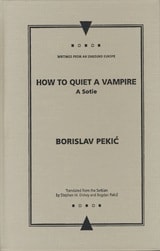
cover of How to Quiet a Vampire: A Sotie

How to Quiet a Vampire

A Sotie

Borislav Pekic

Northwestern University Press, 2005

The disquieting novel How to Quiet a Vampire is a rumination on terror and intellect in the tradition of Joseph Heller and George Steiner. Published to acclaim in 1977, Pekic's novel of ideas follows Konrad Rutkowski, professor of medieval history and former Gestapo officer, as he returns to the scene of his war crimes determined to renounce, or perhaps justify, his Nazi past. In a series of letters, Rutkowski lays out his ambivalent reactions to war and violence, connecting his own swirling ideas to those of the major figures of European thought: Plato, St. Augustine, Descartes, Nietzsche, Freud, and others.

Delving far deeper than mere intellect, however, Borislav Pekic was himself a frequent political agitator and occasional prisoner, and he drew on his first hand knowledge of police methods and life under totalitarianism to paint a chilling portrait of a supposedly free-thinking intellectual acting in the service of repression. At the same time he questions whether Rutkowski's ideology puts him outside the philosophical tradition he so admires—or if the line separating European thought from totalitarianism is not as clear as we like to think.
[more]
cover of The Living Dead: A Study of the Vampire in Romantic Literature

The Living Dead

A Study of the Vampire in Romantic Literature

James B. Twitchell

Duke University Press, 1981

In his Preface to The Living Dead: A Study of the Vampire in Romantic Literature, James Twitchell writes that he is not interested in the current generation of vampires, which he finds "rude, boring and hopelessly adolescent. However, they have not always been this way. In fact, a century ago they were often quite sophisticated, used by artists varied as Blake, Poe, Coleridge, the Brontes, Shelley, and Keats, to explain aspects of interpersonal relations. However vulgar the vampire has since become, it is important to remember that along with the Frankenstein monster, the vampire is one of the major mythic figures bequeathed to us by the English Romantics. Simply in terms of cultural influence and currency, the vampire is far more important than any other nineteenth-century archetypes; in fact, he is probably the most enduring and prolific mythic figure we have. This book traces the vampire out of folklore into serious art until he stabilizes early in this century into the character we all too easily recognize.
[more]
cover of The Monster with a Thousand Faces: Guises of the Vampire in Myth and Literature

The Monster with a Thousand Faces

Guises of the Vampire in Myth and Literature

Brian J. Frost

University of Wisconsin Press, 1989
Brian Frost chronicles the history of the vampire in myth and literature, providing a sumptuous repast for all devotees of the bizarre. In a wide-ranging survey, including plot summaries of hundreds of novels and short stories, the reader meets an amazing assortment of vampires from the pages of weird fiction, ranging from the 10,000-year-old femme fatale in Robert E. Howard’s Conan the Conqueror to the malevolent fetus in Eddy C. Bertin’s “Something Small, Something Hungry.” Nostalgia buffs will enjoy a discussion of the vampire yarns in the pulp magazines of the interwar years, while fans of contemporary vampire fiction will also be sated.
[more]
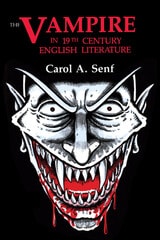
cover of The Vampire in Nineteenth Century English Literature

The Vampire in Nineteenth Century English Literature

Carol A. Senf

University of Wisconsin Press, 1988
Carol A. Senf traces the vampire’s evolution from folklore to twentieth-century popular culture and explains why this creature became such an important metaphor in Victorian England. This bloodsucker who had stalked the folklore of almost every culture became the property of serious artists and thinkers in Victorian England, including Charlotte and Emily Brontë, George Eliot, Charles Dickens, Karl Marx, and Friedrich Engels. People who did not believe in the existence of vampires nonetheless saw numerous metaphoric possibilities in a creature from the past that exerted pressure on the present and was often threatening because of its sexuality.
[more]
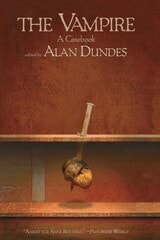
cover of The Vampire: A Casebook

The Vampire

A Casebook

Edited by Alan Dundes

University of Wisconsin Press, 1998

    Vampires are the most fearsome and fascinating of all creatures of folklore. For the first time, detailed accounts of the vampire and how its tradition developed in different cultures are gathered in one volume by eminent folklorist Alan Dundes. Eleven leading scholars from the fields of Slavic studies, history, anthropology, and psychiatry unearth the true nature of the vampire from its birth in graveyard lore to the modern-day psychiatric patient with a penchant for drinking blood.
    The Vampire: A Casebook takes this legend out of the realm of literature and film and back to its dark beginnings in folk traditions. The essays examine the history of the word “vampire;” Romanian vampires; Greek vampires; Serbian vampires; the physical attributes of vampires; the killing of vampires; and the possible psychoanalytic underpinnings of vampires. Much more than simply a scary creature of the human imagination, the vampire has been and continues to haunt the lives of all those who encounter it—in reality or in fiction.

[more]