Results by title
4 books match the query 'Vampire films'
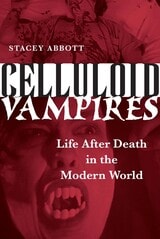
Celluloid Vampires
Life After Death in the Modern WorldBy Stacey Abbott
University of Texas Press, 2007
In 1896, French magician and filmmaker George Méliès brought forth the first celluloid vampire in his film Le manoir du diable. The vampire continues to be one of film's most popular gothic monsters and in fact, today more people become acquainted with the vampire through film than through literature, such as Bram Stoker's classic Dracula. How has this long legacy of celluloid vampires affected our understanding of vampire mythology? And how has the vampire morphed from its folkloric and literary origins?
In this entertaining and absorbing work, Stacey Abbott challenges the conventional interpretation of vampire mythology and argues that the medium of film has completely reinvented the vampire archetype. Rather than representing the primitive and folkloric, the vampire has come to embody the very experience of modernity. No longer in a cape and coffin, today's vampire resides in major cities, listens to punk music, embraces technology, and adapts to any situation. Sometimes she's even female.
With case studies of vampire classics such as Nosferatu, Martin, Blade, and Habit, the author traces the evolution of the American vampire film, arguing that vampires are more than just blood-drinking monsters; they reflect the cultural and social climate of the societies that produce them, especially during times of intense change and modernization. Abbott also explores how independent filmmaking techniques, special effects makeup, and the stunning and ultramodern computer-generated effects of recent films have affected the representation of the vampire in film.

Stage Blood
Vampires of the 19th Century StageRoxana Stuart
University of Wisconsin Press, 1994
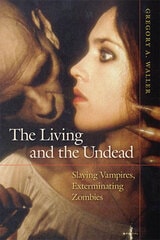
The Living and the Undead
Slaying Vampires, Exterminating ZombiesGregory A. Waller
University of Illinois Press, 2010
Examining a broad range of novels, stories, plays, films, and made-for-television movies, Waller focuses upon a series of interrelated texts: Bram Stoker's Dracula (1897); several film adaptations of Stoker's novel; F. W. Murnau's Nosferatu, A Symphony of Horror (1922); Richard Matheson's I Am Legend (1954); Stephen King's 'Salem's Lot (1975); Werner Herzog's Nosferatu the Vampyre (1979); and George Romero's Night of the Living Dead (1968) and Dawn of the Dead (1979). All of these works, Waller argues, speak to our understanding and fear of evil and chaos, of desire and egotism, of slavish dependence and masterful control. This paperback edition of The Living and the Undead features a new preface in which Waller positions his analysis in relation to the explosion of vampire and zombie films, fiction, and criticism in the past twenty-five years.
Vampire Lectures
Laurence A. Rickels
University of Minnesota Press, 1999
A wild and wide-ranging “psycho-history” of the vampire.
A wild and wide-ranging “psycho-history” of the vampire.
Bela Lugosi may-as the eighties gothic rock band Bauhaus sang-be dead, but the vampire lives on. A nightmarish figure dwelling somewhere between genuine terror and high camp, a morbid repository for the psychic projections of diverse cultures, an endlessly recyclable mass-media icon, the vampire is an enduring object of fascination, fear, ridicule, and reverence. In The Vampire Lectures, Laurence A. Rickels sifts through the rich mythology of vampirism, from medieval folklore to Marilyn Manson, to explore the profound and unconscious appeal of the undead.Based on the course Rickels has taught at the University of California, Santa Barbara, for several years (a course that is itself a cult phenomenon on campus), The Vampire Lectures reflects Rickels’s unique lecture style and provides a lively history of vampirism in legend, literature, and film. Rickels unearths a trove that includes eyewitness accounts of vampire attacks; burial rituals and sexual taboos devised to keep vampirism at bay; Hungarian countess Elisabeth Bathory’s use of girls’ blood in her sadistic beauty regimen; Bram Stoker’s Dracula, with its turn-of-the-century media technologies; F. W. Murnau’s haunting Nosferatu; and crude, though intense, straight-to-video horror films such as Subspecies. He makes intuitive, often unexpected connections among these sometimes wildly disparate sources.More than a compilation of vampire lore, however, The Vampire Lectures makes an original and intellectually rigorous contribution to literary and psychoanalytic theory, identifying the subconscious meanings, complex symbolism, and philosophical arguments-particularly those of Marx, Freud, and Nietzsche-embedded in vampirism and gothic literature.ISBN 0-8166-3391-6 Cloth £34.50 $49.95xxISBN 0-8166-3392-4 Paper £14.00 $19.95376 Pages 5 7/8 x 9 SeptemberTranslation inquiries: University of Minnesota Press