Results by title
3 books match the query 'Vargas Llosa, Mario'
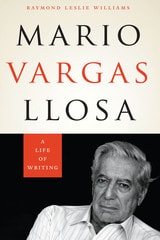
Mario Vargas Llosa
A Life of WritingBy Raymond Leslie Williams
University of Texas Press, 2014
Awarded the Nobel Prize in 2010 at the age of seventy-four, Peruvian writer Mario Vargas Llosa has held pivotal roles in the evolution and revolutions of modern Latin American literature. Perhaps surprisingly, no complete history of Vargas Llosa’s works, placed in biographical and historical context, has been published—until now. A masterwork from one of America’s most revered scholars of Latin American fiction, Mario Vargas Llosa: A Life of Writing provides a critical overview of Vargas Llosa’s numerous novels while reinvigorating debates regarding conventional interpretations of the work.
Weaving analysis with discussions of the writer’s political commentary, Raymond Leslie Williams traces the author’s youthful identity as a leftist student of the 1960s to a repudiation of some of his earlier ideas beginning in the 1980s. Providing a unique perspective on the complexity, nuance, and scope of Vargas Llosa’s lauded early novels and on his passionate support of indigenous populations in his homeland, Williams then turns his eye to the recent works, which serve as a bridge between the legacies of the Boom and the diverse array of contemporary Latin American fiction writers at work today. In addition, Williams provides a detailed description of Vargas Llosa’s traumatic childhood and its impact on him—seen particularly in his lifelong disdain for authority figures—as well as of the authors who influenced his approach, from Faulkner to Flaubert. Culminating in reflections drawn from Williams’s formal interviews and casual conversations with the author at key phases of both men’s careers, this is a landmark publication that will spark new lines of inquiry into an intricate body of work.
Mario Vargas Llosa
Public Intellectual in Neoliberal Latin AmericaJuan E. De Castro
University of Arizona Press, 2011
The idea of a sitting president debating a novelist may seem surprising to readers unfamiliar with Latin American politics, but Vargas Llosa has enjoyed considerable influence in the political arena, thanks in no small part to his run for the Peruvian presidency in 1990. Though he was awarded the Nobel Prize in 2010 for his literary achievements, he is as well known in the Spanish-speaking world for his political columns as he is for his novels. In his widely syndicated political pieces, Vargas Llosa asserts a position he calls “liberal” in the classical sense of affirming the importance of a free market and individual rights, though as De Castro argues, he has often aligned himself with groups that emphasize the former at the expense of the latter.
What makes Vargas Llosa’s rise to political prominence compelling is “not only that he is still a vibrantly active writer, but that he was at the time of the beginning of his rise to literary fame, and throughout the 1960s, a staunch defender of the Cuban Revolution.” While his early literary output seemed to proclaim an allegiance with the Left, Vargas Llosa was soon to take a right turn that De Castro argues was anticipatory and representative of the Latin American embrace of the free market in the 1990s. Understanding Vargas Llosa’s political thought is thus of more than biographical interest. It is a key to understanding the social and cultural shifts that have taken place not only in Peru but throughout Latin America.
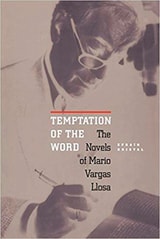
Temptation of the Word
The Novels of Mario Vargas LlosaEfrain Kristal
Vanderbilt University Press, 1998
Temptation of the Word offers an ambitious and careful reading of the creative process--the origin of themes and the development of literary techniques--that Mario Vargas Llosa has brought to each of his novels, published through 1996. To understand the novelist's intellectual environment, Efrain Kristal analyzes the entire corpus of Vargas Llosa's writings, his literary influences in several languages, his intellectual biography, and his political activism, all in the light of the evolving political turbulence of his times and his own changing concept of literature.