Results by title
2 books match the query 'Vaughan, Michael'

Henri Bergson’s Creative Evolution 100 Years Later
Special Issue of SubStance, Issue 114, 36:3 (2007)Michael Kolkman
University of Wisconsin Press, 2007
This special issue of SubStance (2007) celebrates the centennial of Henri Bergson’s Creative Evolution, published in 1907. Since evolution is a living process and not a completed history, any understanding of it must necessarily be open-ended. If no one can have the last word, Bergson writes, the project of understanding evolution “will only be built up by the collective and progressive effort of many thinkers, of many observers also, completing, correcting and improving one another.”
Included in the issue are articles from Bergson scholars from the United States, Japan, France and Great Britain. Topics in the issue range from Bergson’s encounters with Darwin, Nietzsche, Derrida and Deleuze, and from the analytical to the metaphysical.
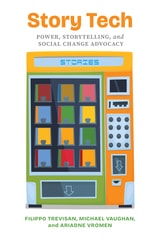
Story Tech
Power, Storytelling, and Social Change AdvocacyFilippo Trevisan, Michael Vaughan, and Ariadne Vromen
University of Michigan Press, 2025
Story Tech explores the increasingly influential impact of technologies—such as databases, algorithms, and digital story banks—that are usually invisible to the public. It shows that hidden “story tech” enables political organizations to treat stories as data that can be queried for storylines and used to intervene in news and information cycles in real time. In particular, the authors review successful story-centered campaigns that helped change dominant narratives on disability rights, marriage equality, and essential workers’ rights in the United States and Australia. They compare the use of storytelling advocacy across different types of organizations including volunteer grassroots groups, large national advocacy coalitions, and trade unions, and examine how trends differ for storytellers, organizers, and their technology partners. As political stories shift to being “on demand,” they reshape power relationships in key public debates in ways that produce moments of tension as well as positive narrative change. Story Tech examines these trends and illustrates how storytelling success can—and should—be achieved in conjunction with personal dignity, privacy, and empowerment for storytellers and their communities, particularly marginalized ones.