Results by title
7 books match the query 'Veil'
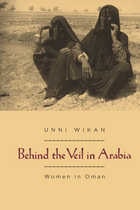
Behind the Veil in Arabia
Women in OmanUnni Wikan
University of Chicago Press, 1991
Through photographs and detailed case histories, Unni Wikan explores the strict segregation of women, the wearing of the burqa mask, the elaborate nuptial rituals, and the graceful quality of Oman's social relations.
"Wikan does provide insights into the real position of these secluded and segregated women. . . . All this is interesting and valuable."—Ahdaf Soueif, Times Literary Supplement
"The book is detailed, insightful, and . . . engrossing. Anyone interested in the day-to-day triumphs and sorrows of women who live 'behind the veil' will want to read this account."—Arab Book World
"Wikan, a fine ethnographer, has an eye for everything that is distinctive about the culture and . . . builds up a wholly convincing picture. Above all, there is a sustained attempt to penetrate the inner lives of these strangely serene people."—Frank H. Stewart, Wilson Quarterly
"This book will certainly be of interest to all scholars concerned with sexual identity in the Islamic world."—Henry Munson, American Anthropologist
[more]

Beneath the Veil of the Strange Verses
Reading Scandalous TextsJeremiah L. Alberg
Michigan State University Press, 2013
Jeremiah Alberg’s fascinating book explores a phenomenon almost every news reader has experienced: the curious tendency to skim over dispatches from war zones, political battlefields, and economic centers, only to be drawn in by headlines announcing a late-breaking scandal. Rationally we would agree that the former are of more significance and importance, but they do not pique our curiosity in quite the same way. The affective reaction to scandal is one both of interest and of embarrassment or anger at the interest. The reader is at the same time attracted to and repulsed by it. Beneath the Veil of the Strange Verses describes the roots out of which this conflicted desire grows, and it explores how this desire mirrors the violence that undergirds the scandal itself. The book shows how readers seem to be confronted with a stark choice: either turn away from scandal completely or become enthralled and thus trapped by it. Using examples from philosophy, literature, and the Bible, Alberg leads the reader on a road out of this false dichotomy. By its nature, the author argues, scandal is the basis of our reading; it is the source of the obstacles that prevent us from understanding what we read, and of the bridges that lead to a deeper grasp of the truth.
[more]
Beyond the Veil of Knowledge
Triangulating Security, Democracy, and Academic ScholarshipPiki Ish-Shalom
University of Michigan Press, 2019
Is there a need to remodel constructivism to be more politically attuned? Author Piki Ish-Shalom calls for an activist academy that engages society and the polity to prevent the watering down of democracy, while helping to create a space for criticism. In this book, he suggests several concrete measures for this engagement within three spheres: individual theoretical work, the academic community as a whole, and within society and the polity. Beyond the Veil of Knowledge suggests that essentially contested concepts are a key medium that politicians use to try to minimize public resistance to their political goals. For constructivists, this means that the social construction of both social knowledge and the social world can be understood as the sociopolitical construction of knowledge and the sociopolitical world.
[more]

From Behind the Veil
A STUDY OF AFRO-AMERICAN NARRATIVERobert B. Stepto
University of Illinois Press, 1991
This pioneering study of Afro-American narrative is far more critical, historical, and textual than biographical, chronological, and atextual. Robert Stepto asserts that Afro-American culture has its store of canonical stories or pregeneric myths, the primary one being the quest for freedom and literacy. This second edition includes a new preface and an afterward entitled "Distrust of the Reader in Afro-American Narratives."
[more]
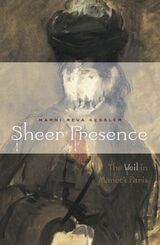
Sheer Presence
The Veil in Manet’s ParisMarni Reva Kessler
University of Minnesota Press, 2006
Tamar’s instrument of seduction in the Hebrew Bible, Penelope’s shroud in Homer’s Odyssey, accessory of brides as well as widows, and hallmark of the religious and the wealthy, the veil has historically been an intriguing signifier. Initially donned in France for liturgical purposes and later for masked balls and as a sun- and windscreen at the seashore, face-covering veils were adopted for fashionable urban use during the reign of Napoleon III. In Sheer Presence, Marni Reva Kessler demonstrates how this ubiquitous garment and its visual representations knot together many of the precepts of Parisian life. Considering the period from the beginning of Napoleon III’s rule in 1852 to 1889, when the Paris Universal Exhibition displayed veiled North African Muslims and other indigenous colonial peoples, Kessler deftly connects the increased presence of the veil on the streets and on canvas to Haussmann’s massive renovation of Paris. The fashion of veil wearing, she argues, was imbricated with broader concerns: fears of dust and disease fueled by Haussmannization and class mixing on the city streets, changes in ideals of youth and beauty, attempts to increase popular support for imperialism, and the development of modernist art practices. A veil was protection for the proper woman from the vices associated with the modern city, preserving—at least on the surface—her femininity and class superiority. Kessler explores these themes with close readings of paintings by Gustave Caillebotte, Edgar Degas, and Edouard Manet—including Manet’s perplexing portraits of artist Berthe Morisot—as well as photographs, images from the popular press, engravings, lithographs, and academic paintings. She also mines French fashion journals, etiquette books, novels, and medical publications for clues to the veil’s complex meanings during the period.Positioning the veil directly at the intersection of feminist, formalist, and social art history, Kessler offers a fresh perspective on period discourses of public health, seduction and sexuality, colonial stereotypes, and, ultimately, an emerging modernity.Marni Reva Kessler is assistant professor of art history at the University of Kansas.
[more]

The Poetics and Politics of the Veil in Iran
An Archival and Photographic AdventureAzadeh Fatehrad
Intellect Books, 2019
This volume explores the lives of women in Iran through the social, political, and aesthetic contexts of veiling, unveiling, and re-veiling. Through poetic writings and photographs, Azadeh Fatehrad responds to the legacy of the Iranian Revolution via the representation of women in photography, literature, and film. The images and texts are documentary, analytical, and personal.
The Poetics and Politics of the Veil in Iran features Fatehrad’s own photographs in addition to work by artists Hengameh Golestan, Shirin Neshat, Shadi Ghadirian, Abbas Kiarostami, Mohsen Makhmalbaf, Adolf Loos, Gaëtan Gatian de Clérambault, and Alison Watt. In exploring women’s lives in post-revolutionary Iran, Fatehrad considers the role of the found image and the relationship between the archive and the present, resulting in an illuminating history of feminism in Iran in the twentieth and twenty-first centuries.
The Poetics and Politics of the Veil in Iran features Fatehrad’s own photographs in addition to work by artists Hengameh Golestan, Shirin Neshat, Shadi Ghadirian, Abbas Kiarostami, Mohsen Makhmalbaf, Adolf Loos, Gaëtan Gatian de Clérambault, and Alison Watt. In exploring women’s lives in post-revolutionary Iran, Fatehrad considers the role of the found image and the relationship between the archive and the present, resulting in an illuminating history of feminism in Iran in the twentieth and twenty-first centuries.
[more]
Veil and Burn
Laurie Clements Lambeth
University of Illinois Press, 2007
Concerned with physical experience, pain, and disability, Veil and Burn illuminates an intense desire to feel through the Other, embrace it, become it, and in the transformation, to understand the suffering body. In poems about animals, artifacts, and monsters, Lambeth displays a fascination for all bodies while exploring their pain, common fate, alienation, and abilities. Hovering between poem and prose fragment, between the self and fellow creatures, Laurie Clements Lambeth celebrates physical sensation, imbuing it with lyric shape, however broken, however imprisoned the shape may be.
[more]