Results by title
2 books match the query 'Venezuela's Bolivarian Revolution'
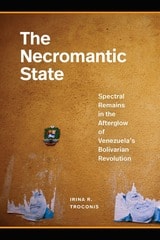
The Necromantic State
Spectral Remains in the Afterglow of Venezuela's Bolivarian RevolutionIrina R. Troconis
Duke University Press, 2025
In the spring of 2013, televisions across Venezuela announced the death of then-president Hugo Chávez, leader of the Bolivarian Revolution and key political actor in Latin America’s “turn to the left.” Chávez’s death, however, was not the end of Chávez’s life. In The Necromantic State, Irina R. Troconis examines how Chávez, as a “specter,” has lingered in Venezuela’s public, private, and digital spaces. Focusing on contemporary Venezuela and drawing from a diverse corpus that includes tattoos, toys, memes, graffiti, and a hologram haunting the streets of downtown Caracas, Troconis contends that, in moments of failed transitions, political tensions, and crises of legitimacy, the state brings the dead back to life to negotiate the terms of its survival. By showing how this necromantic performance enables the state’s material and visual manifestations in public and private spaces, Troconis untangles a sociopolitical moment in which the ghostly acts as the affective, social, and political force that grounds state authority and ensures the preservation of the status quo, as it circumscribes acts of political imagination and limits popular resistance.
[more]
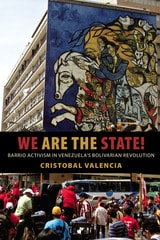
We Are the State!
Barrio Activism in Venezuela’s Bolivarian RevolutionCristobal Valencia
University of Arizona Press, 2015
Chavistas are the local leaders and activists in Venezuela’s Bolivarian Revolution, working to establish democracy through government-sponsored social missions, community self-governance, and popular collectives. We Are the State! tells the story of their grassroots activism. In perspectives gleaned from participant observation with barrio residents in workplaces, communal kitchens, city-wide forums, and grassroots meetings and assemblies, as well as family and recreational events, anthropologist Cristobal Valencia vividly recounts tensions between activists, local officials, and the wealthy opposition.
The author offers an anthropological analysis of the state, social movements, and democracy as lived experiences of the poor, gendered, and racialized residents of two parishes in Caracas, Venezuela, and Afro-Venezuelan communities nearby. Ethnographic research reveals the shift in relationships of power and the evolving political practices among the Chavistas, the Chávez government, and the opposition. Examining the subjective experiences of barrio residents in everyday processes of state formation, this book provides a new perspective on the Chavistas, arguing that they are a broad-based social movement and driving force behind a revolution struggling to transfer state power to organized civil society.
Through his intense engagement with the constantly changing social, political, and economic dynamics, Valencia dramatically challenges top-down understandings of the state and power in Venezuela. He shows the unequal relationships between sectors of civil society, and he shows state formation as a process enmeshed in the struggles for social justice, demonstrating that the state is a sociopolitical entity that acts through civil society, rather than above it.
[more]