Results by title
4 books match the query 'Vergara, Camilo José'

Evoking Newark
Fifty YearsCamilo José Vergara
Rutgers University Press, 2027
Evoking Newark is a systematic photographic documentation of Newark, NJ, from 1977-2024. This project creates a flexible framework for tracing Newark’s evolution. In this ambitious volume, award-winning photographer Camilo José Vergara creates an indelible record of the city, beginning along its most important commercial thoroughfares, such as Broad, Market, Springfield Ave., Clinton Ave., Central Ave., and MLK Jr. Blvd. He also takes a closer look at landmarks as well as more modest buildings whose folksy character caught his eye. As an urban documentary photographer, Vergara frequently returned to re-photograph Newark in order to track changes over time. For almost fifty years, he identified multiple street intersections that were particularly revealing settings for charting developments in the city.
Vergara examines in particular the slow renewal of these main thoroughfares, the demolition of high-rise housing projects, the ruination and clearing of industrial sites, the building of multi-family houses in once-vacant lots, and the construction of skyscrapers and cultural institutions. To complete the project, he added photos of graffiti and murals that comment on local and national events celebrating African American and Hispanic heroes and heroines and memorials remembering the dead. With these efforts at careful documentation, Brick City demonstrates the usefulness of a time-based documentary approach to the study of post-industrial urban areas. The photographs are accompanied by detailed captions about the locations portrayed, and in many cases by Vergara's own observations and transcripts of his interviews with local people as well as overheard conversations. The photos and captions are one way of telling us that “this happened,” and a means of refreshing the memories of viewers who have experienced Newark generations ago--recollections that contribute to their sense of identity.
Harlem
The Unmaking of a GhettoCamilo José Vergara
University of Chicago Press, 2013
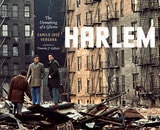
Photographer Camilo José Vergara has been chronicling the neighborhood for forty-three years, and Harlem: The Unmaking of a Ghetto is an unprecedented record of urban change. Vergara began his documentation of Harlem in the tradition of such masters as Helen Levitt and Aaron Siskind, and he later turned his focus on the neighborhood’s urban fabric, both the buildings that compose it and the life and culture embedded in them. By repeatedly returning to the same locations over the course of decades, Vergara is able to show us a community that is constantly changing—some areas declining, as longtime businesses give way to empty storefronts, graffiti, and garbage, while other areas gentrify, with corporate chain stores coming in to compete with the mom-and-pops. He also captures the ever-present street life of this densely populated neighborhood, from stoop gatherings to graffiti murals memorializing dead rappers to impersonators honoring Michael Jackson in front of the Apollo, as well as the growth of tourism and racial integration.
Woven throughout the images is Vergara’s own account of his project and his experience of living and working in Harlem. Taken together, his unforgettable words and images tell the story of how Harlem and its residents navigated the segregation, dereliction and slow recovery of the closing years of the twentieth century and the boom and racial integration of the twenty-first century. A deeply personal investigation, Harlem will take its place with the best portrayals of urban life.
How the Other Half Worships
Camilo José Vergara
Rutgers University Press, 2005
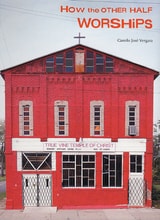
Domestically and abroad, America is known as the richest country in the world. It is hard not to be impressed by the standard of living in the nation’s most affluent suburban and urban neighborhoods. Yet, scattered amid stretches that abound in wealth, the country is home to neighborhoods rife with violence, poverty, segregation, and decay. Within these blighted urban landscapes, however, there is at least one notable example of plenty: churches. They do not always appear as traditional houses of worship, but often emerge from the retrofitted shells of former storefronts, garages, factories, warehouses, domestic dwellings, and public institutions. Regardless of the façade, churches populate America’s poorest neighborhoods.
Bringing together more than 300 richly textured color photographs and a series of candid interviews with pastors, church officials, and congregation members, this extraordinary book explores the conditions, beliefs, and practices that shape the churches and the lives of the nation’s urban poor. Over a period of thirty years, sociologist and photographer Camilo José Vergara repeatedly visited these places of worship and the eclectic mix of buildings that house them. In twenty-one cities located in ten states across the country, photographic sequences coupled with insightful narrative show how ordinary structures assume, modify, and shed a religious character, how traditional churches—if they fail to adapt to new congregations—are demolished, and how new churches are designed and built from the ground up.
Vergara pays special attention to the objects, texts, and imagery that religious leaders make use of to create environments that inspire devotion. Pastors of developing congregations often arrive as crusaders, with missions that cannot be served by traditional religious iconography, and with budgets that force them to use inexpensive materials. In some cases, pastors bring objects of worship from their home towns in places such as Mexico, Puerto Rico, Africa, and the West Indies. Despite the idiosyncratic features and folk decoration that distinguish ghetto churches from one another, however, Vergara shows that, for the most part, they are driven by similar religious agendas. They tend to preach about resilience, avoid involving themselves in national and international events, and consider their truths to be absolute and eternal.
A powerful, poignant, and visually arresting portrait, How the Other Half Worships stands as a stark witness to how churches are being rebuilt in the dilapidated streets of America’s cities and how religion is being reinvented by the nation’s poor.
The Street
A Photographic Field Guide to American InequalityNaa Oyo A. Kwate
Rutgers University Press, 2021
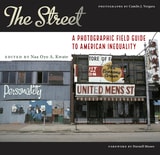
Using MacArthur fellow Camilo José Vergara’s intimate street photographs of Camden, New Jersey as reference points, the essays in this collection analyze these images within the context of troubled histories and misguided policies that have exacerbated racial and economic inequalities. Rather than blaming Camden’s residents for the blighted urban landscape, the multidisciplinary array of scholars contributing to this guide reveal the oppressive structures and institutional failures that have led the city to this condition. Tackling topics such as race and law enforcement, gentrification, food deserts, urban aesthetics, credit markets, health care, childcare, and schooling, the contributors challenge conventional thinking about what we should observe when looking at neighborhoods.