Results by title
4 books match the query 'Veterans' writings, American'
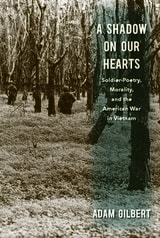
A Shadow on Our Hearts
Soldier-Poetry, Morality, and the American War in VietnamAdam Gilbert
University of Massachusetts Press, 2018
The soldier-poets provide important insights into the ethical dimensions of their physical and psychological surroundings before, during, and after the war. They also offer profound perspectives on the relationships between American soldiers and the Vietnamese people. From firsthand experiences, they reflect on what it meant to be witnesses, victims, and perpetrators of the war's violence. And they advance an uncompromising vision of moral responsibility that indicts a range of culprits for the harms caused by the conflict. Gilbert explores the powerful and perceptive work of these soldier-poets through the lens of morality and presents a radically alternative, deeply personal, and ethically penetrating account of the American war in Vietnam.
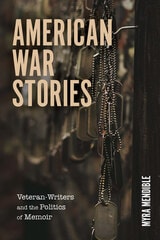
American War Stories
Veteran-Writers and the Politics of MemoirMyra Mendible
University of Massachusetts Press, 2021
American War Stories centers on an extensive selection of memoirs written by veterans of the Vietnam, Iraq, and Afghanistan conflicts—including Brian Turner's My Life as a Foreign Country, Marcus Luttrell's Lone Survivor, and Camilo Mejia's Road from ar Ramadi—to explore the complex relationship between memory and politics in the context of postmodern war. Placing veterans' stories in conversation with broader cultural and political discourses, Myra Mendible analyzes the volatile mix of agendas, identities, and issues informing veteran-writers' narrative choices to argue that their work plays an important, though underexamined, political function in how Americans remember and judge their wars.
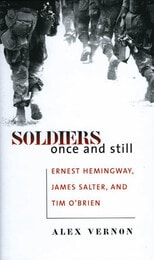
Soldiers Once and Still
Ernest Hemingway, James Salter, and Tim O'BrienAlex Vernon
University of Iowa Press, 2007
Hemingway, Salter, and O’Brien form the core of Soldiers Once and Still because each represents a different warring generation of twentieth-century America: World War I with Hemingway, World War II and Korea with Salter, and Vietnam with O’Brien. Each author also represents a different literary voice of the twentieth century, from modern to mid-century to postmodern, and each presents a different battlefield experience: Hemingway as noncombatant, Salter as air force fighter pilot, and O’Brien as army grunt.
War’s pervasive influence on the individual means that, for veterans-turned-writers like Hemingway, Salter, and O’Brien, the war experience infiltrates their entire body of writing—their works can be seen not only as war literature but also as veterans’ literature. As such, their entire postwar oeuvre, regardless of whether an individual work explicitly addresses the war or the military, is open to Vernon’s exploration of war, society, gender, and literary history.
Vernon’s own experiences as a soldier, a veteran, a writer, and a critic inform this enlightening critique of American literature, offering students and scholars of American literature and war studies an invaluable tool for understanding war’s effects on the veteran writer and his society.
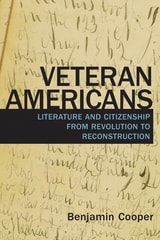
Veteran Americans
Literature and Citizenship from Revolution to ReconstructionBenjamin Cooper
University of Massachusetts Press, 2018
“I may dare to speak, and I intend to speak and write what I think,” wrote a New York volunteer serving in the Mexican War in 1848. Such sentiments of resistance and confrontation run throughout the literature produced by veteran Americans in the nineteenth century—from prisoner-of-war narratives and memoirs to periodicals, adventure pamphlets, and novels. Military men and women were active participants in early American print culture, yet they struggled against civilian prejudice about their character, against shifting collective memories that removed military experience from the nation's self-definition, and against a variety of headwinds in the uneven development of antebellum print culture.
In this new literary history of early American veterans, Benjamin Cooper reveals how soldiers and sailors from the Revolutionary War through the Civil War demanded, through their writing, that their value as American citizens and authors be recognized. Relying on an archive of largely understudied veteran authors, Cooper situates their perspective against a civilian monopoly in defining American citizenship and literature that endures to this day.