Results by title
3 books match the query 'Vice-Presidential candidates'

Call Me Tom
The Life of Thomas F. EagletonJames N. Giglio
University of Missouri Press, 2011
Born in St. Louis, Eagleton began his public career in 1956 as St. Louis Circuit Attorney. At 27, he was the youngest person in the history of the state to hold that position, and he duplicated the feat in his next two elected positions, attorney general in 1960 and lieutenant governor in 1964. In 1968, he was elected to the U.S. Senate, where he served until 1987. He was thrown into the national spotlight in 1972 when revelations regarding his mental health, particularly the shock treatments he received for depression, forced his resignation as a vice presidential nominee of the Democratic Party. All of that would overshadow his significant contributions as senator, especially on environmental and social legislation, as well as his defense of Congressional authority on war making and his role in the U. S. military disengagement from Southeast Asia in 1973.
Respected biographer James N. Giglio provides readers with an encompassing and nuanced portrait of Eagleton by placing the man and his career in the context of his times. Giglio allows readers to see his rumpled suits, smell the smoke of his Pall Mall cigarettes, hear his gravelly voice, and relish his sense of humor. At the same time, Giglio does not shy away from the personal torments that Eagleton had to overcome. A definitive examination of the senator’s career also reveals his unique ability to work with Republican counterparts, especially prior to the 1980s when bipartisanship was more possible.
Measuring the effect his mental illness had on his career, Giglio determines that the removal of aspirations for higher office in 1972 made Eagleton a better senator. He consistently took principled stands, with the ultimate goal of preserving and modernizing the agenda of Franklin D. Roosevelt, his favorite president.
Thoroughly researched using the Eagleton Papers and interviews with more than eighty-five people close to Eagleton, including family, friends, colleagues, subordinates, and former classmates, Call Me Tom offers an engaging and in-depth portrayal of a man who remained a devoted public servant throughout his life.

Ferraro
My StoryGeraldine Ferraro with Linda Bird Francke and with a foreword by Marie Wilson
Northwestern University Press, 2004
Ferraro's run for vice-president was an important moment in American history. The time is right for telling a new generation this story of women's collective political power and the difference women office holders can and do make to public policy.
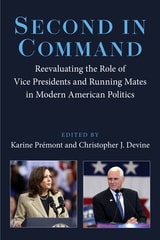
Second in Command
Reevaluating the Role of Vice Presidents and Running Mates in Modern American PoliticsEdited by Karine Prémont and Christopher J. Devine
University of Michigan Press, 2026
In recent years, the office of the vice president has become a focal point of presidential politics and governance. From the emergence of the modern vice presidency under Walter Mondale to Mike Pence’s and Kamala Harris’s dramatic influence on the outcome of the 2020 election, Second in Command explores how vice presidents and vice-presidential candidates have shaped the direction of the country and changed American politics. The frenzy of speculation surrounding the “veepstakes” every four years and extensive media coverage of the vice-presidential debate may seem odd, given the vice presidency’s limited constitutional powers and dismal public reputation.
Dispelling the myth that the vice presidency is a powerless or merely ceremonial role, Second in Command draws on the multidisciplinary expertise of more than a dozen leading vice-presidential scholars to reveal the complex, consequential, and often misunderstood nature of the office. With accessible language and vivid examples, it traces the transformation of vice-presidential power over the past half-century, reveals the evolving electoral significance of vice-presidential running mates, and highlights the need for a deeper public understanding of these pivotal figures. Chapters employ a range of qualitative and quantitative methodologies, including elite interviews, archival research, case studies, and advanced statistical modeling to cover topics such as gender and media effects in running mate selection and the representation of vice presidents in popular culture. This book offers a fresh, engaging, and essential perspective on a vital institution at the heart of American democracy.