Results by title

19 books match the query 'Victoria History'

cover of The Victoria History of Essex: Harwich, Dovercourt and Parkeston in the 19th Century

The Victoria History of Essex

Harwich, Dovercourt and Parkeston in the 19th Century

Andrew Senter Andrew Morrell

University of London Press, 2019

Exploring the changing character of Harwich, Dovercourt and Parkeston through the course of the 19th century, included in this book is the economic, social and political history of the borough. The book provides an overview of the development of areas such as education, religion, public health with a strong focus on Harwich’s maritime history. The borough of Harwich, including the parish of Dovercourt, lies in the far north east corner of Essex. Its coastal location as a natural harbour at the mouth of the Orwell river dictated that Harwich had a prominent role as a port and naval base from the 14th century onwards. In the 19th century Harwich retained its military function, particularly during the Napoleonic and Crimean wars. The port declined economically as a result of losing the continental packet service in the 1830s, but it was rejuvenated by the opening of the railway in 1854. Dovercourt grew as a residential area and seaside resort in the second half of the 19th century, although the rest of the parish retained much of its traditional agricultural character. The opening of the port at nearby Parkeston in 1883 led to a rapid growth in both passenger traffic and trade to and from the continent.
[more]
cover of The Victoria History of Essex: Newport

The Victoria History of Essex

Newport

Edited by Anthony Tuck

University of London Press, 2015

The parish of Newport lies in the valley of the river Cam in north-west Essex about three and a half miles south-west of the market town of Saffron Walden, and a short distance from the Hertfordshire and Cambridgeshire borders. It probably originated in the early 10th century as a royal foundation, and it soon developed some urban features such as a market. Its position on an important through route between London and East Anglia gave it a more varied character than some of its neighbouring villages, and the coming of the railway in the 19th century led to the establishment of a gas works and maltings. Even so, it remained a largely agricultural community until the mid 20th century, but thereafter its position as a thoroughfare village helped to establish Newport as a community with most of its adult population finding work elsewhere, some in London.

This book explores the varying character of Newport over eleven centuries. It examines the changing patterns of landownership, social structure and economy of the village and its institutions, not least its 16th-century grammar school. It also discusses the part played, especially in the 18th, 19th and 20th centuries, by the owners of Shortgrove Hall, within the parish, and Quendon Hall, a few miles to the south.
[more]
cover of The Victoria History of Essex: Southend: Victorian Town and Resort

The Victoria History of Essex

Southend: Victorian Town and Resort

Ken Crowe

University of London Press, 2025

The story of Southend’s growth as a town and resort in the Victorian and Edwardian periods is told here in this new history of Southend.

As the nearest seaside resort to London, the town’s development has been determined in large part by the impact of its seasonal visitors. Yet it was the year-round movement of people from other parts of Essex, England and from the European continent in the late-nineteenth and early-twentieth-centuries that was to have a lasting effect on the character of the town.

Richly illustrated and drawing from original sources, this volume offers new perspectives on the developments that laid the foundations of Southend as we know it today. Its thematic chapters chart the physical expansion of housing in the period and the development of the resort’s infrastructure and economy, among other topics. Although concentrating on Southend and its resort, chapters on agricultural depression and land speculation, education, clubs and societies and unemployment expand the book’s regional focus to neighbouring areas, making this valuable reading for anyone interested in the history of Essex and the UK’s seaside towns.

[more]
cover of The Victoria History of Gloucestershire: Cheltenham Before the Spa

The Victoria History of Gloucestershire

Cheltenham Before the Spa

Edited by Alex Craven and with Beth Hartland

University of London Press, 2018

The familiar image of Cheltenham, a large and prosperous former spa town, world-famous on account of its Georgian and Regency architecture, its festivals and educational establishments, masks an earlier history. While numerous descriptions of the town have been published over the years, most say little about the many centuries of its existence before the 1740s, when it began to develop as a fashionable resort. This is the fullest account ever attempted to chronicle those centuries, from the late Saxon period until the 18th century. In this period, Cheltenham developed into a successful small town, ranged along a single main street, with the market and trades serving not only its own needs but also those of the surrounding countryside. It draws on a range of documentary sources preserved in local and national archives, many of them never examined in detail before. It therefore helps to explain the foundations upon which present-day Cheltenham was constructed.
[more]
cover of The Victoria History of Gloucestershire: Yate

The Victoria History of Gloucestershire

Yate

Rose Wallis

University of London Press, 2015

Yate is a town in South Gloucestershire, north-east of Bristol. Its ancient parish extended across a largely flat vale, which until the 13th century lay within Horwood forest, and was then cleared, inclosed and farmed as rich pasture by the tenants of the influential owners of its three manors. A limestone ridge fringing the vale provided good building stone, and across the parish seams of coal and a rare mineral - celestine - have been exploited until recent times. Yate lay on an important early route between Bristol and Oxford, and its mineral wealth attracted early railway links, so that it was well placed for industrial development. Bristol-based industries moved there during the decades after 1900, including wartime aviation production, so that Yate's population and housing began to increase.

During the 1950s a 'new town' plan was devised which carefully controlled Yate's expansion, and included pioneering housing estate design, diverse industrial development and a large and progressive shopping mall. Yate's boundaries were redrawn in 1988, and the population of this vibrant, modern town now exceeds 20,000.
[more]
cover of The Victoria History of Hampshire: Cliddesden, Hatch and Farleigh Wallop

The Victoria History of Hampshire

Cliddesden, Hatch and Farleigh Wallop

Alison Deveson and Sue Lane

University of London Press, 2018

Tracing the history of two small, closely-linked parishes which lie to the south of Basingstoke on the edge of the chalk downlands, and a third parish, Hatch (abandoned towards the end of the 14th century and has formed part of both of the others), Cliddesden, Hatch and Farleigh Wallop is the latest publication from the Victoria County History of Hampshire project. Each settlement has a common manorial descent from the 15th century onwards and they were managed as components of a single estate under the lordship of the Wallop family from their seat at Farleigh House. This volume discusses the manorial owners and the development of the estate, and also includes much more about the lives and activities of ordinary people living and working in the settlements.   Religious and social history of the area is covered and the survival of an unusually full set of records has enabled the history of the school to be told in detail. This, coupled with lively tales of social activities, provides a fascinating picture of rural life as it was and as it has become in the 21st century – largely a home for commuters, with Hatch absorbed into an ever-growing Basingstoke and farming undertaken from one centre across nearly all the land.   Published by the Institute of Historical Research at the University of London, this is the fourth volume from the Victoria County History of Hampshire following Mapledurwell, Steventon and Basingstoke: a Medieval Town c.1000–c.1600. Each title provides a scholarly account of individual villages and towns of interest to their inhabitants, those in the wider area and to those beyond Hampshire itself.
[more]
cover of The Victoria History of Hampshire: Mapledurwell

The Victoria History of Hampshire

Mapledurwell

John Hare, Jean Morrin, and Stan Waight

University of London Press, 2015

Eastnor is the first parish history to be produced by the Trust for the Victoria County History of Herefordshire, and complements some of the work on Ledbury undertaken for the Heritage Lottery-funded England’s Past for Everyone project between 2005 and 2009. In its expanded treatment of the parish history, emphasising the economy and society of the parish as well as landownership and religious life, Eastnor is modelled on the first individual VCH parish history to be published, that of Mapledurwell, Hampshire, in 2012. Eastnor lies at the southern end of the Malvern Hills and has always been an agricultural parish. In the 19th and 20th centuries it was dominated by the Castle, built between 1812 and 1820, and by its owners, the Somers Cocks family, Barons and later Earls Somers, and their descendants. The Somers Cocks owned most of the land in the parish and employed many of its inhabitants, and this ownership saved the parish and its many timber-framed houses from modern development. In earlier centuries the pattern of land ownership was very different; at the time of Domesday Book the bishop of Hereford’s manor covered the whole parish. From the later Middle Ages the owners of small freeholds extended their holdings, so that in the 16th and 17th centuries several gentry families owned small estates in the parish. In the course of the 18th century these were bought up by the Somers Cocks family. This book explores, using the extensive archival records, how these changes in land ownership affected the inhabitants of the parish and the way in which the land was farmed.
[more]
cover of The Victoria History of Hampshire: Medieval Basingstoke

The Victoria History of Hampshire

Medieval Basingstoke

John Hare

University of London Press, 2017

Basingstoke is frequently seen as a very modern town, the product of the last decades of the 20th century. In reality it has a long, rich and prosperous history. From its beginnings c.1000 it became a significant market centre for the area around, and a place on the route to London from the west. By 1500 it was among the top 60 towns in England by wealth and taxpayers, and the centre of a major industrial area, whose manufactured cloths formed part of international patterns of trade. Moreover, it is well documented particularly for the 15th and 16th century, when it was at its peak, and should provide a useful addition to the limited number of studies of small medieval towns. Much of the old town has been swept away by the shopping centre, but something of the medieval footprint survives in its street beyond this, in a few surviving buildings and above all in its magnificent church. This book examines these features as well as the families, whether outsiders or locals, who made the most of the new thriving economic conditions, and whose dynamism helped create the town’s expansion.
[more]
cover of The Victoria History of Hampshire: Steventon

The Victoria History of Hampshire

Steventon

Jean Morrin

University of London Press, 2016

Steventon, a chalkland village near Basingstoke, is best known because Jane Austen, the famous novelist and daughter of the local rector, spent the first 25 years of her life here. Unlike Chawton and Bath, no house or museum commemorates the author’s memory in Steventon but this new history explains how family life and observation of north Hampshire society shaped her early literary career. She wrote early versions of Pride and Prejudice, Sense and Sensibility and Northanger Abbey in Steventon from 1796 to 1798, drawing on local society for inspiration for characters, manners and sentiments.

But the village had a rich history before and after its famous novelist and there are many other reasons to enjoy this book. Steventon is a typical southern chalkland settlement whose history provides examples of downland agriculture, of agricultural improvements, a scandalous landlord who was driven out of the village by his son and excommunicated by the archbishop of Canterbury, a new Victorian manor house, of landlord–tenant relations and much else. It discusses the social, economic and religious lives of the ordinary people of the village together with the lords of the manor.

This is the second parish history to be published by the new Victoria History of Hampshire group, providing scholarly studies of individual places. It should be of interest to those living in and beyond the county. The first new parish history by the group, Mapledurwell, was published in 2012.
[more]
cover of The Victoria History of Herefordshire: Colwall

The Victoria History of Herefordshire

Colwall

James Bowen

University of London Press, 2020

This book provides a detailed history of the English village of Colwall, including its geography, economy, infrastructure, industry, and population. Colwall lies on the western slopes of the Malvern Hills, near the market town of Ledbury. The large village comprises Colwall Stone, Upper Colwall, and Colwall Green.

Discussing well-known landmarks, such as the Iron Age British Camp and the nearby mineral springs, this local history provides a narrative of the village’s development through the age of the landed gentry between the fifteenth and seventeenth centuries, the agricultural era of the eighteenth century, and the development of a spa economy in the mid-nineteenth century. Industrialization changed the town, with new railway infrastructure, tunnels, and the 1892 opening of the Schweppes bottling plant at Colwall Stone. Today, Colwall’s rural location and beautiful scenery continue to attract both visitors and new residents to the town, making this text a valuable resource for tourists and locals alike.
[more]
cover of The Victoria History of Herefordshire: Cradley

The Victoria History of Herefordshire

Cradley

Anastasia Stylianou and Fergus Eskola-Oakes

University of London Press, 2025

Scenic and rural, the parish of Cradley stretches down westwards from the Malvern Hills, bordered by Worcestershire to the north and east. It is one of the largest parishes in Herefordshire, and from the medieval period to the nineteenth century was populous and prosperous. Cradley manor was a valuable holding of the medieval bishops of Hereford. The ecclesiastical benefice, Anglo-Saxon in origin, was equally lucrative, frequently passing nepotistically to well-connected young priests; however, such connections did not prevent one thirteenth-century rector being outlawed for murder! The expanding number of manors in the parish, from the thirteenth century onwards, resulted in a fragmented model of land ownership and the development of a powerful body of wealthy yeomanry, shaping the distinctive character of the parish and its governance in the early modern period.

Drawing extensively on local archival sources, this volume analyses, among other topics, the centrality of agriculture to the parish's story, charting Cradley's socio-economic growth from the sixteenth to nineteenth centuries, before its subsequent decline. As such, this book constitutes an important contribution to English local history, exploring the prosperity that could be enjoyed by parishes in fertile Eastern Herefordshire, and the impact of changes in the national economy upon rural, agrarian communities.

[more]
cover of The Victoria History of Herefordshire: Eastnor

The Victoria History of Herefordshire

Eastnor

Janet Cooper

University of London Press, 2013

Eastnor is the first parish history to be produced by the Trust for the Victoria County History of Herefordshire, and complements some of the work on Ledbury undertaken for the Heritage Lottery-funded England’s Past for Everyone project between 2005 and 2009. In its expanded treatment of the parish history, emphasising the economy and society of the parish as well as landownership and religious life, Eastnor is modelled on the first individual VCH parish history to be published, that of Mapledurwell, Hampshire, in 2012. Eastnor lies at the southern end of the Malvern Hills and has always been an agricultural parish. In the 19th and 20th centuries it was dominated by the Castle, built between 1812 and 1820, and by its owners, the Somers Cocks family, Barons and later Earls Somers, and their descendants. The Somers Cocks owned most of the land in the parish and employed many of its inhabitants, and this ownership saved the parish and its many timber-framed houses from modern development. In earlier centuries the pattern of land ownership was very different; at the time of Domesday Book the bishop of Hereford’s manor covered the whole parish. From the later Middle Ages the owners of small freeholds extended their holdings, so that in the 16th and 17th centuries several gentry families owned small estates in the parish. In the course of the 18th century these were bought up by the Somers Cocks family. This book explores, using the extensive archival records, how these changes in land ownership affected the inhabitants of the parish and the way in which the land was farmed.
[more]
cover of The Victoria History of Leicestershire: Buckminster and Sewstern

The Victoria History of Leicestershire

Buckminster and Sewstern

Pamela J. Fisher

University of London Press, 2017

Buckminster and Sewstern, in north-east Leicestershire, are two small villages within a single parish, and although both were established before 1086, they have developed different characters. Buckminster was purely an agricultural village until the 1790s, when Sir William Manners enlarged a small park, built a mansion and began to create an estate village. Many of the houses are of red brick, and were built for estate employees by the 9th earl of Dysart between 1878 and 1935, as part of a programme of village improvements. All the land, residential and commercial properties in Buckminster were held in 2017 by the Tollemache family, descendants of Sir William and Lord Dysart. In contrast, Sewstern’s houses are individual in character, and mostly built from local limestone. Before the 20th century, many had large paddocks to the rear. The village is near the presumed ancient route known as Sewstern Lane, and a wide range of trades were followed between the 14th and 19th centuries, until the age of the railways ended the passing trade. Land in both villages was quarried for ironstone in the 20th century, then reinstated for farmland, resulting in fields that are several feet below the level of the roads and property curtilages. This book explores the similarities and differences between the two villages over more than a thousand years of recorded history.  
[more]
cover of The Victoria History of Leicestershire: Castle Donington

The Victoria History of Leicestershire

Castle Donington

Pamela J. Fisher and J.M. Lee

University of London Press, 2016
The parish of Castle Donington  in north-west Leicestershire lies on the south bank of the river Trent, 20 miles north-west of Leicester and 8 miles south-east of Derby. A nucleated village developed on the present site more than 1,000 years ago. A castle was built in the 1150s, and several features of a town soon developed, including a market, fair and hospital. Secondary settlements grew up alongside the Trent, by the King’s Mills and at Cavendish Bridge, the site of an important medieval ferry. Donington Park, which originated in the early 13th century as a hunting park, became a separate estate of the earls of Huntingdon in the late 16th century. Later history has been shaped by strong religious nonconformity and the growth and then decline of traditional industries in the 18th and 19th centuries. Since then, modern transport links, including East Midlands Airport in the south of the parish, have delivered new employment opportunities. Castle Donington in the early 21st century is thriving. Many people travel in daily to work, and thousands more visit the motor-racing circuit at Donington Park and other leisure attractions each year, yet few know of the parish’s rich history. This book, the first in the Leicestershire VCH series since 1964, examines the changing patterns of landscape, landownership, working lives, social structure and religious worship in Castle Donington across many centuries, and includes the settlements at King’s Mills and Cavendish Bridge. It will be of interest to local residents, visitors, family and local historians.
[more]
cover of The Victoria History of Leicestershire: Lutterworth

The Victoria History of Leicestershire

Lutterworth

Pamela J. Fisher

University of London Press, 2022

This volume in the Victoria County History series centers on the town of Lutterworth.
 
From before the Norman Conquest to the development of the jet engine, this volume tells the history of Lutterworth, a small market town in the southwest of Leicestershire. A combination of factors ensured the town’s success, including its position linking the rich agricultural land of south Leicestershire with the Warwickshire Arden and its natural resources of wood and coal. Lutterworth also played a role on the national stage, first in 1428, when the bones of the town rector, the theologian John Wyclif, were disinterred and desecrated on the instructions of the Pope. Lutterworth also made headlines between 1937 and 1942, when Frank Whittle developed the jet engine in a disused foundry in the town.

This book focuses on the people of Lutterworth and the roles they played in shaping the economy, schools, hospitals, churches, and the social life of the community. The evolution and development of the town are described in these pages, from its humble beginnings to the challenges it faces today.
[more]
cover of The Victoria History of Middlesex: Knightsbridge and Hyde

The Victoria History of Middlesex

Knightsbridge and Hyde

Pamela Taylor

University of London Press, 2017

entirely wrongly) Kensington?
[more]
cover of The Victoria History of Middlesex: St Clement Danes, 1660-1900

The Victoria History of Middlesex

St Clement Danes, 1660-1900

Edited by Francis Boorman

University of London Press, 2018

. This period was one of rapid urban transformation in the parish, as the large aristocratic riverside houses of the 17th century gave way to a bustling centre of commerce and culture in the 18th. The slums that developed in the 19th century were then swept away by the grand constructions of the Royal Courts of Justice and the Victoria Embankment, followed by the new thoroughfares of Aldwych and Kingsway, which are still the major landmarks in the area. Characterised by its contrasts, St Clement Danes was home to a mix of rich and poor residents, including lawyers, artisans, servants and prostitutes. The history of this fascinating area introduces a cast of characters ranging from the Twinings tea-trading family, to the rowdy theatre-going butchers of Clare Market and from the famous Samuel Johnson, to the infamous pornographers of Holywell Street. This book also unpicks the complicated structure of local government in the parish, and provides detailed accounts of the parish schools and charities.
[more]
cover of The Victoria History of Middlesex: St George Hanover Square

The Victoria History of Middlesex

St George Hanover Square

Francis Calvert Boorman

University of London Press, 2024

A compact history of the parish of St George Hanover Square in London.

The parish of St George Hanover Square encompasses the wealthy London neighborhoods of Mayfair, Belgravia, and Pimlico, as well as part of Hyde Park. This book relates the history of the parish, from its inception in 1725 to its abolition with the establishment of the London County Council in 1900. The area was transformed through rapid urbanization from largely undeveloped fields on the western fringe of London into one of the most affluent parts of the metropolis, with developments centered on a series of grand squares, including Hanover, Grosvenor, and Belgrave Squares. Through detailed thematic treatments, the book explores the local government of the vestry, as well as institutions such as schools and charities and St George’s Hospital, which is now based in South London. The wider political culture and the economy of the parish are also given their due, from the aristocrats and servants of Mayfair to the industries on the bank of the Thames, including factories and a distillery. Finally, it covers the religious life of the parish, the erection of new churches and chapels, and its division into ecclesiastical parishes and subdistricts as its population boomed in the nineteenth century.
[more]
cover of The Victoria History of Shropshire: Wem

The Victoria History of Shropshire

Wem

Judith Ann Everard and James Bowen

University of London Press, 2020

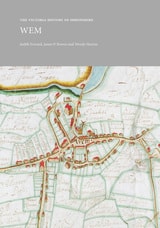
The township of Wem lies on the North Shropshire Plain, about nine miles north of Shrewsbury. The centre of a much larger medieval manor and parish, the township consists of the small medieval market town and its immediate rural hinterland. Anglo-Saxon settlements existed in the area but the town developed from a Norman foundation, with a castle, parish church, market and water mill. The urban area of the township, ‘within the bars’, was distinguished from the rural, ‘without the bars’. Burgages were laid out, with a customary borough-hold tenure, but the borough never attained corporate status. Isolated from the main regional transport routes, Wem developed as a local centre of government and trade in agricultural produce, especially cheese. It was thrust onto the national stage in 1642 when Parliamentarians defeated a Royalist attack and held the town for the duration of the Civil War. The ‘great fire’ of 1677 then destroyed most of the medieval buildings in the town centre, leading to its predominantly Georgian and Victorian appearance today. The decline in agricultural employment and the withdrawal of services and industries from small market towns like Wem in recent decades is a challenge, met by the advantage of the railway station to residents who work elsewhere but choose the town as a place to live.
[more]