Results by title
5 books match the query 'Victorian Britain'
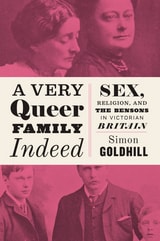
A Very Queer Family Indeed
Sex, Religion, and the Bensons in Victorian BritainSimon Goldhill
University of Chicago Press, 2016
“We can begin with a kiss, though this will not turn out to be a love story, at least not a love story of anything like the usual kind.”
So begins A Very Queer Family Indeed, which introduces us to the extraordinary Benson family. Edward White Benson became Archbishop of Canterbury at the height of Queen Victoria’s reign, while his wife, Mary, was renowned for her wit and charm—the prime minister once wondered whether she was “the cleverest woman in England or in Europe.” The couple’s six precocious children included E. F. Benson, celebrated creator of the Mapp and Lucia novels, and Margaret Benson, the first published female Egyptologist.
What interests Simon Goldhill most, however, is what went on behind the scenes, which was even more unusual than anyone could imagine. Inveterate writers, the Benson family spun out novels, essays, and thousands of letters that open stunning new perspectives—including what it might mean for an adult to kiss and propose marriage to a twelve-year-old girl, how religion in a family could support or destroy relationships, or how the death of a child could be celebrated. No other family has left such detailed records about their most intimate moments, and in these remarkable accounts, we see how family life and a family’s understanding of itself took shape during a time when psychoanalysis, scientific and historical challenges to religion, and new ways of thinking about society were developing. This is the story of the Bensons, but it is also more than that—it is the story of how society transitioned from the high Victorian period into modernity.
[more]
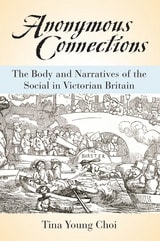
Anonymous Connections
The Body and Narratives of the Social in Victorian BritainTina Young Choi
University of Michigan Press, 2016
Anonymous Connections asks how the Victorians understood the ethical, epistemological, and biological implications of social belonging and participation. Specifically, Tina Choi considers the ways nineteenth-century journalists, novelists, medical writers, and social reformers took advantage of spatial frames-of-reference in a social landscape transforming due to intense urbanization and expansion. New modes of transportation, shifting urban demographics, and the threat of epidemics emerged during this period as anonymous and involuntary forms of contact between unseen multitudes. While previous work on the early Victorian social body have tended to describe the nineteenth-century social sphere in static political and class terms, Choi’s work charts new critical terrain, redirecting attention to the productive—and unpredictable—spaces between individual bodies as well as to the new narrative forms that emerged to represent them. Anonymous Connections makes a significant contribution to scholarship on nineteenth-century literature and British cultural and medical history while offering a timely examination of the historical forebears to modern concerns about the cultural and political impact of globalization.
[more]
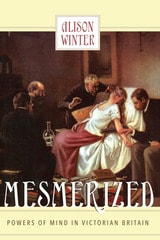
Mesmerized
Powers of Mind in Victorian BritainAlison Winter
University of Chicago Press, 1998
Across Victorian Britain, apparently reasonable people twisted into bizarre postures, called out in unknown languages, and placidly bore assaults that should have caused unbearable pain all while they were mesmerized. Alison Winter's fascinating cultural history traces the history of mesmerism in Victorian society. Mesmerized is both a social history of the age and a lively exploration of the contested territory between science and pseudo-science.
"Dazzling. . . . This splendid book . . . gives us a new form of historical understanding and a model for open and imaginative reading."—James R. Kinkaid, Boston Globe
"A landmark in the history of science scholarship."—John Sutherland, The Independent
"It is difficult to imagine the documentary side of the story being better done than by Winter's well-researched and generously illustrated study. . . . She is a lively and keen observer; and her book is a pleasure to read purely for its range of material and wealth of detail. . . . Fruitful and suggestive."—Daniel Karlin, Times Literary Supplement
"An ambitious, sweeping and fascinating historical study. . . . Beautifully written, thoroughly researched, and well-illustrated."—Bernard Lightman, Washington Times
[more]
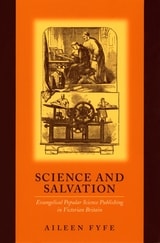
Science and Salvation
Evangelical Popular Science Publishing in Victorian BritainAileen Fyfe
University of Chicago Press, 2004
Threatened by the proliferation of cheap, mass-produced publications, the Religious Tract Society issued a series of publications on popular science during the 1840s. The books were intended to counter the developing notion that science and faith were mutually exclusive, and the Society's authors employed a full repertoire of evangelical techniques—low prices, simple language, carefully structured narratives—to convert their readers. The application of such techniques to popular science resulted in one of the most widely available sources of information on the sciences in the Victorian era.
A fascinating study of the tenuous relationship between science and religion in evangelical publishing, Science and Salvation examines questions of practice and faith from a fresh perspective. Rather than highlighting works by expert men of science, Aileen Fyfe instead considers a group of relatively undistinguished authors who used thinly veiled Christian rhetoric to educate first, but to convert as well. This important volume is destined to become essential reading for historians of science, religion, and publishing alike.
A fascinating study of the tenuous relationship between science and religion in evangelical publishing, Science and Salvation examines questions of practice and faith from a fresh perspective. Rather than highlighting works by expert men of science, Aileen Fyfe instead considers a group of relatively undistinguished authors who used thinly veiled Christian rhetoric to educate first, but to convert as well. This important volume is destined to become essential reading for historians of science, religion, and publishing alike.
[more]
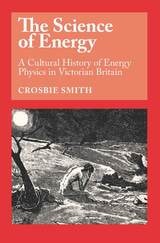
The Science of Energy
A Cultural History of Energy Physics in Victorian BritainCrosbie Smith
University of Chicago Press, 1999
Although we take it for granted today, the concept of "energy" transformed nineteenth-century physics. In The Science of Energy, Crosbie Smith shows how a North British group of scientists and engineers, including James Joule, James Clerk Maxwell, William and James Thomson, Fleeming Jenkin, and P. G. Tait, developed energy physics to solve practical problems encountered by Scottish shipbuilders and marine engineers; to counter biblical revivalism and evolutionary materialism; and to rapidly enhance their own scientific credibility.
Replacing the language and concepts of classical mechanics with terms such as "actual" and "potential" energy, the North British group conducted their revolution in physics so astutely and vigorously that the concept of "energy"—a valuable commodity in the early days of industrialization—became their intellectual property. Smith skillfully places this revolution in its scientific and cultural context, exploring the actual creation of scientific knowledge during one of the most significant episodes in the history of physics.
Replacing the language and concepts of classical mechanics with terms such as "actual" and "potential" energy, the North British group conducted their revolution in physics so astutely and vigorously that the concept of "energy"—a valuable commodity in the early days of industrialization—became their intellectual property. Smith skillfully places this revolution in its scientific and cultural context, exploring the actual creation of scientific knowledge during one of the most significant episodes in the history of physics.
[more]