Results by title
6 books match the query 'Victorian Culture'
Death in the Dining Room and Other Tales of Victorian Culture
Kenneth Ames
Temple University Press, 1995
Fictions of Affliction
Physical Disability in Victorian CultureMartha Stoddard Holmes
University of Michigan Press, 2010
Grand Designs
Labor, Empire, and the Museum in Victorian CultureLara Kriegel
Duke University Press, 2007
Drawing on a wide range of sources, including museum guidebooks, design manuals, illustrated newspapers, pattern books, and government reports, Kriegel brings to life the many Victorians who claimed a stake in aesthetic reform during the middle years of the nineteenth century. The aspiring artists who attended the Government School of Design, the embattled provincial printers who sought a strengthened industrial copyright, the exhibition-going millions who visited the Crystal Palace, the lower-middle-class consumers who learned new principles of taste in metropolitan museums, and the working men of London who critiqued the city’s art and design collections—all are cast by Kriegel as leading cultural actors of their day. Grand Designs shows how these Victorians vied to upend aesthetic hierarchies in an imperial age and, in the process, to refashion London’s public culture.
Impossible Purities
Blackness, Femininity, and Victorian CultureJennifer DeVere Brody
Duke University Press, 1998
Opening with a reading of Daniel Defoe’s “A True-Born Englishman,” which posits the mixed origins of English identity, Brody goes on to analyze mulattas typified by Rhoda Swartz in William Thackeray’s Vanity Fair, whose mixed-race status reveals the “unseemly origins of English imperial power.” Examining Victorian stage productions from blackface minstrel shows to performances of The Octoroon and Uncle Tom’s Cabin, she explains how such productions depended upon feminized, “black” figures in order to reproduce Englishmen as masculine white subjects. She also discusses H.G. Wells’s The Island of Dr. Moreau in the context of debates about the “new woman,” slavery, and fears of the monstrous degeneration of English gentleman. Impossible Purities concludes with a discussion of Bram Stoker’s novella, “The Lair of the White Worm,” which brings together the book’s concerns with changing racial representations on both sides of the Atlantic.
This book will be of interest to scholars in Victorian studies, literary theory, African American studies, and cultural criticism.
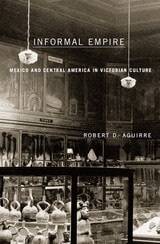
Informal Empire
Mexico And Central America In Victorian CultureRobert D. Aguirre
University of Minnesota Press, 2004
Behind the ancient artifacts exhibited in our museums lies a secret past—of travel, desire, the quest for knowledge, and even theft. Such is the case with the objects of Mesoamerican culture so avidly collected, cataloged, and displayed by the British in the nineteenth century. Informal Empire recaptures the history of those artifacts from Mexico and Central America that stirred Victorian interest—a history that reveals how such objects and the cultures they embodied were incorporated into British museum collections, panoramas, freak shows, adventure novels, and records of imperial administrators.
Robert D. Aguirre draws on a wealth of previously untapped historical information to show how the British colonial experience in Africa and the Near East gave rise to an “informal imperialism” in Mexico and Central America. Aguirre’s work helps us to understand what motivated the British to beg, borrow, buy, and steal from peripheral cultures they did not govern. With its original insights, Informal Empire points to a new way of thinking about British imperialism and, more generally, about the styles and forms of imperialism itself.
Raw Material
Producing Pathology in Victorian CultureErin O'Connor
Duke University Press, 2000
O’Connor focuses on how four particularly troubling physical conditions were represented in a variety of literature. She begins by exploring how Asiatic cholera, which reached epidemic proportions on four separate occasions between 1832 and 1865, was thought to represent the dangers of cultural contamination and dissolution. The next two chapters concentrate on the problems breast cancer and amputation posed for understanding gender. After discussing how breast cancer was believed to be caused by the female body’s intolerance to urban life, O'Connor turns to men’s bodies, examining how new prosthetic technology allowed dismembered soldiers and industrial workers to reconstruct themselves as productive members of society. The final chapter explores how freak shows displayed gross deformity as the stuff of a new and improved individuality. Complicating an understanding of the Victorian body as both a stable and stabilizing structure, she elaborates how Victorians used disease as a messy, often strategically unintelligible way of articulating the uncertainties of chaotic change. Over the course of the century, O’Connor shows, the disfiguring process of disease became a way of symbolically transfiguring the self. While cholera, cancer, limb loss, and deformity incapacitated and even killed people, their dramatic symptoms provided opportunities for imaginatively adapting to a world where it was increasingly difficult to determine not only what it meant to be human but also what it meant to be alive.
Raw Material will interest an audience of students and scholars of Victorian literature, cultural history, and the history of medicine.