Results by title
8 books match the query 'Victorian England'
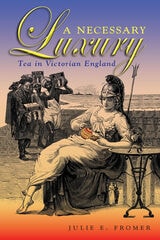
A Necessary Luxury
Tea in Victorian EnglandJulie E. Fromer
Ohio University Press, 2008
In A Necessary Luxury: Tea in Victorian England, Julie E. Fromer analyzes tea histories, advertisements, and nine Victorian novels, including Alice’s Adventures in Wonderland, Wuthering Heights, and Portrait of a Lady. Fromer demonstrates how tea functions within the literature as an arbiter of taste and middle-class respectability, aiding in the determination of class status and moral position. She reveals the way in which social identity and character are inextricably connected in Victorian ideology as seen through the ritual of tea.
Drawing from the fields of literary studies, cultural studies, history, and anthropology, A Necessary Luxury offers in-depth analysis of both visual and textual representations of the commodity and the ritual that was tea in nineteenth-century England.

After the Pre-Raphaelites
Art and Aestheticism in Victorian EnglandElizabeth Prettejohn
Rutgers University Press, 1999
Victorian Aestheticism has often been traded as a frivolous elevation of art above the concerns of political and social life. This book reinterprets Aestheticism as a significant exploration of what it might mean to produce works of art in the modern world. The chapters address not only "art for art's sake" but also linkages with the realms of science and morality. A major concern is the relationship between art and sexuality, from the experiments of the Rossetti circle in the 1860s to the male nude in late-Victorian sculpture. Both homosexual and heterosexual eroticism emerge as key issues in the artistic debates of the late-Victorian period.
As a complement to the existing literature on Pre-Raphaelitism, this collection is essential reading for all students of nineteenth-century art, literature, and culture.
Contributors are: Caroline Arscott, Robyn Asleson, Colin Cruise, Whitney Davis, Kate Flint, Alastair Grieve, Michael Hatt, Anne Koval, Alison Smith, and Robin Spencer
Dying to Know
Scientific Epistemology and Narrative in Victorian EnglandGeorge Levine
University of Chicago Press, 2002
In Dying to Know, eminent critic George Levine makes a landmark contribution to the history and theory of scientific knowledge. This long-awaited book explores the paradoxes of our modern ideal of objectivity, in particular its emphasis on the impersonality and disinterestedness of truth. How, asks Levine, did this idea of selfless knowledge come to be established and moralized in the nineteenth century?
Levine shows that for nineteenth-century scientists, novelists, poets, and philosophers, access to the truth depended on conditions of such profound self-abnegation that pursuit of it might be taken as tantamount to the pursuit of death. The Victorians, he argues, were dying to know in the sense that they could imagine achieving pure knowledge only in a condition where the body ceases to make its claims: to achieve enlightenment, virtue, and salvation, one must die.
Dying to Know is ultimately a study of this moral ideal of epistemology. But it is also something much more: a spirited defense of the difficult pursuit of objectivity, the ethical significance of sacrifice, and the importance of finding a shareable form of knowledge.
Hebrew and Hellene in Victorian England
Newman, Arnold, and PaterBy David DeLaura
University of Texas Press, 1969
Hebrew and Hellene explores the intellectual and personal relations among John Henry Newman, Matthew Arnold, and Walter Pater, three figures important in the development of nineteenth-century English thought and culture. Fundamentally concerned with the humanistic vision of Arnold and Pater, especially as they adapted the traditional religious culture to the needs of their generation, David DeLaura also recognizes Newman's central role. To a far greater degree than has been realized, Newman assumed a commanding position in the thought of the two younger men.
DeLaura seeks to define the mechanics of the process by which the conservative religious humanism of Newman could be exploited in the fluid, relativistic, and "aesthetic" humanism of Pater. The careers of Arnold and Pater are viewed as a continuing effort to reconcile the opposing forces of one of the central modern myths, the great cultural struggle between religious and secular values—Arnold's Hebraism and Hellenism.
DeLaura traces this important movement in nineteenth-century culture by studying the development of key phrases and ideas in the writings of the three men: the secularization of Newman's ideal of "inwardness" in Arnold's "criticism" and "culture" and in Pater's "impassioned contemplation"; the shared emphasis on an elite culture; the growing tendency to identify culture with the functions of traditional religion.
Newman, as the supreme apologist of both religious orthodoxy and the older Oxonian tradition, offered a rich arsenal to the defenders of a literary culture increasingly threatened by the utilitarian spirit (!nd by a rising scientific naturalism. Moreover, with the appearance of his Apologia in 1864, the "mystery" and the "miracle" of Newman's personality intrigued a new literary generation.
In Hebrew and Hellene DeLaura looks beyond the debates of the Late Victorians, the immediate inheritors of this legacy, to the continuing twentieth-century discussion of the nature of literature, its place in the humanizing process, and its role in a science-dominated civilization. He finds the problems faced by Pater, Arnold, and Newman—and some of their solutions—surprisingly relevant to unfinished contemporary debate.
Home Economics
Domestic Fraud in Victorian EnglandRebecca Stern
The Ohio State University Press, 2008
In Home Economics: Domestic Fraud in Victorian England, Rebecca Stern establishes fraud as a basic component of the Victorian popular imagination, key to its intimate, as well as corporate, systems of exchange. Although Victorian England is famous for revering the domestic realm as a sphere separate from the market and its concerns, actual households were hardly isolated havens of fiscal safety and innocence. Rather, the Victorian home was inevitably a marketplace, a site of purchase, exchange, and employment in which men and women hired or worked as servants, contracted marriages, managed children, and obtained furniture, clothing, food, and labor. Alongside the multiplication of joint-stock corporations and the rise of a credit-based economy, which dramatically increased fraud in the Victorian money market, the threat of swindling affected both actual household commerce and popular conceptions of ostensibly private, more emotive forms of exchange. Working with diverse primary material, including literature, legal cases, newspaper columns, illustrations, ballads, and pamphlets, Stern argues that the climate of fraud permeated Victorian popular ideologies about social transactions. Beyond providing a history of cases and categories of domestic deceit, Home Economics illustrates the diverse means by which Victorian culture engaged with, refuted, celebrated, represented, and consumed swindling in familial and other household relationships.
PLOTS OF OPPORTUNITY
REPRESENTING CONSPIRACY IN VICTORIAN ENGLANDAlbert D. Pionke
The Ohio State University Press, 2004
The working classes, colonial subjects, European nationalists, and Roman Catholics—these groups generated intense anxiety for Victorian England’s elite public, which often responded by accusing them of being dangerous conspirators. Bringing together a wide range of literary and historical evidence, Albert D. Pionke argues that the pejorative meanings attached to such opportunistic accusations of conspiracy were undermined by the many valorized versions of secrecy in Victorian society.
After surveying England’s evolving theories of representative politics and individual and collective secretive practices, Pionke traces the intersection of democracy and secrecy through a series of case histories. Using works by Thomas Carlyle, Wilkie Collins, Charles Dickens, Benjamin Disraeli, John Henry Newman, and others, along with periodicals, histories, and parliamentary documents of the period, he shows the rhetorical prominence of groups such as the Freemasons, the Thugs, the Carbonari, the Fenians, and the Jesuits in Victorian democratic discourse.
By highlighting the centrality of representations of conspiracy in every case, Plots of Opportunity shows for the first time the markedly similar strategies of repression, resistance, and concealment used by competing agents in the democracy debate.
Political Descent
Malthus, Mutualism, and the Politics of Evolution in Victorian EnglandPiers J. Hale
University of Chicago Press, 2014
These two traditions, Hale shows, developed in a context of mutual hostility, debate, and refutation. Participants disagreed not only about evolutionary processes but also on broader questions regarding the kind of creature our evolution had made us and in what kind of society we ought therefore to live. Significantly, and in spite of Darwin’s acknowledgement that natural selection was “the doctrine of Malthus, applied to the whole animal and vegetable kingdoms,” both sides of the debate claimed to be the more correctly “Darwinian.” By exploring the full spectrum of scientific and political issues at stake, Political Descent offers a novel approach to the relationship between evolution and political thought in the Victorian and Edwardian eras.

The Mind and Art of Victorian England
Josef L. Altholz, Editor
University of Minnesota Press, 1976
The Mind and Art of Victorian England was first published in 1976. Minnesota Archive Editions uses digital technology to make long-unavailable books once again accessible, and are published unaltered from the original University of Minnesota Press editions.
In a series of ten essays and a generous selection of illustrations, many in color, this volume depicts and assesses the mind and art of Victorian England. Multidisciplinary in approach, the essays deal with a variety of aspects in the history of the Victorian age.
Professor Altholz, the volume editor, writes: "It was an age not of revolution but of reform; political reform which admitted first the middle and then the working classes to the dominant share of the suffrage; economic and social reforms which proclaimed the triumph of laissez-faire while laying the foundations of the welfare state; moral reforms attempted if not achieved through education and religious revival; aesthetic reforms proposed if not achieved and, even in their failure, adding to the richness and diversity of Victorian England. It was an age whose problems cried out for reform; and, despite the prevailing complacency, virtually all the great Victorians were critics of their age. Their criticisms were diverse and often mutually incompatible, with each other -- and their public -- but they shared a high seriousness which gave character and substance to the flowering of their culture. Such was the Victorian age: the high-water mark of English history, the maturation of British culture, and the seedbed of our problems and our discontents."
The illustrations include color reproductions of some of the works discussed by Melvin Waldfogel in his essay "Narrative Painting," and a selection of architectural engravings and photographs.