Results by title
2 books match the query 'Victorian London'
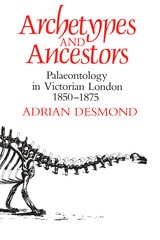
Archetypes and Ancestors
Palaeontology in Victorian London, 1850-1875Adrian Desmond
University of Chicago Press, 1982
"The social construction of scientific knowledge, clearly one of the most exciting trends in the history of science in the 1890's, has made a solid stride forward with the publication of Archetypes and Ancestors. . . . Adrian Desmond set out to determine how much light might be shed on the mid-Victorian controversies over fossil reconstruction by an investigation of the ideological commitments and political programs of London paleontologists. The answer is: a great deal of light. The resulting book is thoroughly fascinating."—Philip Rehbock, American Historical Review
"A sophisticated study of the colonization of scientific territory—specifically of rival attempts to design the dinosaur—and of the constructive (not just obstructive) role of social pressures in the making of 'lasting contributions' to science. Not least it is a joy to read, perkily irreverent at times and full of nice vignettes and memorable turns of phrase."—Roy Porter, Times Higher Education Supplement
"A sophisticated study of the colonization of scientific territory—specifically of rival attempts to design the dinosaur—and of the constructive (not just obstructive) role of social pressures in the making of 'lasting contributions' to science. Not least it is a joy to read, perkily irreverent at times and full of nice vignettes and memorable turns of phrase."—Roy Porter, Times Higher Education Supplement
[more]
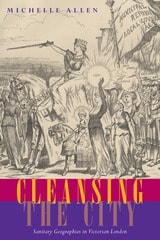
Cleansing the City
Sanitary Geographies in Victorian LondonMichelle Allen
Ohio University Press, 2008
Cleansing the City: Sanitary Geographies in Victorian London explores not only the challenges faced by reformers as they strove to clean up an increasingly filthy city but the resistance to their efforts. Beginning in the 1830s, reform-minded citizens, under the banner of sanitary improvement, plunged into London’s dark and dirty spaces and returned with the material they needed to promote public health legislation and magnificent projects of sanitary engineering. Sanitary reform, however, was not always met with unqualified enthusiasm. While some improvements, such as slum clearances, the development of sewerage, and the embankment of the Thames, may have made London a cleaner place to live, these projects also destroyed and reshaped the built environment, and in doing so, altered the meanings and experiences of the city.
From the novels of Charles Dickens and George Gissing to anonymous magazine articles and pamphlets, resistance to reform found expression in the nostalgic appreciation of a threatened urban landscape and anxiety about domestic autonomy in an era of networked sanitary services. Cleansing the City emphasizes the disruptions and disorientation occasioned by purification—a process we are generally inclined to see as positive. By recovering these sometimes oppositional, sometimes ambivalent responses, Michelle Allen elevates a significant undercurrent of Victorian thought into the mainstream and thus provides insight into the contested nature of sanitary modernization.
From the novels of Charles Dickens and George Gissing to anonymous magazine articles and pamphlets, resistance to reform found expression in the nostalgic appreciation of a threatened urban landscape and anxiety about domestic autonomy in an era of networked sanitary services. Cleansing the City emphasizes the disruptions and disorientation occasioned by purification—a process we are generally inclined to see as positive. By recovering these sometimes oppositional, sometimes ambivalent responses, Michelle Allen elevates a significant undercurrent of Victorian thought into the mainstream and thus provides insight into the contested nature of sanitary modernization.
[more]