Results by title
8 books match the query 'Video art'

Against Immediacy
Video Art and Media PopulismWilliam Kaizen
Dartmouth College Press, 2016
Asians on Demand
Mediating Race in Video Art and ActivismFeng-Mei Heberer
University of Minnesota Press, 2023
Does media representation advance racial justice?
While the past decade has witnessed a push for increased diversity in visual media, Asians on Demand grapples with the pressing question of whether representation is enough to advance racial justice. Surveying a contemporary, cutting-edge archive of video works from the Asian diaspora in North America, Europe, and East Asia, this book uncovers the ways that diasporic artists challenge the narrow—and damaging—conceptions of Asian identity pervading mainstream media.
Through an engagement with grassroots activist documentaries, experimental video diaries by undocumented and migrant workers, and works by high-profile media artists such as Hito Steyerl and Ming Wong, Feng-Mei Heberer showcases contemporary video productions that trouble the mainstream culture industry’s insistence on portraying ethnic Asians as congenial to dominant neoliberal values. Undermining the demands placed on Asian subjects to exemplify institutional diversity and individual exceptionalism, this book provides a critical and nuanced set of alternatives to the easily digestible forms generated by online streaming culture and multicultural lip service more broadly.
Employing feminist, racial, and queer critiques of the contemporary media landscape, Asians on Demand highlights how the dynamics of Asian representation play out differently in Germany, the United States, Taiwan, and Spain. Rather than accepting the notion that inclusion requires an uncomplicated set of appearances, the works explored in this volume spotlight a staunch resistance to formulating racial identity as an instantly accessible consumer product.
Encounters in Video Art in Latin America
Elena Shtromberg
J. Paul Getty Trust, The, 2023
The emergence of video art in Latin America is marked by multiple points of development, across more than a dozen artistic centers, over a period of more than twenty-five years. When it was first introduced during the 1960s, video was seen as empowering: the portability of early equipment and the possibility of instant playback allowed artists to challenge and at times subvert the mainstream media. Video art in Latin America was—and still is—closely related to the desire for social change. Themes related to gender, ethnic, and racial identity as well as the consequences of social inequality and ecological disasters have been fundamental to many artists’ practices.
This compendium explores the history and current state of artistic experimentation with video throughout Latin America. Departing from the relatively small body of existing scholarship in English, much of which focuses on individual countries, this volume approaches the topic thematically, positioning video artworks from different periods and regions throughout Latin America in dialogue with each other. Organized in four broad sections—Encounters, Networks and Archives, Memory and Crisis, and Indigenous Perspectives—the book’s essays and interviews encourage readers to examine the medium of video across varied chronologies and geographies.
Feedback
The Video Data Bank Catalog of Video Art and Artist InterviewsKate Horsfield
Temple University Press, 2006
Inherent Vice
Bootleg Histories of Videotape and CopyrightLucas Hilderbrand
Duke University Press, 2009
Videotape not only radically changed how audiences accessed the content they wanted and loved but also altered how they watched it. Hilderbrand develops an aesthetic theory of analog video, an “aesthetics of access” most boldly embodied by bootleg videos. He contends that the medium specificity of videotape becomes most apparent through repeated duplication, wear, and technical failure; video’s visible and audible degeneration signals its uses for legal transgressions and illicit pleasures. Bringing formal and cultural analysis into dialogue with industrial history and case law, Hilderbrand examines four decades of often overlooked histories of video recording, including the first network news archive, the underground circulation of Superstar: The Karen Carpenter Story, a feminist tape-sharing network, and the phenomenally popular website YouTube. This book reveals the creative uses of videotape that have made essential content more accessible and expanded our understanding of copyright law. It is a politically provocative, unabashedly nostalgic ode to analog.
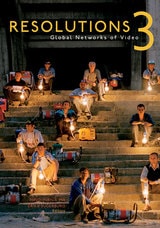
Resolutions 3
Global Networks of VideoMing-Yuen S. Ma
University of Minnesota Press, 2012
Resolutions 3 explores the wide-ranging implications of video art and video-based production in contemporary media culture. It is the third volume in a series composed of Resolution: A Critique of Video Art (1986) and Resolutions: Contemporary Video Practices (1996). While Resolution was one of the first critical texts on video art in the United States, Resolutions was one of the first books to address video as a medium across disciplines from theoretical, activist, and transnational perspectives.
Resolutions 3 articulates this legacy as a challenge to reengage with the explosive viral reach of moving image–based content and its infiltration into and impact on culture and everyday life. The contributors to this work analyze what is now a fourth decade of video practices as marked within and outside the margins of art production, networked interventions, projected spectacle, museum entombment, or 24/7 streaming. Intending to broaden, contest, and amplify the mediated space that was defined by its two predecessors, this volume investigates the ever-changing state of video’s deployment as examiner, tool, journal reportage, improvisation, witness, riff, leverage, and document.
Contributors: Kathleen Ash-Milby, Smithsonian National Museum of the American Indian; Myriam-Odile Blin, Rouen U, France; Nancy Buchanan, California Institute of the Arts; Derek A. Burrill, U of California, Riverside; Sean Cubitt, U of Melbourne; Faisal Devji, New York U; Jennifer Doyle, U of California, Riverside; Jennifer Friedlander, Pomona College; Kathy High, Rensselaer Polytechnic Institute; Lucas Hilderbrand, U of California, Irvine; Nguyen Tan Hoang, Bryn Mawr College; Kathy Rae Huffman; Amelia Jones, McGill U; David Joselit, Yale U; Alexandra Juhasz, Pitzer College; Jessica Lawless, Santa Fe Community College; Hea Jeong Lee; Jesse Lerner, Pitzer College; Akira Mizuta Lippit, U of Southern California; Lionel Manga; Laurence A. Rickels, U of California, Santa Barbara; Kenneth Rogers, U of California, Riverside; Michael Rush, Eli and Edythe Broad Art Museum, Michigan State U; Freya Schiwy, U of California, Riverside; Beverly R. Singer, U of New Mexico; Yvonne Spielmann, U of the West of Scotland; Catherine Taft, Getty Research Institute; Holly Willis, U of Southern California.
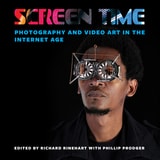
Screen Time
Photography and Video Art in the Internet AgeRichard Rinehart
Bucknell University Press, 2022
Published by Bucknell University Press for the Samek Art Museum.
Distributed worldwide by Rutgers University Press.

Touch
Sensuous Theory And Multisensory MediaLaura U. Marks
University of Minnesota Press, 2002
Proposes a revolutionary approach to the interpretation of art, film, and the digital.
In Touch, Laura U. Marks develops a critical approach more tactile than visual, an intensely physical and sensuous engagement with works of media art that enriches our understanding and experience of these works and of art itself.
These critical, theoretical, and personal essays serve as a guide to developments in nonmainstream media art during the past ten years—sexual representation debates, documentary ethics, the shift from analog to digital media, a new social obsession with smell. Marks takes up well-known artists like experimental filmmaker Ken Jacobs and mysterious animators the Brothers Quay, and introduces groundbreaking, lesser-known film, video, and digital artists. From this emerges a materialist theory—an embodied, erotic relationship to art and to the world. Marks’s approach leads to an appreciation of the works’ mortal bodies: film’s volatile emulsion, video’s fragile magnetic base, crash-prone Net art; it also offers a productive alternative to the popular understanding of digital media as "virtual" and immaterial. Weaving a continuous fabric from philosophy, fiction, science, dreams, and intimate experience, Touch opens a new world of art media to readers.