Results by title
5 books match the query 'Videogames'
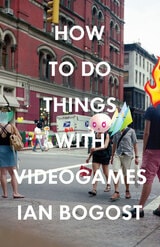
How to Do Things with Videogames
Ian Bogost
University of Minnesota Press, 2011
In recent years, computer games have moved from the margins of popular culture to its center. Reviews of new games and profiles of game designers now regularly appear in the New York Times and the New Yorker, and sales figures for games are reported alongside those of books, music, and movies. They are increasingly used for purposes other than entertainment, yet debates about videogames still fork along one of two paths: accusations of debasement through violence and isolation or defensive paeans to their potential as serious cultural works. In How to Do Things with Videogames, Ian Bogost contends that such generalizations obscure the limitless possibilities offered by the medium’s ability to create complex simulated realities.
Bogost, a leading scholar of videogames and an award-winning game designer, explores the many ways computer games are used today: documenting important historical and cultural events; educating both children and adults; promoting commercial products; and serving as platforms for art, pornography, exercise, relaxation, pranks, and politics. Examining these applications in a series of short, inviting, and provocative essays, he argues that together they make the medium broader, richer, and more relevant to a wider audience.
Bogost concludes that as videogames become ever more enmeshed with contemporary life, the idea of gamers as social identities will become obsolete, giving rise to gaming by the masses. But until games are understood to have valid applications across the cultural spectrum, their true potential will remain unrealized. How to Do Things with Videogames offers a fresh starting point to more fully consider games’ progress today and promise for the future.
Mixed Realism
Videogames and the Violence of FictionTimothy J. Welsh
University of Minnesota Press, 2016
Mixed Realism is about how we interact with media. Timothy J. Welsh shows how videogames, like novels, both promise and trouble experiences of “immersion.” His innovative methodology offers a new understanding of the expanding role of virtuality in contemporary life.
Today’s wired culture is a mixed reality, conducted as exchanges between virtual and material contexts. We make balance transfers at an ATM, update Facebook timelines, and squeeze in sessions of Angry Birds on the subway. However, the “virtual” is still frequently figured as imaginary, as opposed to “real.” The vision of 1990s writers of a future that would pit virtual reality against actual reality has never materialized, yet it continues to haunt cultural criticism. Our ongoing anxiety about immersive media now surrounds videogames, especially “shooter games,” and manifests as a fear that gamers might not know the difference between the virtual world and the real world.
As Welsh notes, this is the paradox of real virtuality. We understand that the media-generated virtualities that fill our lives are not what they represent. But what are they if they are not real? Do they have presence, significance, or influence exceeding their material presence and the user processes that invoke them? What relationships do they establish through and beyond our interactions with them?
Mixed Realism brims with fresh analyses of literary works such as Truman Capote’s In Cold Blood and Mark Z. Danielewski’s House of Leaves, along with sustained readings of controversial videogames such as Super Columbine Massacre and Call of Duty: Modern Warfare 2. Continually connecting the dots between surprising groupings of texts and thinkers, from David Foster Wallace to the cult-classic videogame Eternal Darkness and from Cormac McCarthy to Grand Theft Auto, it offers a fresh perspective on both digital games and contemporary literature.
Simulating Good and Evil
The Morality and Politics of VideogamesMarcus Schulzke
Rutgers University Press, 2020
The Counterfeit Coin
Videogames and Fantasies of EmpowermentChristopher Goetz
Rutgers University Press, 2023

Videogames and Art
Second EditionEdited by Andy Clarke and Grethe Mitchell
Intellect Books, 2013
Together, the contributions position videogame art as an interdisciplinary mix of digital technologies and the traditional art forms. Of particular interest in this volume are machinima, game console artwork, politically oriented videogame art, and the production of digital art. This new and revised edition features an extended critical introduction from the editors and updated interviews with the foremost artists in the field. Rounding out the book is a critique of the commercial videogame industry comprising essays on the current quality and originality of videogames.