Results by title
7 books match the query 'Vigilantes'
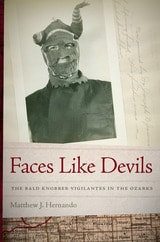
Faces Like Devils
The Bald Knobber Vigilantes in the OzarksMatthew J. Hernando
University of Missouri Press, 2019
Grandmothers on Guard
Gender, Aging, and the Minutemen at the US-Mexico BorderBy Jennifer L. Johnson
University of Texas Press, 2021
For about a decade, one of the most influential forces in US anti-immigrant politics was the Minuteman Project. The armed volunteers made headlines patrolling the southern border. What drove their ethno-nationalist politics?
Jennifer L. Johnson spent hundreds of hours observing and interviewing Minutemen, hoping to answer that question. She reached surprising conclusions. While the public face of border politics is hypermasculine—men in uniforms, fatigues, and suits—older women were central to the Minutemen. Women mobilized support and took part in border missions. These women compel us to look beyond ideological commitments and material benefits in seeking to understand the appeal of right-wing politics. Johnson argues that the women of the Minutemen were motivated in part by the gendered experience of aging in America. In a society that makes old women irrelevant, aging white women found their place through anti-immigrant activism, which wedded native politics to their concern for the safety of their families. Grandmothers on Guard emphasizes another side of nationalism: the yearning for inclusion. The nation the Minutemen imagined was not only a space of exclusion but also one in which these women could belong.
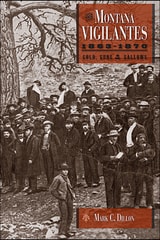
Montana Vigilantes 1863–1870
Gold,Guns and GallowsMark C. Dillon
Utah State University Press, 2016
Using newspaper articles, diaries, letters, biographies, invoices, and books that speak to the compelling history of Montana’s vigilantism in the 1860s, Dillon examines the conduct of the vigilantes in the context of the due process norms of the time. He implicates the influence of lawyers and judges who, like their non-lawyer counterparts, shaped history during the rush to earn fortunes in gold.
Dillon’s perspective as a state Supreme Court justice and legal historian uniquely illuminates the intersection of territorial politics, constitutional issues, corrupt law enforcement, and the basic need of citizenry for social order. This readable and well-directed analysis of the social and legal context that contributed to the rise of Montana vigilante groups will be of interest to scholars and general readers interested in Western history, law, and criminal justice for years to come.
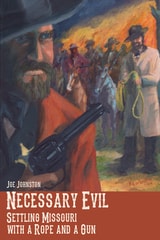
Necessary Evil
Settling Missouri with a Rope and a GunJoe Johnston
Missouri Historical Society Press, 2014
Necessary Evil is the first book to chronicle the implications of vigilantism in Missouri, ultimately showing that the state could never have been settled without a healthy dose of rebel justice. Packed with stories of popular gunslingers such as Wyatt Earp, Wild Bill Hickok, and Jesse James, this action-filled read will be of interest to crime enthusiasts and historians alike.

Night Riders
Defending Community in the Black Patch, 1890–1915Christopher Waldrep
Duke University Press, 1993
Christopher Waldrep shows that, contrary to many accounts, these wealthy tobacco planters did not resist these new forces simply because of a nostalgia for a bygone time. Instead, many sought to become modern capitalists themselves--but on their own terms. The South's rural elite found their ability to hire and control black labor--the established racial practice of the community--threatened by the low prices offered by big companies for their raw materials. In response, farmers organized and demanded better prices for their tobacco. The tobacco companies then attempted to divide the farmers by offering higher prices to those willing to break with the others. When some cultivators succumbed, their betrayal awakened a deeply rooted vigilante tradition that called for the protection of community at all costs. Waldrep analyzes the spasm of violence that ensued in which horsemen, riding at night, destroyed tobacco barns and the warehouses where the companies stored their tobacco. But despite this fierce upheaval, the Black Patch community endured.
The most thorough treatment ever given to the Black Patch war, Night Riders illuminates a moment in history in which the traditional and the modern, the rural and the industrial, fought for the future--and past--of a community.
The Law Into Their Own Hands
Immigration and the Politics of ExceptionalismRoxanne Lynn Doty
University of Arizona Press, 2009
Doty examines the social and political contexts that have enabled these civilian groups to flourish and gain legitimacy amongst policy makers and the public. The sentiments underlying the vigilante movement both draw upon and are channeled through a diverse range of organizations whose messages are often reinforced by the media. Taking action when they believe official policy is lacking, groups ranging from elements of the religious right to anti-immigrant groups to white supremacists have created a social movement.
Doty seeks to alert us to the consequences related to this growing movement and to the restructuring of our society. She maintains that with immigrants being considered as enemies and denied basic human rights, it is irresponsible of both citizens and policy makers to treat this complicated issue as a simple black or white reality.
In this solid and theoretically grounded look at contemporary, post-9/11 border vigilantism, the author observes the dangerous and unproductive manner in which private citizens seek to draw firm and uncompromising lines between who is worthy of inclusion in our society and who is not.
Vigilantes and Lynch Mobs
Narratives of Community and NationLisa Arellano
Temple University Press, 2012
Looking at the narrative accounts of mob violence produced by vigilantes and their advocates as “official” histories, Lisa Arellano shows how these nonfiction narratives conformed to a common formula whose purpose was to legitimate frontier justice and lynching.
In Vigilantes and Lynch Mobs, Arellano closely examines such narratives as well as the work of Western historian and archivist Hubert Howe Bancroft, who was sympathetic to them, and that of Ida B. Wells, who wrote in fierce opposition to lynching. Tracing the creation, maintenance, and circulation of dominant, alternative, and oppositional vigilante stories from the nineteenth-century frontier through the Jim Crow South, she casts new light on the role of narrative in creating a knowable past.
Demonstrating how these histories ennobled the actions of mobs and rendered their leaders and members as heroes, Arellano presents a persuasive account of lynching’s power to create the conditions favorable to its own existence.