Results by title

2 books match the query 'Vinokur, Val'
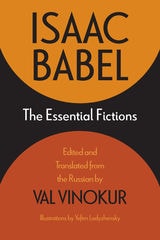
cover of The Essential Fictions

The Essential Fictions

Isaac Babel; Edited and translated from the Russian by Val Vinokur; Illustrations by Yefim Ladyzhensky

Northwestern University Press, 2018

The Essential Fictions offers contemporary readers seventy-two short stories by one of twentieth-century Russia’s premier storytellers, Isaac Babel. This unique volume, which includes Babel’s famous Red Cavalry series and his Odessa Stories, is translated, edited, introduced, and annotated by Val Vinokur, a 2008 Guggenheim Fellow in Translation, and features illustrations by Yefim Ladyzhensky, a painter known for his depictions of everyday life under Soviet rule in Babel’s native Odessa.

Babel was born in 1894 into multicultural Odessa’s thriving Jewish community. Working as a journalist, he witnessed the Bolshevik Revolution and Civil War, and accompanied the Cossack horsemen of the Red Cavalry during the 1920 Polish-Soviet War, distilling these experiences into his fiction. Vinokur highlights Babel’s “horrified hopefulness” and “doleful and bespectacled Jewish comedy” in the face of the bloody conflicts that plagued his generation.

On the centenary of the revolution that toppled the Romanov tsars, Babel’s fictions continue to absorb and fascinate contemporary readers interested in eastern European and Jewish literature as well as the history and politics of the twentieth century.

[more]
cover of The Trace of Judaism: Dostoevsky, Babel, Mandelstam, Levinas

The Trace of Judaism

Dostoevsky, Babel, Mandelstam, Levinas

Val Vinokur

Northwestern University Press, 2009

Recipient, 2008 Guggenheim Fellowship

The defining quality of Russian literature, for most critics, is its ethical seriousness expressed through formal originality. The Trace of Judaism addresses this characteristic through the thought of the Lithuanian-born Franco-Jewish philosopher Emmanuel Levinas. Steeped in the Russian classics from an early age, Levinas drew significantly from Dostoevsky in his ethical thought. One can profitably read Russian literature through Levinas, and vice versa.
 
Vinokur links new readings of Fyodor Dostoevsky, Isaac Babel, and Osip Mandelstam to the work of Levinas, to ask: How does Judaism haunt Russian literature? In what ways is Levinas' ethics as "Russian" as it is arguably "Jewish"? And more broadly, how do ethics and aesthetics inflect each other? Vinokur considers how the encounter with the other invokes responsibilities ethical and aesthetic, and shows how the volatile relationship between ethics and aesthetics--much like the connection between the Russian and Jewish traditions--may be inextricably symbiotic. In an ambitious work that illuminates the writings of all of these authors, Vinokur pursues the implications of this reading for our understanding of the function of literature--its unique status as a sphere in which an ethical vision such as that of Levinas becomes comprehensible.
[more]