Results by title
8 books match the query 'Violence & Harassment'
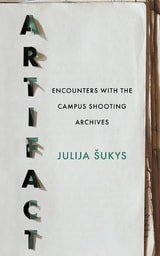
Artifact
Encounters with the Campus Shooting ArchivesJulija Šukys
West Virginia University Press, 2025
2026 IPPY Awards Bronze Medal Winner, Current Events - Social Issues/Humanitarian
2026 PROSE Award Finalist, Humanities: Literature
Artifact is about the stories we tell ourselves after mass shootings. Each college campus shooting leaves a record: archival collections, monuments to the dead, government-led inquiries, internal university investigations, and lawsuits. Artifact: Encounters with the Campus Shooting Archives seeks to understand university and college campus shootings that involve students and faculty of those institutions. The book examines the aftermaths of such attacks by moving between university archives, memorials to victims, conversations with survivors, and beyond.
Julija Šukys examines a series of five North American university and college campus shootings between 1966 and 2015: the École Polytechnique in Montreal, Concordia University in Montreal, Virginia Tech, University of Alabama–Huntsville, and Umpqua Community College in Roseburg, Oregon. These attacks involved students and faculty as both victims and perpetrators—that is, all the shooters were either faculty members or (in one case, would-be) students of the institution where the killings took place.
Šukys arrives at each site long after the killings have taken place: by now, the teddy bears, flowers, and crosses have been cleared away. Prying journalists are long gone. She sorts through myriad objects left at makeshift memorial sites. She talks for hours with a professor who survived an attack only because her colleague’s gun jammed as it was pointed at her head. She wanders and documents the reconfigured buildings made unrecognizable after the horrors that occurred within them. She reads tedious court transcripts, officious government-commissioned reports, and a troubling memoir written by a shooter’s mother and sifts through the mathematics papers that one campus shooter publishes from his prison cell.
Artifact weighs what it means to live in a place where students and their teachers are gunned down on a seemingly regular basis. It asks how we can continue to learn, teach, and live when nothing changes in response to these deaths. It attempts to speak into silence, to look at the pain of those who have come through trauma, and to meet their gazes without platitudes or triumphalism. The result is a searching book about care, memory, forgiveness, and survival.
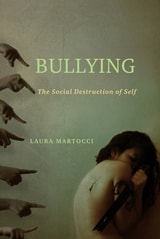
Bullying
The Social Destruction of SelfLaura Martocci
Temple University Press, 2015
Moving beyond the identification of aggressive behaviors to an analysis of how and why we have arrived at a culture that thrives on humiliation, she critiques the social forces that gave rise to, and help maintain, bullying. Martocci’s analysis of gossip, laughter, stereotyping, and competition—dynamics that foment bullying and prompt responses of shame, violence, and depression—is positioned within a larger social narrative: the means by which we negotiate damaged social bonds and the role that bystanders play in the possibility of atonement, forgiveness, and redemption.
Martocci’s fresh perspective on bullying positions shame as pivotal. She urges us to acknowledge the pain and confusion caused by social disgrace; to understand its social, psychological, and neurological nature; and to address it through narratives of loss, grief, and redemption—cultural supports that are already in place.

Centering Student Activism
Feminist Rhetorical Interruptions of Sexual Assault CultureShari J. Stenberg
Utah State University Press, 2026
Centering Student Activism is a deep exploration of institutional responses to sexual assault. It addresses critical issues facing campuses today, examining how students navigate institutional dynamics and utilize the power of new and traditional rhetorical strategies to effect change. In doing so, it provides a profound understanding of the mechanisms by which coalitions can transform educational environments.
Centering Student Activism features a national interview-based study of contemporary student activists who deploy rhetorical strategies and tactics—old and new, embodied and digital—with agility and awareness. They aim their strategies and tactics of “intersectional rhetorical feminism” to interrupt and transform a sedimented culture. The students’ activism highlights not only the harms experienced by survivors in the aftermath of their assaults but also how their efforts to communicate those harms are often stymied or silenced by official responses and practices. These student activists pair interruption with rhetorical transformation as they seek to create a survivor-centric culture. In so doing they spotlight the systemic roots of sexual violence and respond to sexual assault through intersectional, coalition-based work.
Through detailed analysis and compelling narratives, Shari J. Stenberg underscores the importance of community care and mutual support in advocacy efforts. Centering Student Activism is an essential work for navigating institutional dynamics, providing an important resource to students, educators, and administrators who seek to understand how universities silence survivors and how students create ways to speak back and transform institutional culture.
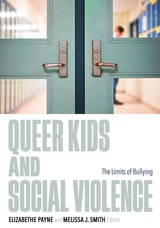
Queer Kids and Social Violence
The Limits of BullyingElizabethe Payne
University of Minnesota Press, 2025
Challenging the myths about LGBTQ+ kids and bullying: what it means to protect queer kids in schools
Conversations around LGBTQ+ kids in school have become dominated by the subject of bullying. Although this may be due to good-faith efforts to protect vulnerable students, Queer Kids and Social Violence demonstrates that a focus on bullying as acts of individual peer aggression fails to address the social norms that perpetuate the violence. Considering the broader contexts of bullying, this volume offers ways to engage with queer youth that are both more humanizing and more likely to create sustainable change.
Essays by leading international scholars analyze how bullying discourse shapes policy and practice, using in-depth case studies, research findings, and examinations of political policy to guide readers through the various forms of violence, identity regulation, and identity erasure in schools. Offering conversation-shifting interventions to respond to a difficult and frightening political moment for LGBTQ+ youth, Queer Kids and Social Violence is a rounded, empathetic picture that does queer youth justice and points the way toward safer schools for all.
Contributors: Ana María Amigo-Ventureira, Durell M. Callier, Cristyn Davies, Renée DePalma, Tania Ferfolja, Jessica Fields, Elliot Fonarev, Jen Gilbert, Tristan Gleason, Dominique C. Hill, Angela Ingram, Laurie Gutmann Kahn, Cris Mayo, Mollie McQuillan, Aoife Neary, C.J. Pascoe, Victoria Rawlings, EJ Renold, Jessica Ringrose, Kerry H. Robinson, Dorte Marie Søndergaard, Cris Townley, Jacqueline Ullman, Boni Wozolek.
Retail e-book files for this title are screen-reader friendly with images accompanied by short alt text and/or extended descriptions.
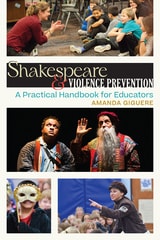
Shakespeare & Violence Prevention
A Practical Handbook for EducatorsAmanda Giguere
University of Wyoming Press, 2025
Framed by examples from Giguere’s work with the Shakespeare & Violence Prevention program, an interdisciplinary outreach project for K–12 schools developed at the University of Colorado Boulder, the text offers helpful entry points, digestible research, and practical exercises to align a violence-prevention curriculum with Shakespeare’s plays. It provides a condensed overview of key findings from violence prevention, clear synopses of the plays, and practicable strategies to implement the program. Guided by firsthand experience with a tried-and-true school program that reaches thousands of K–12 students annually, Giguere shares the Colorado Shakespeare Festival method, which focuses on “upstander” roleplays to practice violence-prevention strategies. Using a clear distillation of Shakespeare studies and violence-prevention research, she shows how the two fields naturally reinforce the concepts of teamwork, empathy, change, and hope.
Shakespeare and Violence Prevention is a new spin on these classic texts that empowers teachers and community leaders to use these tools to create research-guided university engagement programs, theatre company outreach programs, and K–12 student engagement with Shakespeare, even for those without expertise in violence prevention or Shakespeare.
Teaching against Violence
The Reassessing ToolboxInez Testoni
Central European University Press, 2014

The Lecherous Professor
Sexual Harassment on CampusBillie Wright Dziech and Linda Weiner
University of Illinois Press, 1990

The Tolerance Generation
Growing Up Online in the Anti-Bullying EraSarah Miller
University of Chicago Press, 2026
Draws directly on insights from teens to reframe our understanding of bullying in the age of social media and why anti-bullying campaigns have been unsuccessful in combating it.
Fitting in and standing out is an eternal rite of passage for teenagers. Increasingly, their struggles to establish hierarchies and regulate social norms are labeled under the umbrella of “bullying.” This phenomenon is considered such a significant problem that all fifty states have passed anti-bullying legislation, and many schools now engage prevention programs that promote tolerance, kindness, and active bystander interventions. Despite these efforts, bullying remains as widespread as ever. Why is that? The answer lies in a unique challenge faced by teens today: social media.
In The Tolerance Generation, sociologist Sarah Miller explores how youth grapple with bullying in the digital age alongside the anti-bullying industry. Drawing on two school years with students at a Northeastern high school, Miller reveals how institutional efforts to curb bullying are no match for the many online interactions in which bullying thrives. She charts teens’ experiences as they confront not only bullying, but also sexting exposures, school shooting threats, and viral cancel culture, illustrating the escalating pressures social media places on youth. Yet the school’s anti-bullying campaigns are a mismatch. They are engineered to address individual instances of explicit conflict, not to change the culture that contributes to bullying, nor to help marginalized students who are most likely to be targeted. Miller captures how exclusion and harm spread through the interplay of teens’ on and offline lives and shows how this is due, in part, to school practices that both reinforce—and fail to address—bullying as a systemic problem.
But while social media can foster conflict, it can also be a tool for building a youth culture of care. Miller shows how many teens harness digital culture to develop their own prevention strategies, going beyond tolerance to use social media as a site for education, conflict resolution, and resistance. Ultimately, Miller argues that the anti-bullying movement is an inadequate training ground for youth to learn how to deal with American inequalities. However, by addressing the structural factors that produce bullying, and by listening to teens’ wisdom on how best to handle it, schools can create a more effective curriculum.