Results by title

2 books match the query 'Violence on television'
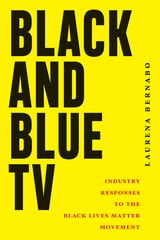
cover of Black and Blue TV: Industry Responses to the Black Lives Matter Movement

Black and Blue TV

Industry Responses to the Black Lives Matter Movement

Laurena Bernabo

Rutgers University Press, 2026

Black and Blue TV explores the ways television productions have responded to the Black Lives Matter movement. Television programs’ engagement with BLM was common before George Floyd’s murder sparked international protests in the summer of 2020, at which point it became nearly unavoidable for many series. Images of police using violence against Black Americans fueled criticisms of the role of television—especially cop shows—in perpetuating “copaganda,” highlighting the fact that television’s cops are nearly always the good guys, even when they break the law and use excessive force. Black and Blue TV identifies trends and anomalies in television’s engagement with BLM but also investigates the people who influence what those representations look like. Pairing textual criticism with interviews with television creatives, executives, and media activists, author Laurena Bernabo traces shifts in how these individuals understand their role in televisual culture and the cultural forum of narratives that are produced and distributed as a result.
[more]
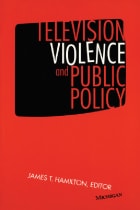
cover of Television Violence and Public Policy

Television Violence and Public Policy

James T. Hamilton, Editor

University of Michigan Press, 2000

Since 1954, violence in television programming has been the subject of legislative debate, congressional hearings, agency pronouncements, and presidential commentary. Most recently, ratings of television programs have been discussed and implemented while other means of controlling the access to certain kinds of television programs have been discussed. The debate over the age-based program rating system recently implemented by the television industry has generated many questions about television violence.
The essays in the volume provide answers to many of these questions on specific policy issues surrounding media violence. The contributors suggest that the research on television violence can serve as the basis for a framework that categorizes programs based on the context in which the violence is presented. The manner in which information is conveyed about violent content affects how viewers react to such warnings. Program warnings with MPAA-style ratings have the potential to confuse parents (since they do not provide detailed content information) and attract some viewers such as teenage males.
The contributors include some of the top researchers in the field of communications, several of whom participated in the National Television Violence Study. Contributors are Eva Blumenthal, Joanne Cantor, Wayne Danielson, Ed Donnerstein, Tim Gray, Kristen Harrison, Cynthia Hoffner, Marlies Klijn, Marina Krcmar, Dale Kunkel, Dominic Lasorsa, Rafael Lopez, Dan Linz, Adriana Olivarez, James Potter, Stacy Smith, Matthew L. Spitzer, Ellen Wartella, D. Charles Whitney, and Barbara Wilson.
This volume will be of interest to communications researchers, media policy experts, legal scholars, government and industry officials, and social scientists interested in media and television.
James Hamilton is Director of the Program on Violence and the Media, Duke University.
[more]