Results by title
4 books match the query 'Viramontes, Helena María'
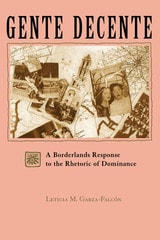
Gente Decente
A Borderlands Response to the Rhetoric of DominanceBy Leticia Magda Garza-Falcón
University of Texas Press, 1998
In his books The Great Plains, The Great Frontier, and The Texas Rangers, historian Walter Prescott Webb created an enduring image of fearless, white, Anglo male settlers and lawmen bringing civilization to an American Southwest plagued with "savage" Indians and Mexicans. So popular was Webb's vision that it influenced generations of historians and artists in all media and effectively silenced the counter-narratives that Mexican American writers and historians were concurrently producing to claim their standing as "gente decente," people of worth.
These counter-narratives form the subject of Leticia M. Garza-Falcón's study. She explores how prominent writers of Mexican descent-such as Jovita González, Américo Paredes, María Cristina Mena, Fermina Guerra, Beatriz de la Garza, and Helena María Viramontes -have used literature to respond to the dominative history of the United States, which offered retrospective justification for expansionist policies in the Southwest and South Texas. Garza-Falcón shows how these counter-narratives capture a body of knowledge and experience excluded from "official" histories, whose "facts" often emerged more from literary techniques than from objective analysis of historical data.
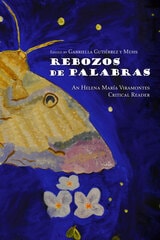
Rebozos de Palabras
An Helena María Viramontes Critical ReaderEdited by Gabriella Gutiérrez y Muhs
University of Arizona Press, 2013
As Gabriella Gutiérrez y Muhs points out in her insightful introduction, not only has Viramontes’s work not yet received the broad critical engagement it richly deserves, but there remains a monumental gap in the interpretations of Chicana literature that reach mainstream audiences. Rebozos de Palabras addresses this void by focusing on how the Chicana image has evolved through Viramontes’s body of work. With a foreword by Sonia Saldívar-Hull, this collection addresses Viramontes entire oeuvre through newly produced articles by major literary critics and emerging scholars who engage Viramontes’s writing from multiple perspectives.
Refiguring Race and Risk
Counternarratives of Care in the US Security StateRoberta Wolfson
The Ohio State University Press, 2024
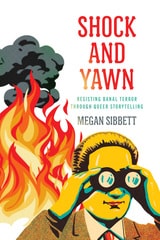
Shock and Yawn
Resisting Banal Terror Through Queer StorytellingMegan Sibbett
The Ohio State University Press, 2026
Building on queer theorists’ critiques of intimate and administrative violence, especially Gloria Anzaldúa’s “intimate terrorism,” Sibbett develops methodologies for conceptualizing and subverting violence aimed at queer, racialized, and gendered bodies in this era of surveillance and increasing authoritarianism. Sibbett addresses book bans, anti-trans legislation, idealized histories of westward expansion, and more, examining materials that include public service announcements, advertising, social media, news reports, poems, interviews, and novels. In so doing, she demonstrates the crucial role queer testimonies—and queer histories and queer futures—play in revealing systemic violence and illuminating the transformative potential of everyday resistance.