Results by title
4 books match the query 'Virdi, Jaipreet'
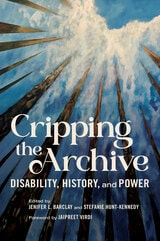
Cripping the Archive
Disability, History, and PowerEdited by Jenifer L. Barclay and Stefanie Hunt-Kennedy Foreword by Jaipreet Virdi
University of Illinois Press, 2025
Jenifer L. Barclay and Stefanie Hunt-Kennedy edit a collection of interdisciplinary essays that consider how and why physical, sensory, intellectual, and psychological disabilities are underrepresented, erased, or distorted in the historical record. The contributors draw on the methodology and practice of cripping to uncover disability in contested archives and explore ways to build inclusive archives accountable to, and centered on, disabled people and disability justice. Throughout, they show ableness informing the politics of the archive as a physical space, a discriminatory record, and a collection of silences.
An essential contribution to research methods and disability justice, Cripping the Archive offers a blueprint for intersectional and interdisciplinary approaches that bridge disability studies, history, and archival studies.

Hearing Happiness
Deafness Cures in HistoryJaipreet Virdi
University of Chicago Press, 2020
At the age of four, Jaipreet Virdi’s world went silent. A severe case of meningitis left her alive but deaf, suddenly treated differently by everyone. Her deafness downplayed by society and doctors, she struggled to “pass” as hearing for most of her life. Countless cures, treatments, and technologies led to dead ends. Never quite deaf enough for the Deaf community or quite hearing enough for the “normal” majority, Virdi was stuck in aural limbo for years. It wasn’t until her thirties, exasperated by problems with new digital hearing aids, that she began to actively assert her deafness and reexamine society’s—and her own—perception of life as a deaf person in America.
Through lyrical history and personal memoir, Hearing Happiness raises pivotal questions about deafness in American society and the endless quest for a cure. Taking us from the 1860s up to the present, Virdi combs archives and museums in order to understand the long history of curious cures: ear trumpets, violet ray apparatuses, vibrating massagers, electrotherapy machines, airplane diving, bloodletting, skull hammering, and many more. Hundreds of procedures and products have promised grand miracles but always failed to deliver a universal cure—a harmful legacy that is still present in contemporary biomedicine.
Weaving Virdi’s own experiences together with her exploration into the fascinating history of deafness cures, Hearing Happiness is a powerful story that America needs to hear.
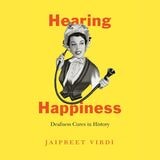
Hearing Happiness
Deafness Cures in HistoryJaipreet Virdi
University of Chicago Press, 2020
This is an auto-narrated audiobook edition of this book.
Weaving together lyrical history and personal memoir, Virdi powerfully examines society’s—and her own—perception of life as a deaf person in America.
At the age of four, Jaipreet Virdi’s world went silent. A severe case of meningitis left her alive but deaf, suddenly treated differently by everyone. Her deafness downplayed by society and doctors, she struggled to “pass” as hearing for most of her life. Countless cures, treatments, and technologies led to dead ends. Never quite deaf enough for the Deaf community or quite hearing enough for the “normal” majority, Virdi was stuck in aural limbo for years. It wasn’t until her thirties, exasperated by problems with new digital hearing aids, that she began to actively assert her deafness and reexamine society’s—and her own—perception of life as a deaf person in America.
Through lyrical history and personal memoir, Hearing Happiness raises pivotal questions about deafness in American society and the endless quest for a cure. Taking us from the 1860s up to the present, Virdi combs archives and museums in order to understand the long history of curious cures: ear trumpets, violet ray apparatuses, vibrating massagers, electrotherapy machines, airplane diving, bloodletting, skull hammering, and many more. Hundreds of procedures and products have promised grand miracles but always failed to deliver a universal cure—a harmful legacy that is still present in contemporary biomedicine.
Weaving Virdi’s own experiences together with her exploration into the fascinating history of deafness cures, Hearing Happiness is a powerful story that America needs to hear.
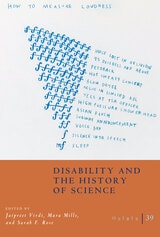
Osiris, Volume 39
Disability and the History of ScienceEdited by Jaipreet Virdi, Mara Mills, and Sarah F. Rose
University of Chicago Press Journals, 2024
Disability has been a central—if unacknowledged—force in the history of science, as in the scientific disciplines. Across historical epistemology and laboratory research, disability has been “good to think with”: an object of investigation made to yield generalizable truths. Yet disability is rarely imagined to be the source of expertise, especially the kind of expertise that produces (rational, neutral, universal) scientific knowledge.
This volume of Osiris places disability history and the history of science in conversation to foreground disability epistemologies, disabled scientists, and disability sciencing (engagement with scientific tools and processes). Looking beyond paradigms of medicalization and industrialization, the volume authors also examine knowledge production about disability from the ancient world to the present in fields ranging from mathematics to the social sciences, resulting in groundbreaking histories of taken-for-granted terms such as impairment, infirmity, epidemics, and shōgai.
Some contributors trace the disabling impacts of scientific theories and practices in the contexts of war, factory labor, insurance, and colonialism; others excavate racial and settler ableism in the history of scientific facts, protocols, and collections; still others query the boundaries between scientific, lay, and disability expertise. Contending that disability alters method, authors bring new sources and interpretation techniques to the history of science, overturn familiar narratives, apply disability analyses to established terms and archives, and discuss accessibility issues for disabled historians. The resulting volume announces a disability history of science.