Results by title
13 books match the query 'Virtues'
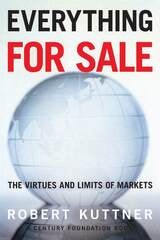
Everything for Sale
The Virtues and Limits of MarketsRobert Kuttner
University of Chicago Press, 1999
"The best survey of the limits of free markets that we have. . . . A much needed plea for pragmatism: Take from free markets what is good and do not hesitate to recognize what is bad."—Jeff Madrick, Los Angeles Times
"It ought to be compulsory reading for all politicians—fortunately for them and us, it is an elegant read."—The Economist
"Demonstrating an impressive mastery of a vast range of material, Mr. Kuttner lays out the case for the market's insufficiency in field after field: employment, medicine, banking, securities, telecommunications, electric power."—Nicholas Lemann, New York Times Book Review
"A powerful empirical broadside. One by one, he lays on cases where governments have outdone markets, or at least performed well."—Michael Hirsh, Newsweek
"To understand the economic policy debates that will take place in the next few years, you can't do better than to read this book."—Suzanne Garment, Washington Post Book World
Finite Perfection
Reflections on VirtueMichael A. Weinstein
University of Massachusetts Press, 1985
A contemporary account of how virtue can have significance in a world that has lost the certainty of common and collective meanings.
Finite Perfection: Reflections on Virtue is a work of political philosophy and ethical theory in which Michael A. Weinstein develops a rigorous and original account of virtue grounded in the existentialist tradition rather than in classical metaphysics or theology. The book's title captures its central philosophical tension: where classical and religious traditions have often located virtue in relation to an infinite, divine, or transcendent standard of perfection, Weinstein insists on taking seriously the finitude of the human condition—the irreducible limits of time, mortality, and embodied existence—and asking what excellence and virtue can mean for beings who are, by nature, incomplete and bounded.
Weinstein's approach is rooted in the concept of the self-possessed individual—a person who has achieved a kind of integrity and mastery over themselves not through escape from finitude, but through honest acknowledgment and creative embrace of it. Virtue, on this view, is not a transcendence of human limitation but a perfecting of what is possible within it: the best a finite being can be. This framework draws productively on the existentialist tradition (particularly its emphasis on authenticity, self-creation, and the confrontation with mortality), while also engaging with the Aristotelian tradition of virtue ethics and the Nietzschean understanding of self-overcoming.
Throughout its pages, Weinstein brings his characteristic intellectual breadth to bear, moving across political philosophy, ethics, and social theory to construct an account of virtue that is both philosophically rigorous and deeply humane.
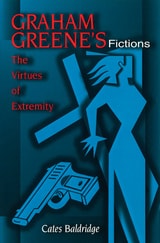
Graham Greene's Fictions
The Virtues of ExtremityCates Baldridge
University of Missouri Press, 2000
The first critical evaluation of Greene's novels since his death in 1991, Graham Greene's Fictions: The Virtues of Extremity is a reconsideration of the author's major literary achievements, as well as a recasting of his overall worldview. Hitherto, most criticism of Greene's fiction has forced him into the constricting category of the "Catholic novelist," consequently flattening the peaks and valleys of his uncompromising vision of life. Graham Greene's Fictions is Cates Baldridge's response to this critical disservice—an exploration that ignores the conventional preconceptions about Greene's fiction and reveals him to be one of the leading British novelists of the twentieth century.
More than a general assessment, Graham Greene's Fictions offers a fresh interpretation of familiar texts and attempts to discover within Greene's work a structure of thought that has not yet been seen with sufficient clarity. Each chapter focuses on a major aspect of Greene's vision as expressed through his novels. Greene's caustic attitude toward middle-class orthodoxies and his critiques of the three reigning ideologies of his time--Christianity, Marxism, and liberalism—are just two of the areas that Baldridge explores. Although five of Greene's novels are singled out for extensive evaluation—Brighton Rock, The Power and the Glory, The Heart of the Matter, The Comedians, and The Honorary Consul—what Baldridge attempts is nothing less than a comprehensive re-imagination of "Greeneland's" fictional topography.
Written for both the scholar and the general audience, this innovative study successfully captures the attention of all readers whether it is the first or the fifty-first work of Greene criticism one has read.
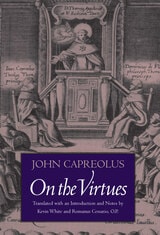
On the Virtues
Jean Capreolus
Catholic University of America Press, 2001

Power to Hurt
THE VIRTUES OF ALIENATIONWilliam Monroe
University of Illinois Press, 1998
Chosen as a Choice Magazine's Outstanding Academic Book for 1999.
Rhetoric, Technology, and the Virtues
Jared S. Colton
Utah State University Press, 2018
Rhetoric, Technology, and the Virtues argues that virtue ethics supports postmodern criticisms of rational autonomy and universalism while also enabling a discussion of the actual ethical behaviors that digital users form through their particular communicative ends and various rhetorical purposes. Authors Jared Colton and Steve Holmes extend Aristotle’s hexis framework through contemporary virtue ethicists and political theorists whose writing works from a tacit virtue ethics framework. They examine these key theorists through a range of case studies of digital habits of human users, including closed captioning, trolling, sampling, remixing, gamifying for environmental causes, and using social media, alongside a consideration of the ethical habits of nonhuman actors.
Tackling a needed topic with clarity and defined organization, Rhetoric, Technology, and the Virtues carefully synthesizes various strands of ethical thinking, convincingly argues that virtue ethics is a viable framework for digital rhetoric, and provides a practical way to assess the changing hexeis encountered across the network of ethical situations in the digital world.
Second-Best Justice
The Virtues of Japanese Private LawJ. Mark Ramseyer
University of Chicago Press, 2015
With Second-Best Justice, J. Mark Ramseyer offers a more compelling, better-grounded explanation: the low rate of lawsuits in Japan results not from distrust of a dysfunctional system but from trust in a system that works—that sorts and resolves disputes in such an overwhelmingly predictable pattern that opposing parties rarely find it worthwhile to push their dispute to trial. Using evidence from tort claims across many domains, Ramseyer reveals a court system designed not to find perfect justice, but to “make do”—to adopt strategies that are mostly right and that thereby resolve disputes quickly and economically.
An eye-opening study of comparative law, Second-Best Justice will force a wholesale rethinking of the differences among alternative legal systems and their broader consequences for social welfare.
The Bourgeois Virtues
Ethics for an Age of CommerceDeirdre Nansen McCloskey
University of Chicago Press, 2006
McCloskey’s sweeping, charming, and even humorous survey of ethical thought and economic realities—from Plato to Barbara Ehrenreich—overturns every assumption we have about being bourgeois. Can you be virtuous and bourgeois? Do markets improve ethics? Has capitalism made us better as well as richer? Yes, yes, and yes, argues McCloskey, who takes on centuries of capitalism’s critics with her erudition and sheer scope of knowledge. Applying a new tradition of “virtue ethics” to our lives in modern economies, she affirms American capitalism without ignoring its faults and celebrates the bourgeois lives we actually live, without supposing that they must be lives without ethical foundations.
High Noon, Kant, Bill Murray, the modern novel, van Gogh, and of course economics and the economy all come into play in a book that can only be described as a monumental project and a life’s work. The Bourgeois Virtues is nothing less than a dazzling reinterpretation of Western intellectual history, a dead-serious reply to the critics of capitalism—and a surprising page-turner.
The Dadly Virtues
Adventures from the Worst Job You'll Ever LoveJonathan V. Last
Templeton Press, 2015
The Dadly Virtues is a tongue-in-cheek collection of encouragement and guidance for any stage of fatherhood, from pacifying babies to prepping for senior prom, from cutting the cord to getting the first, “Best Grandpa” t-shirt. P.J. O’Rourke sets the stage with the chapter, “What Do Men Get from Fatherhood? Besides What They Put In …” and then is followed by:
•Matthew Continetti’s, “Newborn Terror: The Moment You Realize that ‘Bundle of Joy’ Is a Euphemism for Something Very Different.”
•Stephen F. Hayes’ “Siblings: The Best Gift You’ll Ever Give Your Kids.”
•Jonah Goldberg’s “Get Your Kid a Dog: The Moral Case for Pets.”
•Tucker Carlson’s “In Praise of Adventure: How to Fill a Child’s Life with Excitement and Danger (without Getting Them Killed).”
•Michael Graham’s, “Dating: Enjoy the Movie and Please Keep the Impregnation to a Minimum.”
•Christopher Caldwell’s “College: It’s Not as Bad as You Think; It’s Worse.”
•Andrew Ferguson’s “Emerging Adults and Empty Nesters: Just When You Had Fatherhood All Figured Out.”
•Toby Young’s “The Dark Side: Bad Parenting and the Things We Think, but Do Not Say.”
•Joseph Epstein’s “Thanks, Grandpa: Grandfatherhood and the Spirit of the Age.”
•And more.
Father-to-be, two-time-dad, or granddad, each essay will make you laugh and, at the same time, reinforce your commitment to the virtuous—the dadly—life.
The Ethics of St. Thomas Aquinas
Happiness, Natural Law, and the VirtuesLeo Elders
Catholic University of America Press, 2019
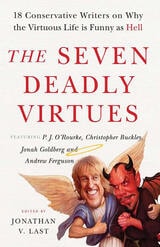
The Seven Deadly Virtues
18 Conservative Writers on Why the Virtuous Life is Funny as HellJonathan V. Last
Templeton Press, 2014
The book’s contributors include Sonny Bunch, Christopher Buckley, David “Iowahawk” Burge, Christopher Caldwell, Andrew Ferguson, Jonah Goldberg, Michael Graham, Mollie Hemingway, Rita Koganzon, Matt Labash, James Lileks, Rob Long, Larry Miller, P. J. O’Rourke, Joe Queenan, Christine Rosen, and Andrew Stiles. Jonathan V. Last, senior writer at the Weekly Standard, editor of the collection, is also a contributor. All eighteen essays in this book are appearing for the first time anywhere.
In the book’s opening essay, P. J. O’Rourke observes: “Virtue has by no means disappeared. It’s as much in public view as ever. But it’s been strung up by the heels. Virtue is upside down. Virtue is uncomfortable. Virtue looks ridiculous. All the change and the house keys are falling out of Virtue’s pants pockets.”
Here are the virtues everyone (including the book’s contributors) was taught in Sunday school but have totally forgotten about until this very moment. In this sanctimony-free zone:
• Joe Queenan observes: “In essence, thrift is a virtue that resembles being very good at Mahjong. You’ve heard about people who can do it, but you’ve never actually met any of them.”
• P. J. O’Rourke notes: “Fortitude is quaint. We praise the greatest generation for having it, but they had aluminum siding, church on Sunday, and jobs that required them to wear neckties or nylons (but never at the same time). We don’t want those either.”
• Christine Rosen writes: “A fellowship grounded in sociality means enjoying the company of those with whom you actually share physical space rather than those with whom you regularly and enthusiastically exchange cat videos.”
• Rob Long offers his version of modern day justice: if you sleep late on the weekend, you are forced to wait thirty minutes in line at Costco.
• Jonah Goldberg offers: “There was a time when this desire-to-do-good-in-all-things was considered the only kind of integrity: ‘Angels are better than mortals. They’re always certain about what is right because, by definition, they’re doing God’s will.’ Gabriel knew when it was okay to remove a mattress tag and Sandalphon always tipped the correct amount.”
• Sonny Bunch dissects forbearance, observing that the fictional Two Minutes Hate of George Orwell’s 1984 is now actually a reality directed at living, breathing people. Thanks, in part, to the Internet, “Its targets are designated by a spontaneously created mob—one that, due to its hive-mind nature—is virtually impossible to call off.”
By the time readers have completed The Seven Deadly Virtues, they won’t even realize that they’ve just been catechized into an entirely different—and better—moral universe.
The Virtues
John H. Garvey
Catholic University of America Press, 2022
Vices, Virtues, and Consequences
Essays in Moral and Political PhilosophyPeter Simpson
Catholic University of America Press, 2019