Results by title

3 books match the query 'Visionaries'
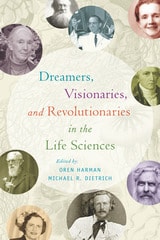
cover of Dreamers, Visionaries, and Revolutionaries in the Life Sciences

Dreamers, Visionaries, and Revolutionaries in the Life Sciences

Edited by Oren Harman and Michael R. Dietrich

University of Chicago Press, 2018

What are the conditions that foster true novelty and allow visionaries to set their eyes on unknown horizons? What have been the challenges that have spawned new innovations, and how have they shaped modern biology? In Dreamers, Visionaries, and Revolutionaries in the Life Sciences, editors Oren Harman and Michael R. Dietrich explore these questions through the lives of eighteen exemplary biologists who had grand and often radical ideas that went far beyond the run-of-the-mill science of their peers.
 
From the Frenchman Jean-Baptiste Lamarck, who coined the word “biology” in the early nineteenth century, to the American James Lovelock, for whom the Earth is a living, breathing organism, these dreamers innovated in ways that forced their contemporaries to reexamine comfortable truths. With this collection readers will follow Jane Goodall into the hidden world of apes in African jungles and Francis Crick as he attacks the problem of consciousness. Join Mary Lasker on her campaign to conquer cancer and follow geneticist George Church as he dreams of bringing back woolly mammoths and Neanderthals. In these lives and the many others featured in these pages, we discover visions that were sometimes fantastical, quixotic, and even threatening and destabilizing, but always a challenge to the status quo.
[more]
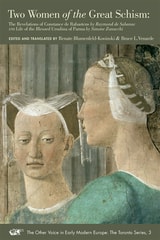
cover of Two Women of the Great Schism: The Revelations of Constance de Rabastens by Raymond de Sabanac and Life of the Blessed Ursulina of Parma by Simone Zanacchi

Two Women of the Great Schism

The Revelations of Constance de Rabastens by Raymond de Sabanac and Life of the Blessed Ursulina of Parma by Simone Zanacchi

Raymond de Sabanac and Simone Zanacchi

Iter Press, 2010
The Great Schism (1378–1417) divided Western Christendom into two groups: those who recognized a pope in Rome and those who recognized one in Avignon. It was a crisis of authority that brought with it spiritual anxiety and political uproar. This book presents the responses of two fascinating women whose experiences demonstrate the impact of the Schism on ordinary Christians. Constance de Rabastens (active 1384–1386), who lived in a village in rural Languedoc, had dramatic visions indicting the Avignon pope Clement VII, despite his being recognized in her region. Ursulina of Parma (1375–1408), a diminutive young woman from an urban milieu in Italy, believed that she was commanded by Christ to engage in shuttle diplomacy between the Roman and Avignon papacies in order to end the Schism. Two Women of the Great Schism translates an account of Constance’s visionary experiences as recorded by her confessor Raymond de Sabanac and a posthumous biography of Ursulina by Simone Zanacchi, a pious abbot who wrote some sixty years after his subject’s death. These texts bring to life the extraordinary spiritual and political engagement of two late medieval women who refused to be passive bystanders as rival papal factions tore Christendom apart.
[more]
cover of Willing to Know God: Dreamers and Visionaries in the Later Middle Ages

Willing to Know God

Dreamers and Visionaries in the Later Middle Ages

Jessica Barr

The Ohio State University Press, 2010

Although authors of mystical treatises and dream visions shared a core set of assumptions about how visions are able to impart transcendent truths to their recipients, the modern divide between “religious” and “secular” has led scholars to study these genres in isolation. Willing to Know God addresses the simultaneous flowering of mystical and literary vision texts in the Middle Ages by questioning how the vision was thought to work. What preconditions must be met in these texts for the vision to transform the visionary? And when, as in poems such as Pearl, this change does not occur, what exactly has gone wrong?

 
Through close readings of medieval women’s visionary texts and English dream poems, Jessica Barr argues that the vision required the active as well as the passive participation of the visionary. In these texts, dreamers and visionaries must be volitionally united with the divine and employ their rational and analytic faculties in order to be transformed by the vision.
 
Willing to Know God proposes that the study of medieval vision texts demands a new approach that takes into account both vision literature that has been supposed to have a basis in lived experience and visions that are typically read as fictional. It argues that these two “genres” in fact complement and inform one another. Rather than discrete literary modes, they are best read as engaged in an ongoing conversation about the human mind’s ability to grasp the divine.
[more]